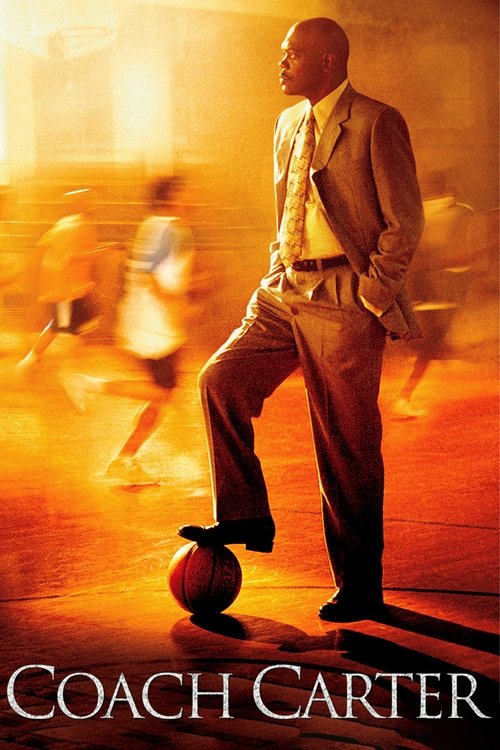
Coach Carter (2005)
Directed by Thomas Carter
No — Coach Carter is not especially woke, scoring 33 out of 100 on our wokeness meter.
Coach Carter arrives from 2005 with a true story, a whistle, and Samuel L. Jackson delivering discipline like a subpoena.
Consciousness Markers
The film centers a predominantly Black ensemble cast telling a Black community story, with Samuel L. Jackson, Rob Brown, Ashanti, and others in leading roles; a notable major-studio showcase for Black talent in 2005, though the diversity is organic to the true story rather than a casting directive.
The film is built around Carter's stern motivational speeches and moral lessons about academics, discipline, and responsibility, culminating in the famous 'our deepest fear' monologue — it is didactic by design, though the lecturing is character-driven rather than issue-driven.
The film is steeped in the struggles of an inner-city Black community, framing education as a path away from crime and limited prospects; Carter's arguments about his players' futures carry implicit racial and economic critique, though it is presented as universal uplift rather than explicit racial politics.
Female characters like Principal Garrison and Kyra have some agency — Kyra has an abortion and pursues college on her own terms — but the film is fundamentally a male-centered sports narrative and does not advance a feminist agenda.
No LGBTQ+ characters, relationships, or themes appear in the film.
No environmental or climate themes are present.
The film critiques the drug trade and educational neglect but offers no anti-capitalist or eat-the-rich messaging.
No body-positivity themes appear.
No neurodivergent characters or themes are depicted.
The film is a straightforward biographical dramatization of 1999 events, not a reinterpretation of history through a modern ideological lens.
Why it received this score
Coach Carter arrives from 2005 with a true story, a whistle, and Samuel L. Jackson delivering discipline like a subpoena. The film follows Ken Carter at Richmond High, where he benches an undefeated team over poor grades and makes teenagers sign contracts about attendance, behavior, and a 2.3 GPA. Its cultural awareness is real but rooted in the subject. A majority Black ensemble tells a Black community story, and the film treats education as a path away from crime and limited prospects. That is representation with a pulse, not a casting memo. The racial consciousness is present, though it arrives as universal uplift. The film shows the conditions. It does not mount a seminar on systemic racism.
Where the film does lecture, it lectures through Carter. The gym lockdown, the stern speeches, the famous "our deepest fear" monologue: this is heavy-handed by design. The moral lessons concern responsibility, sacrifice, and homework. The sermonizing is character-driven, not issue-driven. Feminist gestures exist. Principal Garrison pushes back, and Kyra makes choices about pregnancy and college on her own terms. But the narrative belongs to men and basketball. The film has no interest in LGBTQ lives, climate anxiety, anti-capitalist rage, body positivity, neurodivergence, or revisionist history. Its progressive sensibilities are older, humanist, and athletic. It wants scholarships, not revolution.
As a cultural artifact, Coach Carter sits in a middle zone. It showcases Black talent and inner-city struggle without turning either into a modern checklist. It is inspirational, formulaic, and effective in the way that sports dramas often are. The film believes in institutions, tough love, and the transformative power of a clipboard. That may be its most old-fashioned quality. It does not ask us to dismantle anything. It asks us to do homework. In that sense, its social consciousness is modest, sincere, and mostly confined to the gym.
Analysis generated by our Consciousness Algorithm
Part of


Synopsis
Based on a true story, in which Richmond High School head basketball coach Ken Carter made headlines in 1999 for benching his undefeated team due to poor academic results.
Questions about Coach Carter
Is Coach Carter woke?
No — Coach Carter is not especially woke, scoring 33 out of 100 on our wokeness meter. That earns it a verdict of Based.
Does Coach Carter have any woke elements?
3 of the 10 markers register at 30 or above, led by Lecture Energy (55), Representation Casting (55) and Racial Consciousness (45). On Lecture Energy: The film is built around Carter's stern motivational speeches and moral lessons about academics, discipline, and responsibility, culminating in the famous 'our deepest fear' monologue — it is didactic by design, though the lecturing is character-driven rather than issue-driven.
How does Coach Carter compare to other 2005 movies?
It ranks #14 of the 181 films from 2005 we've scored; their average is 13. The wokest is The Constant Gardener (72).
How is the Woke Score calculated?
An AI-assisted process researches the film and its reception, scores it 0–100 on ten markers, then combines those into one 0–100 Woke Score. It measures a specific set of 2020s cultural themes, not film quality.