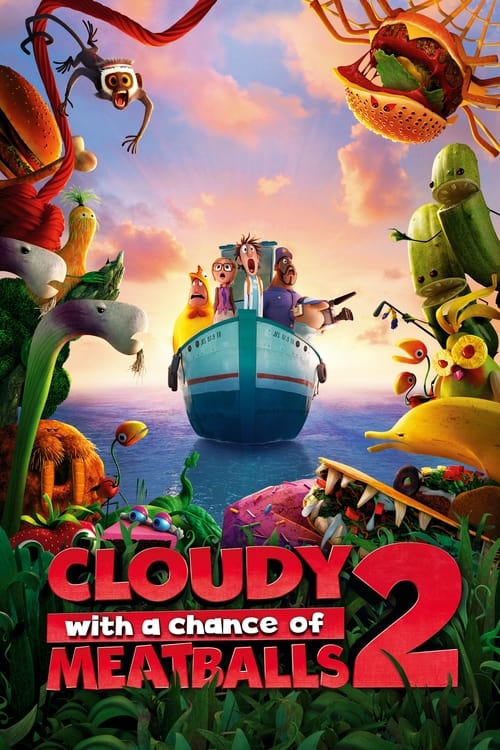
Cloudy with a Chance of Meatballs 2 (2013)
Directed by Kris Pearn
No — Cloudy with a Chance of Meatballs 2 is not woke, scoring 19 out of 100 on our wokeness meter.
Cloudy with a Chance of Meatballs 2 arrives as a sequel to a film that already exhausted the novelty of weather-based food precipitation.
Consciousness Markers
Chester V is a corporate CEO villain whose company 'Live Corp' is literally 'evil' spelled backwards, and he schemes to harvest sentient foodimals into profitable food bars — a light but unmistakable anti-corporate satire.
The voice cast is reasonably diverse (Terry Crews, Benjamin Bratt as a Guatemalan character, Khamani Griffin), but this is natural ensemble casting with no commentary or self-congratulation attached.
The foodimal island functions as a self-sustaining ecosystem whose destruction is treated as a genuine loss, giving the film a mild environmental-preservation undercurrent, though it is never framed as a climate message.
The film is a gag-driven kids' comedy that mostly avoids preaching, though the 'corporations are evil' and 'protect the ecosystem' beats carry a faint moralizing undertone.
Sam Sparks is a capable, assertive character who pushes back on Chester, but the film makes no feminist argument and her role is standard animated-sidekick material.
The film features non-white characters without any engagement with race, racism, or racial identity as a theme.
No LGBTQ+ characters, themes, or subtext appear anywhere in the film.
No body-positivity themes or messaging are present.
Flint is a quirky inventor, but his eccentricity is played for comedy rather than framed as neurodivergence.
The film engages with no historical events or figures to revise.
Why it received this score
Cloudy with a Chance of Meatballs 2 arrives as a sequel to a film that already exhausted the novelty of weather-based food precipitation. It is loud, colorful, and committed to the proposition that a strawberry with eyes constitutes a character. The voice cast is diverse in the ordinary way: Terry Crews replaces Mr. T as Earl, Benjamin Bratt returns as Manny, and Khamani Griffin appears as Cal. These are roles, not statements. The film does not pause to congratulate itself for their presence, which is either a relief or a missed opportunity depending on the viewer's appetite for applause breaks.
The script's one real ideological pulse comes from Chester V, a CEO whose company Live Corp is Evil spelled backwards. He wants to harvest sentient foodimals into food bars. That is a clean anti-corporate joke, delivered with a wink and no lecture. The island's food ecosystem is treated as worth preserving, and its potential death registers as a loss. The film never frames this as a climate parable. It simply notices that wiping out a living world for quarterly profits is bad manners.
Sam Sparks remains capable and willing to challenge Chester, though her arc is standard animated girlfriend material. Race exists only as casting, not as theme. There is no LGBTQ content, no body positivity, and no neurodivergent framing for Flint's eccentricity. History is not revised because history does not appear. The moralizing is faint: protect the ecosystem, distrust corporations. Mostly the film wants to show a tacodile chasing a man. It does so with professional competence. The result is a sequel that is neither offensive nor important, a mild confection with a faint aftertaste of social commentary. We classify it accordingly, with the weary precision the task demands.
Analysis generated by our Consciousness Algorithm
Part of


Synopsis
After the disastrous food storm in the first film, Flint and his friends are forced to leave the town. Flint accepts the invitation from his idol Chester V to join The Live Corp Company, which has been tasked to clean the island, and where the best inventors in the world create technologies for the betterment of mankind. When Flint discovers that his machine still operates and now creates mutant food beasts like living pickles, hungry tacodiles, shrimpanzees and apple pie-thons, he and his friends must return to save the world.
Questions about Cloudy with a Chance of Meatballs 2
Is Cloudy with a Chance of Meatballs 2 woke?
No — Cloudy with a Chance of Meatballs 2 is not woke, scoring 19 out of 100 on our wokeness meter. That earns it a verdict of Ultra Based.
Does Cloudy with a Chance of Meatballs 2 have any woke elements?
1 of the 10 markers register at 30 or above, led by Eat the Rich (35). On Eat the Rich: Chester V is a corporate CEO villain whose company 'Live Corp' is literally 'evil' spelled backwards, and he schemes to harvest sentient foodimals into profitable food bars — a light but unmistakable anti-corporate satire.
How does Cloudy with a Chance of Meatballs 2 compare to other 2013 movies?
It ranks #63 of the 274 films from 2013 we've scored; their average is 14. The wokest is Belle (76).
How is the Woke Score calculated?
An AI-assisted process researches the film and its reception, scores it 0–100 on ten markers, then combines those into one 0–100 Woke Score. It measures a specific set of 2020s cultural themes, not film quality.