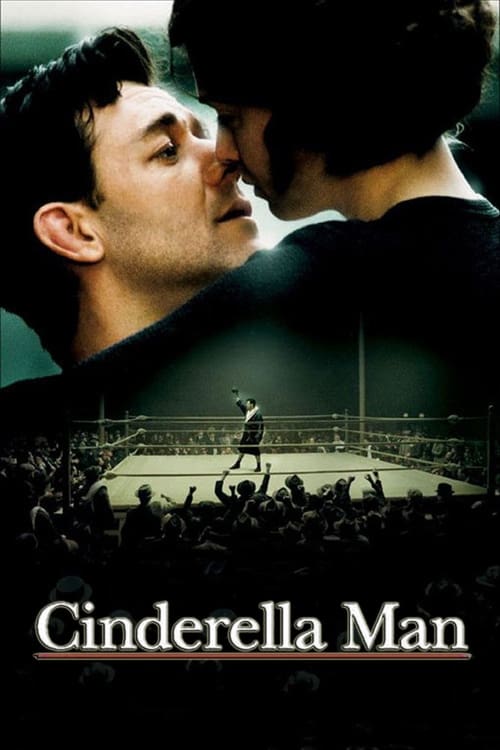
Cinderella Man (2005)
Directed by Ron Howard
No — Cinderella Man is not woke, scoring 11 out of 100 on our wokeness meter.
Ron Howard's Cinderella Man arrives with the sturdy, well-upholstered craftsmanship of a director who has never met a Depression-era tenement he could not light handsomely.
Consciousness Markers
The Great Depression backdrop, dock-worker poverty, and the contrast with the wealthy promoter and champion Baer give it a class-conscious texture, but the film's message is individual perseverance and the American dream, not eat-the-rich ideology.
The film is sentimental and inspirational about the underdog spirit, but it preaches through emotion and story rather than explicit moral lecturing.
Mae Braddock has some agency — she resents Gould profiting from her husband's danger and throws a drink at Baer — but she remains a traditional supportive wife in a patriarchal Depression-era setting.
Joe Louis and John Henry Lewis appear as opponents and are treated with respect, but the film offers no racial commentary or consciousness; they exist as historical fixtures of the boxing world.
The cast is overwhelmingly white, reflecting the historical Irish-American milieu. Black boxers Joe Louis and John Henry Lewis appear as real historical figures, not as deliberate diversity casting.
No LGBTQ+ characters, themes, or subtext of any kind.
No environmental or climate themes whatsoever.
A boxing film centered on physical toughness and violence; no body-positivity themes.
No neurodivergent characters or themes.
A faithful, conventional dramatization of Braddock's true story with no revisionist reframing of history.
Why it received this score
Ron Howard's Cinderella Man arrives with the sturdy, well-upholstered craftsmanship of a director who has never met a Depression-era tenement he could not light handsomely. Russell Crowe plays James J. Braddock, an Irish-American heavyweight who breaks his hand, loses everything, hauls cargo on the New Jersey docks, and then punches his way back to the title. Toronto stands in for 1930s New York with period streetcars and fake storefronts. The film wants us to feel the cold in that apartment, and it succeeds. It is an underdog story told with total sincerity, and sincerity of this vintage has its own gravitational pull.
Where social consciousness is concerned, the film keeps its ambitions modest. The Depression provides a class texture: dock workers scrambling for a day's wage, a promoter counting his take, the champion Max Baer dripping with contempt. Yet the moral engine is individual perseverance. Braddock repays his relief money out of pride, and the sportswriter Damon Runyon anoints him the Cinderella Man so that a struggling public can see itself in him. Joe Louis and John Henry Lewis appear as opponents, treated with plain respect and no commentary whatsoever. Mae Braddock resents Joe Gould profiting from her husband's danger and eventually throws a drink at Baer, which is about as far as the film's feminism travels before she returns to the radio and the children.
The remaining ledger is close to empty. No LGBTQ presence, no environmental conscience, no body-positive rejoicing in flesh, no neurodivergent interiority, no revisionist reworking of the historical record. The film sermonizes through swelling music and slow embraces, never through speeches. As a document of contemporary progressive sensibility, it registers as a faint pulse in a very large, very earnest body. Admirers of classical studio craft will find plenty to admire. Those seeking a manifesto will need to look elsewhere.
Analysis generated by our Consciousness Algorithm
Part of


Synopsis
The true story of boxer Jim Braddock who, following his retirement in the 1930s, makes a surprise comeback in order to lift his family out of poverty.
Questions about Cinderella Man
Is Cinderella Man woke?
No — Cinderella Man is not woke, scoring 11 out of 100 on our wokeness meter. That earns it a verdict of Ultra Based.
Does Cinderella Man have any woke elements?
Very few. None of the 10 markers reaches 30, the level where a marker counts as present; the highest is Eat the Rich at 22.
How does Cinderella Man compare to other 2005 movies?
It ranks #71 of the 181 films from 2005 we've scored; their average is 13. The wokest is The Constant Gardener (72).
How is the Woke Score calculated?
An AI-assisted process researches the film and its reception, scores it 0–100 on ten markers, then combines those into one 0–100 Woke Score. It measures a specific set of 2020s cultural themes, not film quality.