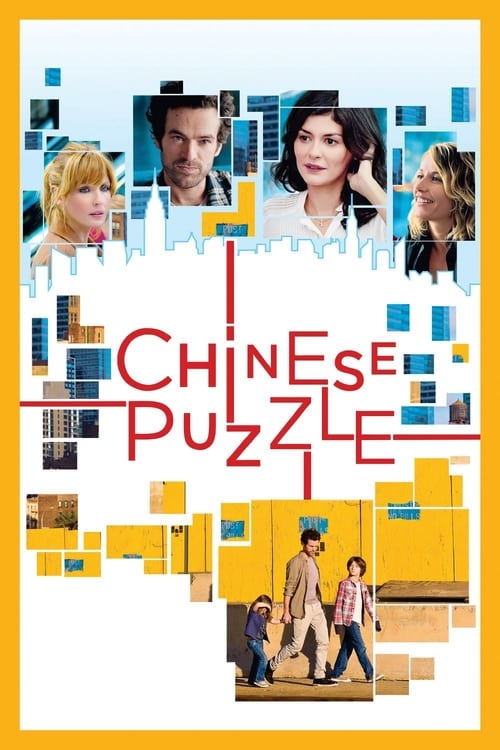
Chinese Puzzle (2013)
Directed by Cédric Klapisch
No — Chinese Puzzle is not especially woke, scoring 26 out of 100 on our wokeness meter.
Cédric Klapisch returns for a third pass at Xavier Rousseau, a man who has spent a decade making the same romantic miscalculations with marginally better tailoring.
Consciousness Markers
Xavier's Belgian friend Isabelle is a lesbian living with her Chinese-American girlfriend Ju, and the couple's relationship, pregnancy, and infidelity arc occupy substantial screen time and drive key plot mechanics.
The cast includes French, British, Chinese-Canadian, and Chinese-American performers (Sandrine Holt, Li Jun Li), and the New York setting naturally folds in a multiethnic ensemble, though the diversity is organic to the story rather than a casting statement.
Chinatown, immigration bureaucracy, and a sham green-card marriage put cross-cultural dynamics on screen, yet the film treats them as comic plot devices rather than vehicles for racial commentary.
Female characters (Wendy, Martine, Isabelle) exercise independence and sexual agency, but the film is centered on Xavier's romantic and paternal anxieties and offers no feminist thesis.
The occasional hallucinated visits from Schopenhauer and Hegel add a whiff of philosophizing, but the tone is breezy and the film never lectures its audience.
Wendy's wealthy American boyfriend John and his Central Park luxury apartment are gently contrasted with Xavier's bohemian poverty, but the film draws no economic indictment.
No environmental or climate themes appear anywhere in the film.
No body-image or body-positivity themes are present.
No neurodivergence themes or characters are depicted.
The film is a contemporary fictional comedy-drama with no historical revisionism.
Why it received this score
Cédric Klapisch returns for a third pass at Xavier Rousseau, a man who has spent a decade making the same romantic miscalculations with marginally better tailoring. When Wendy takes the children to New York, Xavier follows, because proximity to his offspring apparently outweighs his aversion to any form of planning. He lands in Brooklyn with his Belgian friend Isabelle, who is pregnant by way of his sperm donation, and her Chinese-American girlfriend Ju. The arrangement is presented without ceremony. Klapisch's New York is casually multiethnic, and the lesbian couple at its center receives genuine narrative weight, including a pregnancy, an infidelity involving a second Isabelle, and a furtive exit through a window. None of this is announced as a statement. It simply occupies the plot, which is its own modest achievement.
The cultural machinery of the film is Chinatown, a green-card marriage, and an immigration officer who squints. These are comic devices, deployed for farce and never for sermon. Xavier marries Nancy, the niece of a cab driver he rescued from road rage, and the pair perform domesticity for a skeptical bureaucrat. Wendy's wealthy boyfriend John lives above Central Park while Xavier scrapes by, yet the film declines to draw an economic lesson from the contrast. There is no climate anxiety here, no body politics, no neurological taxonomy. The film has other things on its mind, mostly Xavier's inability to finish a novel.
Schopenhauer and Hegel appear in brief hallucinations, offering philosophical garnish to a man who cannot complete a sentence about his own life. The tone stays breezy. When the editor complains that the finished book ends too happily, Xavier replies that when you find happiness there is nothing more to say. It is a soft landing for a soft trilogy, executed with enough charm to justify the trip across the Atlantic, twice, in both directions, and then once more for the parade.
{"thematic_tags": ["sequel"]}
Analysis generated by our Consciousness Algorithm


Synopsis
Xavier is a 40-year-old father of two who still finds life very complicated. When the mother of his children moves to New York, he can't bear them growing up far away from him and so he decides to move there as well.
Questions about Chinese Puzzle
Is Chinese Puzzle woke?
No — Chinese Puzzle is not especially woke, scoring 26 out of 100 on our wokeness meter. That earns it a verdict of Based.
Does Chinese Puzzle have any woke elements?
2 of the 10 markers register at 30 or above, led by LGBTQ+ Themes (55) and Representation Casting (35). On LGBTQ+ Themes: Xavier's Belgian friend Isabelle is a lesbian living with her Chinese-American girlfriend Ju, and the couple's relationship, pregnancy, and infidelity arc occupy substantial screen time and drive key plot mechanics.
How does Chinese Puzzle compare to other 2013 movies?
It ranks #40 of the 274 films from 2013 we've scored; their average is 14. The wokest is Belle (76).
Is Chinese Puzzle the most woke Spanish Apartment Trilogy movie?
Yes. It scores highest of the 3 Spanish Apartment Trilogy films we've scored.