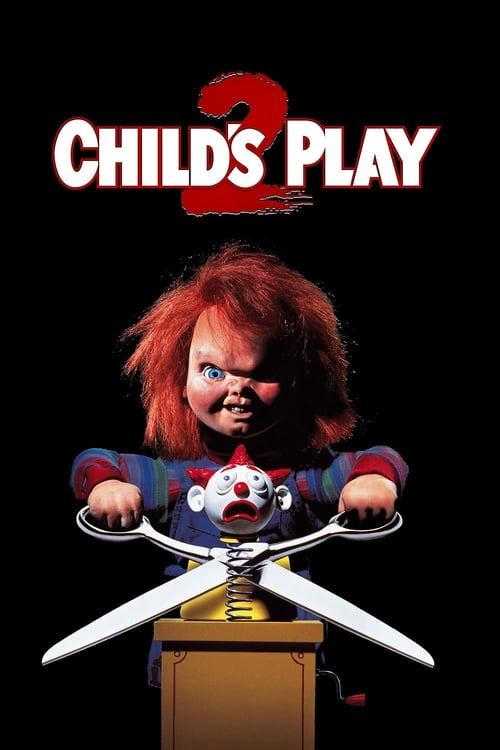
Child's Play 2 (1990)
Directed by John Lafia
No — Child's Play 2 is not woke, scoring 4 out of 100 on our wokeness meter.
Child's Play 2 arrives two years after its predecessor with a mandate that can be stated plainly: reassemble the doll, put him back to work, and see if the stockholders calm down.
Consciousness Markers
The Play Pals Corporation reassembles Chucky purely to reassure stockholders and salvage publicity, a light corporate-greed thread that sets the plot in motion but is never developed into a critique.
Kyle is a capable, street-smart teenage girl who becomes the co-survivor, but this is standard final-girl slasher mechanics rather than a feminist statement.
The cast is uniformly white, with no casting choices made to signal diversity or representation.
No LGBTQ+ characters, themes, or subtext appear anywhere in the film.
Race is entirely absent as a subject or concern in the film.
No environmental or climate themes are present.
No body-positivity themes or messaging.
No neurodivergence themes; Andy's trauma is treated as a plot device, not a condition.
No historical revisionism; the film is pure supernatural fiction.
The film makes no attempt to preach or deliver a message; it is a straightforward slasher.
Why it received this score
Child's Play 2 arrives two years after its predecessor with a mandate that can be stated plainly: reassemble the doll, put him back to work, and see if the stockholders calm down. The Play Pals Corporation does exactly this, and the film treats the decision as grim corporate housekeeping. A worker dies on the assembly line within minutes. Nobody in the boardroom loses sleep. This is the closest the picture comes to social commentary, and it lasts roughly as long as it takes to electrocute a man. The thread of corporate appetite dangles there, never pulled.
What follows is a slasher assembled with workmanlike competence and no apparent ambition beyond the next kill. Christine Elise's Kyle is a cynical foster teen who swears, steals, and eventually rams an air hose down the villain's throat. She is a capable co-survivor, and the film grants her the final blow. The mechanics that produce her, however, are the standard final-girl economics of the genre. She exists to be useful in the third act, not to make an argument. Jenny Agutter and Grace Zabriskie are dispatched with the efficiency of a production that knows precisely what it is.
The film has no interest in instructing anyone. It says nothing about race, nothing about the climate, nothing about the body, nothing about the mind. Andy's trauma is a device that gets him placed in a foster home and then gets him chased. The cast is uniformly white and the film never notices, because the subject does not arise. Gene Siskel gave it zero stars and called it a vicious, ugly little thriller. He was not wrong, and he was also not the audience. The picture opened at number one in the United States and returned its budget twice over. There is no sermon here, no lesson, no invitation to self-improvement. Just a doll, a factory, and a high-pressure hose.
Analysis generated by our Consciousness Algorithm
Part of


Synopsis
Chucky is reconstructed by a toy factory to dispel the negative publicity surrounding the doll, and tracks young Andy Barclay to a foster home where the chase begins again.
Questions about Child's Play 2
Is Child's Play 2 woke?
No — Child's Play 2 is not woke, scoring 4 out of 100 on our wokeness meter. That earns it a verdict of Ultra Based.
Does Child's Play 2 have any woke elements?
Very few. None of the 10 markers reaches 30, the level where a marker counts as present; the highest is Eat the Rich at 15.
How does Child's Play 2 compare to other 1990 movies?
It ranks #35 of the 68 films from 1990 we've scored; their average is 9. The wokest is Nightbreed (60).
Is Child's Play 2 the most woke Child's Play movie?
No. It ranks #7 of the 7 Child's Play films we've scored; the wokest is Seed of Chucky (60).