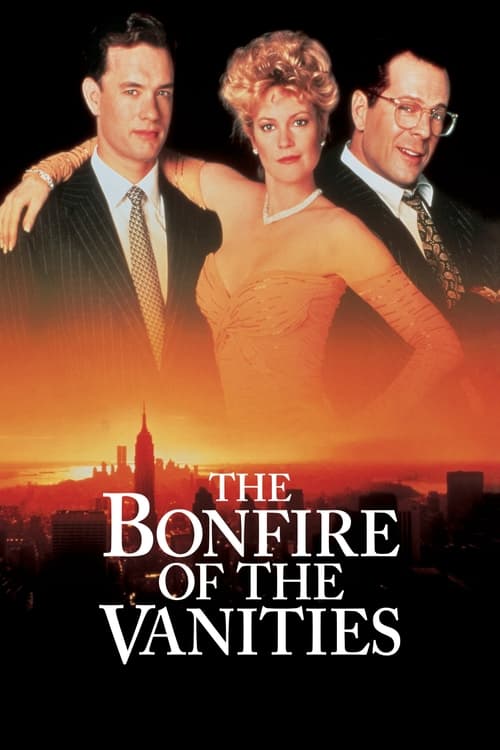
The Bonfire of the Vanities (1990)
Directed by Brian De Palma
No — The Bonfire of the Vanities is not especially woke, scoring 38 out of 100 on our wokeness meter.
The Bonfire of the Vanities opened in December 1990 carrying a forty-seven million dollar budget and Tom Wolfe's bestselling novel, and closed its theatrical run with roughly fifteen million dollars and the assembled scorn of American film criticism.
Consciousness Markers
Race is the film's central engine: a Black teen is struck by a white Wall Street trader, a DA seeks a white defendant to court minority voters, and a Reverend Bacon figure engages in race-baiting, though the satire treats all sides cynically rather than advancing a progressive racial thesis.
The film satirizes Wall Street greed through Sherman McCoy, a self-styled 'Master of the Universe' bond trader, and the avarice of the wealthy elite, though the critique is cynical rather than a coherent eat-the-rich polemic.
The film concludes with Judge White delivering an extended sermon denouncing the self-righteousness and cynical manipulation of the characters, a moralizing tirade that critics like Siskel singled out as a preachy ending.
The cast is led by white stars (Hanks, Willis, Griffith), but Morgan Freeman was cast as Judge White after the studio changed the character's ethnicity from Jewish to African American, and the film features several Black supporting characters central to the plot.
The female characters are a gold-digging mistress and a cuckolded wife; the film offers no feminist critique or agency, and Maria Ruskin is largely a femme fatale archetype.
No LGBTQ+ characters, themes, or subtext appear anywhere in the film.
No environmental or climate themes are present.
No body-positivity themes or messaging appear in the film.
No neurodivergent characters or themes are present.
The film is a contemporary satire of 1980s New York, not a historical narrative subject to revisionist reframing.
Why it received this score
The Bonfire of the Vanities opened in December 1990 carrying a forty-seven million dollar budget and Tom Wolfe's bestselling novel, and closed its theatrical run with roughly fifteen million dollars and the assembled scorn of American film criticism. Brian De Palma, who took over the project late and inherited most of its problems, was handed a studio picture that wanted a sympathetic lead. Tom Hanks supplies that sympathy, and it sinks him. Sherman McCoy, the bond trader who calls himself a Master of the Universe, needs the cold arrogance of a patrician, and Hanks plays him as a decent man having a bad week. Bruce Willis drifts through as the dissolute reporter Peter Fallow, and Melanie Griffith performs the mistress Maria Ruskin with an accent that appears to be traveling under its own passport.
Race is the film's engine, as it was in the novel, and the production's handling of it is instructive. The judge who presides over McCoy's trial was Jewish in the book and was recast as African American, with Morgan Freeman stepping in after Alan Arkin was replaced, a decision the studio made to answer criticism about the film's racial politics. The result is a movie that treats bigotry as one more racket among many. A district attorney hunts a white defendant to court minority voters. A civil rights figure trades in race-baiting. Everyone is on the make, nobody is sincere, and the satire declines to hand out halos to any faction.
The film's quarrel with money is genuine but sour. Wall Street avarice gets its drubbing, yet the target is hypocrisy itself, and the conclusion abandons comedy for a courtroom sermon in which Judge White lectures the assembled rabble on their own self-righteousness. Gene Siskel found the ending preachy, and he was correct. There is nothing here for the modern progressive checklist: no queerness, no environmental grievance, no concern for body or mind. All that survives is a period piece about a city eating itself, and a studio that spent a fortune discovering the audience had already moved on.
Analysis generated by our Consciousness Algorithm
Part of


Synopsis
After his mistress runs over a black teen, a Wall Street hotshot sees his life unravel in the spotlight; A down-and-out reporter breaks the story and opportunists clamber to use it to their advantage.
Questions about The Bonfire of the Vanities
Is The Bonfire of the Vanities woke?
No — The Bonfire of the Vanities is not especially woke, scoring 38 out of 100 on our wokeness meter. That earns it a verdict of Based.
Does The Bonfire of the Vanities have any woke elements?
4 of the 10 markers register at 30 or above, led by Racial Consciousness (50), Eat the Rich (45) and Lecture Energy (45). On Racial Consciousness: Race is the film's central engine: a Black teen is struck by a white Wall Street trader, a DA seeks a white defendant to court minority voters, and a Reverend Bacon figure engages in race-baiting, though the satire treats all sides cynically rather than advancing a progressive racial thesis.
How does The Bonfire of the Vanities compare to other 1990 movies?
It ranks #4 of the 68 films from 1990 we've scored; their average is 9. The wokest is Nightbreed (60).
How is the Woke Score calculated?
An AI-assisted process researches the film and its reception, scores it 0–100 on ten markers, then combines those into one 0–100 Woke Score. It measures a specific set of 2020s cultural themes, not film quality.