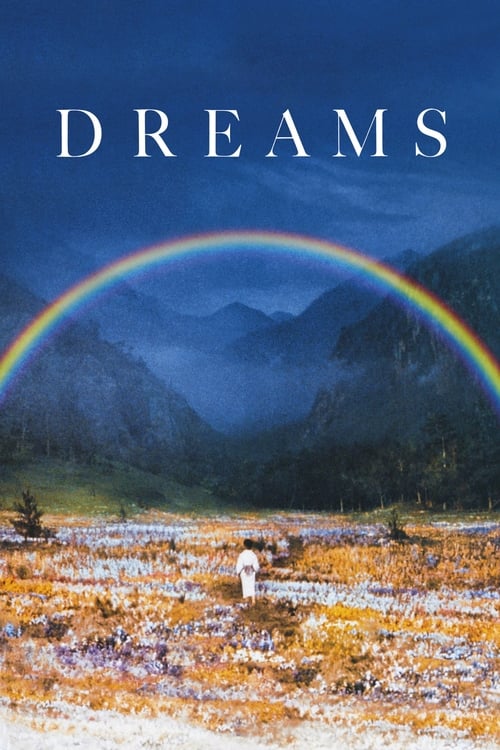
Dreams (1990)
Directed by Akira Kurosawa
Partly — Dreams is somewhat woke, scoring 43 out of 100 on our wokeness meter.
Dreams arrives from 1990, a year in which a director could still assemble eight personal vignettes and call the result a motion picture.
Consciousness Markers
Environmental and anti-nuclear warnings run through 'Mount Fuji in Red,' 'The Weeping Demon,' and 'The Village of the Water Mills,' lamenting pollution and humanity's abuse of nature.
Several vignettes turn explicitly didactic, with speeches explaining radioactive isotopes, condemning nuclear assurances, and lamenting modern technology's pollution.
The Weeping Demon says former millionaires and officials suffer hell for their sins, and the water-mill village rejects modern industrial convenience, but there is no sustained eat-the-rich program.
Cast is almost entirely Japanese with Martin Scorsese as Van Gogh; no modern diversity casting or commentary.
No LGBTQ+ characters, themes, or subtext.
Women appear as mothers, spirits, and mourners, but the film advances no feminist critique or agenda.
Japanese cultural specificity and war guilt are present, but no racial-justice consciousness or commentary.
No body-positivity themes or diverse body representation.
No neurodivergence themes or characters.
The Tunnel reflects on Japanese wartime loss and command guilt, but it is not a revisionist historical narrative.
Why it received this score
Dreams arrives from 1990, a year in which a director could still assemble eight personal vignettes and call the result a motion picture. Kurosawa, working from his own nocturnal material, gives us fox weddings, a peach orchard staffed by the spirits of felled trees, a blizzard, a tunnel crowded with dead soldiers, Van Gogh played by Martin Scorsese, and two separate apocalypses. The anthology form suits him. Each segment is a small sealed room, and the viewer is escorted through them like a guest at a very long and very serious dinner party.
The environmental sermonizing is where the film's social consciousness pools. Mount Fuji in Red stages a nuclear meltdown and then pauses for a lecture on radioactive isotopes, a man in a suit helpfully explaining that red means plutonium and yellow means strontium, before conceding the uselessness of color-coding one's own extinction. The Weeping Demon follows a nuclear holocaust in which former millionaires and government officials have sprouted horns and now howl through the night, a punishment calibrated to their sins. The Village of the Water Mills closes the picture with a community that has forsaken electricity and modern convenience, its elders explaining, at length, why the old ways are better. The lecturing is not subtle. It is not meant to be.
Elsewhere the film is gentler and stranger. The Tunnel carries a commander's grief for the platoon he sent to die, and it moves without reaching for any modern vocabulary of guilt. The Peach Orchard mourns what a family cut down. Crows lets Scorsese wander a wheat field and lose an ear. The contemporary apparatus of representation, identity, and institutional critique is simply absent. The cast is Japanese, the women are mothers and spirits, and the politics belong to a man who believes we are poisoning the earth. A sober vintage. Strong on nature, light on intersectionality.
Analysis generated by our Consciousness Algorithm
Part of


Synopsis
Eight visually rich vignettes drawn from Kurosawa’s own dreams—fox weddings and vanished orchards, a soldier’s ghosts, a walk through Van Gogh’s canvases, nuclear nightmares, and a water-mill utopia—meditate on childhood, art, mortality, and humanity’s uneasy bond with nature.
Questions about Dreams
Is Dreams woke?
Partly — Dreams is somewhat woke, scoring 43 out of 100 on our wokeness meter. That earns it a verdict of Woke-Adjacent.
What makes Dreams woke?
3 of the 10 markers register at 30 or above, led by Climate Crusade (55), Lecture Energy (50) and Eat the Rich (35). On Climate Crusade: Environmental and anti-nuclear warnings run through 'Mount Fuji in Red,' 'The Weeping Demon,' and 'The Village of the Water Mills,' lamenting pollution and humanity's abuse of nature.
How does Dreams compare to other 1990 movies?
It ranks #3 of the 68 films from 1990 we've scored; their average is 9. The wokest is Nightbreed (60).
How is the Woke Score calculated?
An AI-assisted process researches the film and its reception, scores it 0–100 on ten markers, then combines those into one 0–100 Woke Score. It measures a specific set of 2020s cultural themes, not film quality.