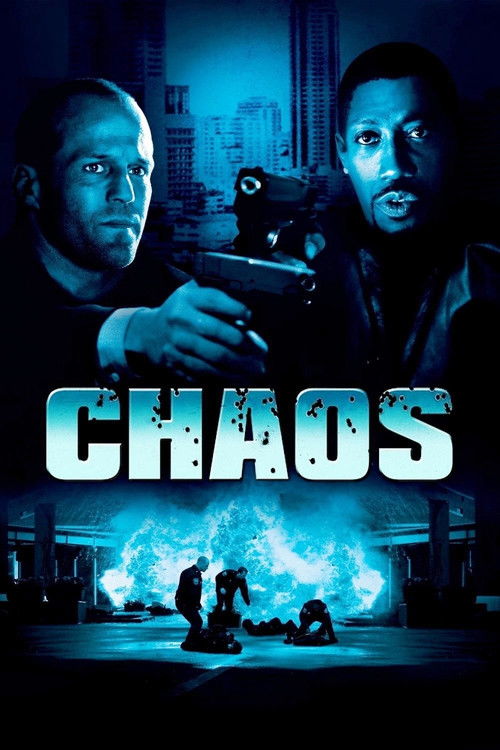
Chaos (2005)
Directed by Tony Giglio
No — Chaos is not woke, scoring 7 out of 100 on our wokeness meter.
Chaos arrives from 2005 bearing the weary gait of a thriller that knows exactly what it is and has made peace with the arrangement.
Consciousness Markers
The cast is overwhelmingly white and male, with Wesley Snipes as the only notable non-white performer in a supporting antagonist role that carries no commentary on identity. No deliberate diversity casting is evident.
The heist targets a bank and the villains are disgruntled ex-cops resentful of being abandoned by the system, but this is revenge-motivated crime rather than any coherent anti-capitalist critique.
Chaos theory is invoked as a plot device and referenced via Gleick's book, but the film never pauses to lecture the audience on ideas or morals.
Female characters (Justine Waddell, Jessica Steen) occupy minor, functional roles with no feminist themes or agency-driven arcs.
There are no LGBTQ+ characters, relationships, or subtext anywhere in the film.
The film engages no racial themes whatsoever; its conflict is entirely intra-institutional and personal.
No environmental or climate content appears in the film.
No body-positivity themes or messaging are present.
No neurodivergent characters or themes are depicted.
The film is a fictional thriller with no historical revisionism.
Why it received this score
Chaos arrives from 2005 bearing the weary gait of a thriller that knows exactly what it is and has made peace with the arrangement. Tony Giglio directs Jason Statham, Ryan Phillippe, and Wesley Snipes through a Seattle bank heist that yields no money and a great deal of mathematics. The cast is a monument to a vanished era of action cinema: white, male, and untroubled. Wesley Snipes appears as the antagonist, a supporting turn the film greets with no curiosity about what his presence might signify. He is the heavy. The two women in the ensemble, Justine Waddell and Jessica Steen, are assigned the traditional duties of the genre, which is to say they appear, they assist, and they recede.
Politically, the film is inert. Its villains are ex-convicts and disgraced officers nursing a grievance about a system that used them up and cast them aside, a sentiment that gestures toward class resentment without ever finishing the thought. The bank is a target, not a symbol. Nobody lectures. The chaos theory material, lifted from James Gleick's popular science volume, functions as a puzzle mechanic and a twist delivery device, not a thesis. The film name-drops a book and trusts the audience to infer intellectual ambition. There is no racial consciousness here, no environmental concern, no inquiry into identity, no interest in bodies or minds or the historical record. What remains is a heist picture that respects the conventions of the heist picture.
The result is competent, muddled entertainment, and there is something almost restful about its incuriosity. It premiered abroad in 2005 and reached North American shelves in 2008, a delay suggesting its own distributors struggled to locate a cultural argument for its existence. They were right not to look. Chaos concerns patterns, coincidence, and the impossibility of predicting human behavior, and it applies those ideas chiefly to a final reveal. The measure of social consciousness is correspondingly modest, which is not an insult. Some vintages are simply table wine.
{"thematic_tags": []}
Analysis generated by our Consciousness Algorithm


Synopsis
In Seattle, detective Quentin Conners is unfairly suspended and his partner Jason York leaves the police force after a tragic shooting on Pearl Street Bridge, when the hostage and the criminal die. During a bank heist with a hostage situation, Conners is assigned in charge of the operation with the rookie Shane Dekker as his partner. The thieves, lead by Lorenz, apparently do not steal a penny from the bank. While chasing the gangsters, the police team disclose that they planted a virus in the system, stealing one billion dollars from the different accounts, using the principle of the Chaos Theory. Further, they find that Lorenz is killing his accomplices.
Questions about Chaos
Is Chaos woke?
No — Chaos is not woke, scoring 7 out of 100 on our wokeness meter. That earns it a verdict of Ultra Based.
Does Chaos have any woke elements?
Very few. None of the 10 markers reaches 30, the level where a marker counts as present; the highest is Representation Casting at 18.
How does Chaos compare to other 2005 movies?
It ranks #103 of the 181 films from 2005 we've scored; their average is 13. The wokest is The Constant Gardener (72).
How is the Woke Score calculated?
An AI-assisted process researches the film and its reception, scores it 0–100 on ten markers, then combines those into one 0–100 Woke Score. It measures a specific set of 2020s cultural themes, not film quality.