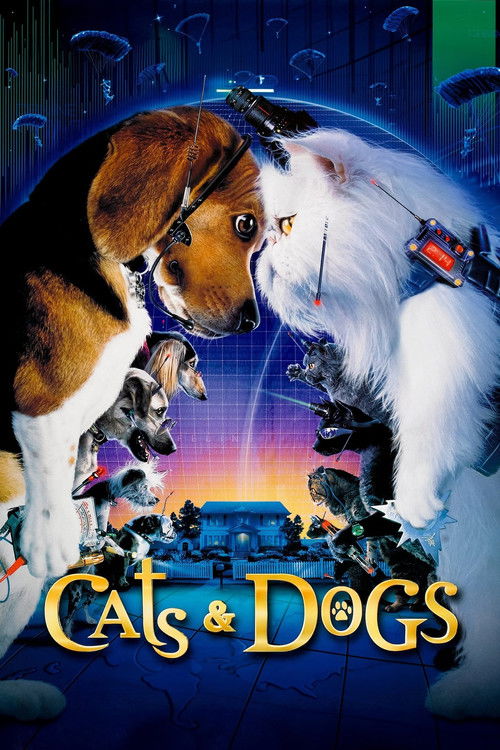
Cats & Dogs (2001)
Directed by Lawrence Guterman
No — Cats & Dogs is not woke, scoring 8 out of 100 on our wokeness meter.
Cats & Dogs arrives from the summer of 2001 with a simple proposition: the long feud between the species is a covert war, complete with underground headquarters, ninja assassins, and a Persian cat named Mr. Tinkles who dreams of global dominion.
Consciousness Markers
The voice and live-action cast includes Michael Clarke Duncan and Miriam Margolyes, but their presence is incidental to a talking-animal spy spoof with no commentary on representation.
Susan Sarandon voices Ivy, a capable former field agent, but she functions as a standard love-interest/mentor figure with no feminist thesis attached.
No LGBTQ+ characters, themes, or subtext of any kind appear in this 2001 family comedy.
The film is about cats versus dogs; race is never a subject, and the human cast's diversity carries no thematic weight.
No environmental or climate themes whatsoever; the plot concerns allergy vaccines and pet espionage.
No critique of capitalism or wealth; the villain's motive is world domination, not economics.
No body-positivity messaging; the film's humor relies on slapstick and pet gags.
No neurodivergent characters or themes are present.
The film invents a fictional secret war between cats and dogs and makes no claims about real history.
A broad kids' spy spoof with no moralizing or social messaging; it aims to entertain, not instruct.
Why it received this score
Cats & Dogs arrives from the summer of 2001 with a simple proposition: the long feud between the species is a covert war, complete with underground headquarters, ninja assassins, and a Persian cat named Mr. Tinkles who dreams of global dominion. The plot turns on a professor's allergy vaccine, which would let humanity keep dogs without sneezing, and thereby shift the balance of pet power. It is a children's spy spoof, assembled with puppets, CGI, and the confident assumption that a beagle in a spy harness is inherently funny. That assumption is mostly correct.
The film's cultural footprint is faint. Michael Clarke Duncan voices Sam, an Old English Sheepdog agent, and Miriam Margolyes appears in live action as Sophie the maid, but neither presence carries any argument about who gets to be on screen. Susan Sarandon gives Ivy, a former field agent, a dry competence, though the role remains the standard mentor and old flame, there to encourage the puppy and soften the gruff veteran. Beyond that, the cupboard is bare. There is no environmental sermon, no critique of the wealthy, no meditation on identity or the body, no neurodivergent reading to be extracted from a talking cat with a vendetta.
What the film does have is craft in service of nonsense, and an eagerness to please that never once stops to instruct. It wants laughs, ticket sales, and a sequel, and it got all three. For those of us who classify such things, this is a relief and a slight disappointment. There is nothing here to argue about, which is its own kind of achievement.
Analysis generated by our Consciousness Algorithm
Part of


Synopsis
When a professor develops a vaccine that eliminates human allergies to dogs, he unwittingly upsets the fragile balance of power between cats and dogs and touches off an epic battle for pet supremacy. The fur flies as the feline faction, led by Mr. Tinkles, squares off against wide-eyed puppy Lou and his canine cohorts.
Questions about Cats & Dogs
Is Cats & Dogs woke?
No — Cats & Dogs is not woke, scoring 8 out of 100 on our wokeness meter. That earns it a verdict of Ultra Based.
Does Cats & Dogs have any woke elements?
Very few. None of the 10 markers reaches 30, the level where a marker counts as present; the highest is Representation Casting at 15.
How does Cats & Dogs compare to other 2001 movies?
It ranks #64 of the 148 films from 2001 we've scored; their average is 12. The wokest is Monster's Ball (60).
How is the Woke Score calculated?
An AI-assisted process researches the film and its reception, scores it 0–100 on ten markers, then combines those into one 0–100 Woke Score. It measures a specific set of 2020s cultural themes, not film quality.