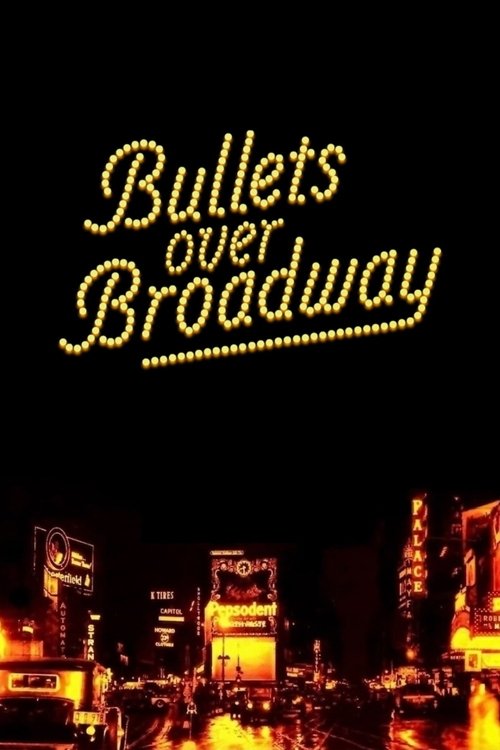
Bullets Over Broadway (1994)
Directed by Woody Allen
No — Bullets Over Broadway is not woke, scoring 5 out of 100 on our wokeness meter.
Bullets Over Broadway arrives from 1994, which is to say from a period when a Woody Allen picture could be counted on to deliver a brisk backstage farce, a few quotable lines, and no instruction manual.
Consciousness Markers
Helen Sinclair and Olive Neal are vivid, scene-stealing women, but they are satirical targets of vanity and incompetence rather than vehicles for a feminist argument.
The ensemble is overwhelmingly white and drawn from Woody Allen's usual repertory of stage-trained New York actors; Harvey Fierstein's brief appearance is incidental rather than a statement of inclusive casting.
The playwright's Marxist friend Sheldon Flender is a minor running joke, but the film's real economy is showbiz compromise, not class critique.
The film's moralizing is confined to a light closing note about talent and love; it never stops to preach at the audience.
No LGBTQ+ characters, relationships, or themes appear anywhere in the film.
The 1920s Broadway milieu is depicted as entirely white; race is never raised as a subject.
No environmental or climate content of any kind.
Warner Purcell's compulsive eating and dieting are played strictly for farce, the opposite of a body-positive message.
No neurodivergent characters or themes are present.
The 1928 setting is affectionate pastiche, not a revisionist re-reading of history.
Why it received this score
Bullets Over Broadway arrives from 1994, which is to say from a period when a Woody Allen picture could be counted on to deliver a brisk backstage farce, a few quotable lines, and no instruction manual. The plot concerns David Shayne, an earnest Pittsburgh playwright who accepts mob money to stage God of Our Fathers in 1928 and watches his artistic integrity dissolve under the weight of a talentless gangster's girlfriend, a fading alcoholic leading lady, and a hitman with an uncredited gift for dramaturgy. The machinery is well oiled. Dianne Wiest won an Academy Award for her work as Helen Sinclair, and Chazz Palminteri's Cheech supplies the film's quiet thesis about talent arriving from inconvenient places.
The cultural inventory here is thin. The ensemble is white, the milieu is white, and the film never pauses to notice either fact, which for a 1928 Broadway setting is a choice the picture declines to interrogate. Harvey Fierstein appears briefly, and his presence registers as casting, not commentary. Race is absent as a subject. Climate is absent as a subject. Neurodivergence is absent as a subject. Warner Purcell's compulsive eating is staged as slapstick, which places the film at some distance from contemporary body-positive discourse. Sheldon Flender's Marxism is a running gag about a man who theorizes revolution while pursuing his friend's partner, and the film's actual economic argument is that show business eats everyone's principles, a conclusion with no political edge to speak of.
Helen Sinclair and Olive Neal are the two most memorable figures in the picture, and both are satirical targets. Vanity, delusion, and incompetence are the jokes. Nobody is being recruited to a cause. The film's only sermon, delivered at the end, concerns the difference between talent and love, and it lasts about ninety seconds. This is a comedy of manners with a body count, and it asks nothing of the audience beyond attention and a tolerance for the 1920s. A modest artifact. Well made. Uninterested in the present tense.
Analysis generated by our Consciousness Algorithm


Synopsis
After young playwright, David Shayne obtains funding for his play from gangster Nick Valenti, Nick's girlfriend Olive miraculously lands the role of a psychiatrist—but not only is she a bimbo who could never pass for a psychiatrist—she's a dreadful actress. David puts up with the leading man who is a compulsive eater, the grand dame who wants her part jazzed up, and Olive's interfering hitman/bodyguard—but, eventually he must decide whether art or life is more important.
Questions about Bullets Over Broadway
Is Bullets Over Broadway woke?
No — Bullets Over Broadway is not woke, scoring 5 out of 100 on our wokeness meter. That earns it a verdict of Ultra Based.
Does Bullets Over Broadway have any woke elements?
Very few. None of the 10 markers reaches 30, the level where a marker counts as present; the highest is Feminist Agenda at 12.
How does Bullets Over Broadway compare to other 1994 movies?
It ranks #45 of the 86 films from 1994 we've scored; their average is 10. The wokest is On Deadly Ground (75).
How is the Woke Score calculated?
An AI-assisted process researches the film and its reception, scores it 0–100 on ten markers, then combines those into one 0–100 Woke Score. It measures a specific set of 2020s cultural themes, not film quality.