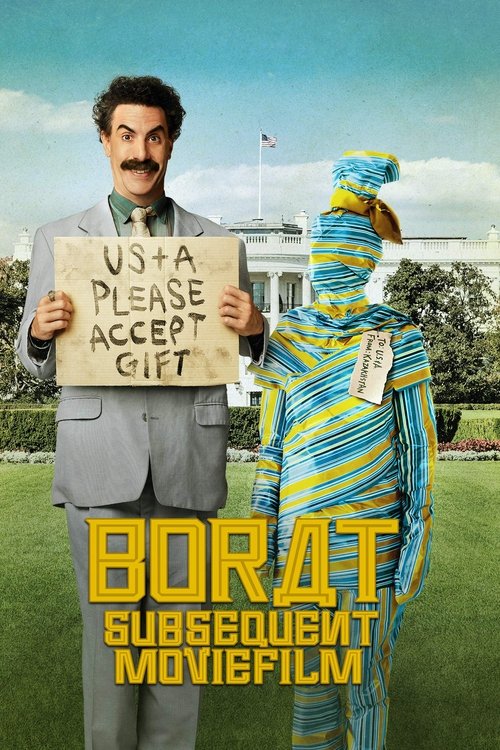
Borat Subsequent Moviefilm: Delivery of Prodigious Bribe to American Regime for Make Benefit Once Glorious Nation of Kazakhstan (2020)
Directed by Jason Woliner
Partly — Borat Subsequent Moviefilm: Delivery of Prodigious Bribe to American Regime for Make Benefit Once Glorious Nation of Kazakhstan is somewhat woke, scoring 40 out of 100 on our wokeness meter.
Fourteen years of gulag labor have done little to soften Borat Sagdiyev, and the second installment of his American travels arrives with the same hidden-camera ambush tactics and one unexpected passenger.
Consciousness Markers
Tutar's arc from oppressed, illiterate daughter to self-actualized reporter is a genuine feminist liberation narrative, complete with a babysitter who dismantles Borat's sexist teachings and an ending that rewrites Kazakhstan's misogynistic laws.
The film's prank-driven satire is largely aimed at exposing American antisemitism, racism, and QAnon paranoia, but it operates through mockery of bigots rather than an affirmative racial-consciousness thesis.
The film closes with a direct get-out-the-vote message and is openly designed to alarm viewers about illiberal democracy before the 2020 election, though its messaging arrives mostly through prank satire rather than sermonizing.
Bulgarian actress Maria Bakalova anchors the film as Tutar, and the cast is filled with real, non-actor Americans of varied backgrounds, though this is a byproduct of the mockumentary format rather than deliberate representational casting.
The breast-implant subplot gestures at rejecting cosmetic-surgery pressure when Tutar refuses the operation, but it is framed as a rejection of patriarchal control rather than a body-positivity statement.
Only glancing jabs at American consumerism and the absurdity of the political-media complex; no sustained eat-the-rich critique.
No LGBTQ+ themes or characters of note; Borat's attempted seduction of Giuliani is played for homophobic-adjacent shock comedy, not queer representation.
No environmental or climate themes whatsoever.
No neurodivergence themes or characters.
The film is a fictional mockumentary that invents events (Borat as COVID patient zero) for comedy; it does not reinterpret real history through an ideological lens.
Why it received this score
Fourteen years of gulag labor have done little to soften Borat Sagdiyev, and the second installment of his American travels arrives with the same hidden-camera ambush tactics and one unexpected passenger. The film's most durable achievement is Tutar, the teenage daughter hauled out of a barn and dragged across the country as a prospective bride. Her arc, from illiterate chattel to self-possessed reporter, is a genuine liberation narrative, and the babysitter who quietly dismantles Borat's inherited misogyny does more ideological work in ten minutes than most films manage in two hours. The ending, in which Kazakhstan's laws are rewritten, is a fantasy of feminist triumph delivered with a straight face.
The pranks themselves aim at American antisemitism, QAnon paranoia, and the febrile rituals of the 2020 campaign. This is mockery of bigots, not a thesis about race, and the film is content to let its targets hang themselves. The Giuliani bedroom sequence remains the most discussed passage, though it trades in shock and innuendo more than any coherent statement. A breast-implant subplot gestures at refusing cosmetic pressure, but the refusal reads as a rejection of patriarchal instruction, not a celebration of bodies as they are. The jabs at consumerism and the political-media complex are glancing at best.
The closing plea to vote is an explicit piece of civic alarmism stitched onto the final reel. The film wants to frighten its audience about illiberal democracy, and it does so through pranks and a direct address, a curious delivery system for a message. It is a comedy of ambush with a conscience bolted on at the end, effective in the moment and slightly uneasy in retrospect.
Analysis generated by our Consciousness Algorithm

Synopsis
14 years after making a film about his journey across the USA, Borat risks life and limb when he returns to the United States with his young daughter, and reveals more about the culture, the COVID-19 pandemic, and the political elections.
Questions about Borat Subsequent Moviefilm: Delivery of Prodigious Bribe to American Regime for Make Benefit Once Glorious Nation of Kazakhstan
Is Borat Subsequent Moviefilm: Delivery of Prodigious Bribe to American Regime for Make Benefit Once Glorious Nation of Kazakhstan woke?
Partly — Borat Subsequent Moviefilm: Delivery of Prodigious Bribe to American Regime for Make Benefit Once Glorious Nation of Kazakhstan is somewhat woke, scoring 40 out of 100 on our wokeness meter. That earns it a verdict of Woke-Adjacent.
What makes Borat Subsequent Moviefilm: Delivery of Prodigious Bribe to American Regime for Make Benefit Once Glorious Nation of Kazakhstan woke?
4 of the 10 markers register at 30 or above, led by Feminist Agenda (65), Lecture Energy (40) and Racial Consciousness (40). On Feminist Agenda: Tutar's arc from oppressed, illiterate daughter to self-actualized reporter is a genuine feminist liberation narrative, complete with a babysitter who dismantles Borat's sexist teachings and an ending that rewrites Kazakhstan's misogynistic laws.
How does Borat Subsequent Moviefilm: Delivery of Prodigious Bribe to American Regime for Make Benefit Once Glorious Nation of Kazakhstan compare to other 2020 movies?
It ranks #38 of the 227 films from 2020 we've scored; their average is 21. The wokest is One Night in Miami... (83).
How is the Woke Score calculated?
An AI-assisted process researches the film and its reception, scores it 0–100 on ten markers, then combines those into one 0–100 Woke Score. It measures a specific set of 2020s cultural themes, not film quality.