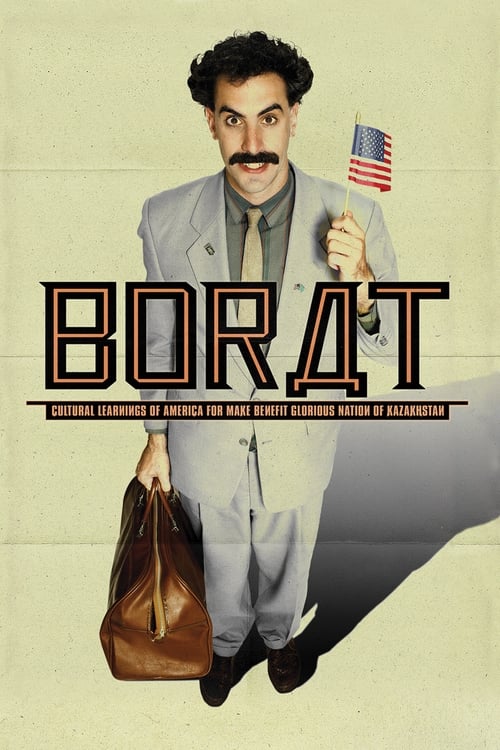
Borat: Cultural Learnings of America for Make Benefit Glorious Nation of Kazakhstan (2006)
Directed by Larry Charles
No · Based
How we score movies →Consciousness Markers
The film exposes American racism and prejudice through unscripted encounters, but simultaneously relies on ethnic caricature and mockery of Kazakhs and other non-American groups as its comedic foundation.
The documentary framing and the film's project of exposing American prejudices carries some pedagogical intent, but it is subordinate to comedic goals.
The film relies on ethnic caricature and features minimal substantive representation of minorities beyond mockery. The cast is predominantly white Americans used as subjects of ridicule.
The film contains minimal critique of capitalism or systemic economic exploitation. It focuses on cultural attitudes rather than economic structures.
While the film critiques American misogyny through its exposure of male characters, the women depicted are primarily objects of humiliation and sexual mockery rather than agents in the narrative.
No LGBTQ+ themes, representation, or storylines are present in the film.
No climate-related themes or environmental consciousness appears in the film.
No body positivity themes or representation of diverse body types in a positive context are present in the film.
No neurodivergence representation or themes appear in the film.
The film does not engage in revisionist historical narratives or reframing of historical events.


Synopsis
Kazakh journalist Borat Sagdiyev travels to America to make a documentary. As he zigzags across the nation, Borat meets real people in real situations with hysterical consequences. His backwards behavior generates strong reactions around him exposing prejudices and hypocrisies in American culture.
Why it received this score
Borat occupies a peculiar position in the contemporary cultural taxonomy. Released in 2006, it arrived before the crystallization of modern progressive sensibilities, yet its entire project consists of trapping real Americans into exposing their own prejudices and ignorance. The film functions as a mirror held up to American racism, misogyny, and jingoism, which might seem aligned with current consciousness. However, the mechanics of the comedy rely on a foreign character played by a Jewish British comedian mocking Kazakhs, women, and various American subcultures, a formula that would generate substantially more friction if released today.
The representation issue here is genuinely thorny. The film's critique of American attitudes toward women and minorities is delivered through a character who himself is deeply misogynistic and xenophobic, which creates a kind of double-layered satire. One cannot easily separate the critique of American hypocrisy from the film's own reliance on ethnic caricature and the dehumanization of its subjects. The women in the film, particularly, exist primarily as objects of mockery and sexual humiliation. The few non-white American characters are treated as punchlines rather than as vehicles for genuine satirical commentary.
The film's anti-capitalist content is minimal. While it mocks certain American institutions and attitudes, it does not interrogate systems of exploitation or wealth accumulation in any sustained way. There is no body positivity, no neurodivergence representation, no climate consciousness. The historical revisionism is absent. The lecture energy, while present in the framing device of the documentary, feels more like a vehicle for comedy than a genuine attempt at social instruction. What emerges from this analysis is a film that benefits from being read through a contemporary lens as progressive satire, but which relies on comedic methods that are fundamentally at odds with modern progressive values.
Analysis generated by our Consciousness Algorithm
Critic Reviews
“You won't know what outrageous fun is until you see Borat. High-five!”
“Absurd, outrageous, gross, disturbing, insightful, and so funny it’ll burst half the blood vessels in your face.”
“Borat is a rarity: a comedy whose middle name is danger, or as the Kazakhs say, kauwip-kater.”
“Except for a screamingly funny climax in which he attempts to kidnap Pamela Anderson (who reportedly wasn't in on the joke), I found the Borat feature (directed by Larry Charles, who does similar duties on "Curb Your Enthusiasm") depressing; and the paroxysms of the audience reinforced the feeling that I was watching a bearbaiting or pigsticking.”