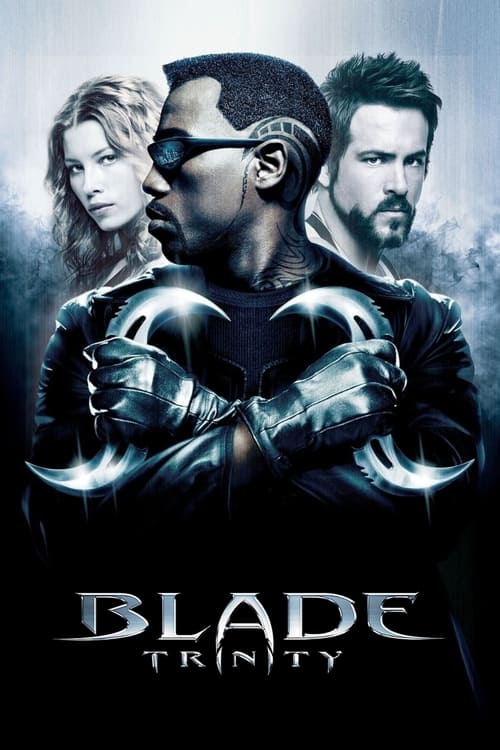
Blade: Trinity (2004)
Directed by David S. Goyer
No — Blade: Trinity is not woke, scoring 15 out of 100 on our wokeness meter.
Blade: Trinity arrives at the tail end of 2004, a third installment in a franchise that had already established its star, its leather, and its willingness to let Wesley Snipes glower through the proceedings with minimal dialogue.
Consciousness Markers
Wesley Snipes headlines as Blade and Jessica Biel co-leads as Abigail, with a multiracial supporting ensemble, but the film treats this as ordinary casting rather than a diversity-forward statement.
Abigail Whistler is a capable fighter and co-lead, but the film offers no explicit feminist agenda or gender-conscious commentary.
No explicit LGBTQ+ themes or characters are present; Parker Posey's villainous camp is not substantive queer representation.
Blade is a Black lead, but the film does not engage with race, racial identity, or racial politics in any conscious way.
There is no environmental or climate-related theme in the film.
The vampire blood farms are villainous exploitation, not a critique of capitalism or wealth inequality.
The film contains no body-positivity themes or messaging.
A blind scientist appears, but disability is not framed as neurodivergence or explored as a theme.
The film invents a fictional vampire origin for Dracula, but this is not historical revisionism.
The film is a straightforward action-horror sequel and does not pause for preachy or lecture-like messaging.
Why it received this score
Blade: Trinity arrives at the tail end of 2004, a third installment in a franchise that had already established its star, its leather, and its willingness to let Wesley Snipes glower through the proceedings with minimal dialogue. David S. Goyer, the series' longtime screenwriter, takes the director's chair here, and the production reportedly went poorly. None of that surfaces as anything so cohesive as a theme. What we get is a Black lead, a female co-lead who handles a bow with competence, and a supporting ensemble assembled without commentary. The film casts this way because it is 2004 and the producers wanted seats filled. No statement is intended, and none is delivered.
Which brings us to the film's cultural inventory, and it is thin. The vampires run blood farms, villainy of the most literal kind, extraction for consumption, and the film has no interest in stretching that image into an argument about labor or capital. Parker Posey chews scenery as Danica Talos, and her camp is a performance choice, not a text. A blind scientist labors in the background, and her blindness functions as plot mechanics. Nobody lectures. Nobody pauses mid-fight to explain what the film is really about. It is a vampire movie with a katana and a great deal of choppy editing.
Roger Ebert gave it one and a half stars, and the consensus has not softened since. As a cultural artifact, it registers as nearly inert, a genre picture that absorbed the casting norms of its moment and converted none of them into messaging. The progressive gestures here are ambient and unexamined, present in the bodies on screen and absent from the script. We file it accordingly: loud, tired, and innocent of any agenda beyond the box office.
Analysis generated by our Consciousness Algorithm


Synopsis
For years, Blade has fought against the vampires in the cover of the night. But now, after falling into the crosshairs of the FBI, he is forced out into the daylight, where he is driven to join forces with a clan of human vampire hunters he never knew existed—The Nightstalkers. Together with Abigail and Hannibal, two deftly trained Nightstalkers, Blade follows a trail of blood to the ancient creature that is also hunting him—the original vampire, Dracula.
Questions about Blade: Trinity
Is Blade: Trinity woke?
No — Blade: Trinity is not woke, scoring 15 out of 100 on our wokeness meter. That earns it a verdict of Ultra Based.
Does Blade: Trinity have any woke elements?
1 of the 10 markers register at 30 or above, led by Representation Casting (35). On Representation Casting: Wesley Snipes headlines as Blade and Jessica Biel co-leads as Abigail, with a multiracial supporting ensemble, but the film treats this as ordinary casting rather than a diversity-forward statement.
How does Blade: Trinity compare to other 2004 movies?
It ranks #42 of the 178 films from 2004 we've scored; their average is 12. The wokest is Tropical Malady (62).
Is Blade: Trinity the most woke Blade movie?
Yes. It scores highest of the 3 Blade films we've scored.