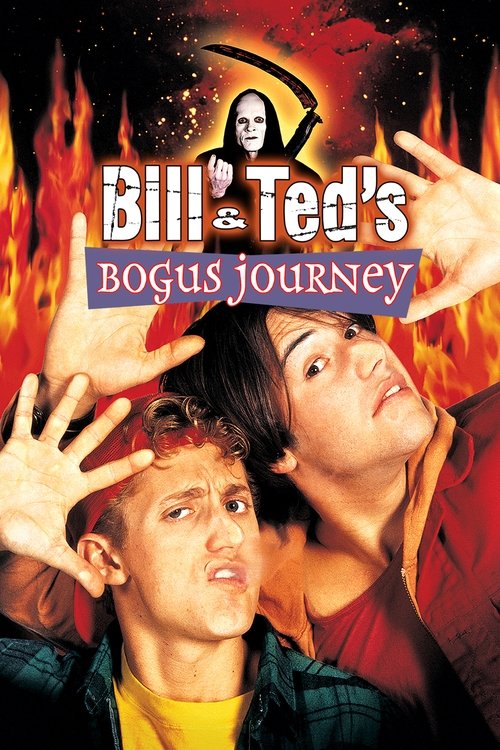
Bill & Ted's Bogus Journey (1991)
Directed by Peter Hewitt
No — Bill & Ted's Bogus Journey is not woke, scoring 0 out of 100 on our wokeness meter.
Bill and Ted's Bogus Journey arrives as the second entry in a franchise that has never pretended to be about anything other than two amiable young men and their guitars.
Consciousness Markers
The film features a multiracial supporting cast, including Pam Grier, but it does not engage with representation as a theme or make casting a statement.
No LGBTQ+ characters, relationships, or themes appear in the film.
The female characters are largely defined by their relationships to Bill and Ted and serve as romantic interests or hostages; no feminist critique is present.
Race is not a subject of the film; characters of color exist without any racial commentary or consciousness.
No environmental or climate themes are present.
The film's utopian future and rock stardom are not framed as a critique of capitalism or wealth inequality.
No body-positive themes or messaging are present.
Bill and Ted's slacker demeanor is comedic characterization, not an exploration of neurodivergence.
The film uses time travel and parodies Ingmar Bergman, but it does not revise historical narratives for modern ideological purposes.
The film is a silly comedy with no preachy or lecture-like messaging.
Why it received this score
Bill and Ted's Bogus Journey arrives as the second entry in a franchise that has never pretended to be about anything other than two amiable young men and their guitars. Pete Hewitt, making his feature debut, sends the pair through a Bergman spoof, a robot insurrection, and a tour of both Heaven and Hell, all without pausing to address a single item on the contemporary cultural ledger. The result plays like a time capsule from a period when a comedy could kill its heroes in the first act and consider that sufficient narrative ambition.
The audit comes back empty, and it comes back empty honestly. Pam Grier receives prominent billing as Ms. Wardroe, the Battle of the Bands organizer, and the film then reveals her to be Rufus in disguise, which means the production's most visible gesture toward a multiracial cast is undone by a plot twist that hands the part back to George Carlin. Joanna and Elizabeth graduate from medieval princesses to accomplished musicians, yet the screenplay keeps them tethered to engagement rings and, later, to ropes above a stage. Race, sexuality, class, and the environment go unmentioned, not through evasion but through genuine disinterest.
The film's vision of paradise is a record contract, twenty-five thousand dollars in prize money, and a ballad broadcast to the entire planet. It does not occur to anyone involved that this arrangement might warrant scrutiny. Death, played with weary dignity by William Sadler, is the closest thing to a thesis, and his thesis is that Twister is a difficult game for a reaper. We are left with a harmless, inventive, occasionally inspired sequel that asks nothing of its audience beyond ninety minutes of attention.
Analysis generated by our Consciousness Algorithm


Synopsis
Amiable slackers Bill and Ted are once again roped into a fantastical adventure when De Nomolos, a villain from the future, sends evil robot duplicates of the two lads to terminate and replace them. The robot doubles actually succeed in killing Bill and Ted, but the two are determined to escape the afterlife, challenging the Grim Reaper to a series of games in order to return to the land of the living.
Questions about Bill & Ted's Bogus Journey
Is Bill & Ted's Bogus Journey woke?
No — Bill & Ted's Bogus Journey is not woke, scoring 0 out of 100 on our wokeness meter. That earns it a verdict of Ultra Based.
Does Bill & Ted's Bogus Journey have any woke elements?
No. All 10 markers score zero.
How does Bill & Ted's Bogus Journey compare to other 1991 movies?
It ranks #61 of the 68 films from 1991 we've scored; their average is 14. The wokest is Paris Is Burning (77).
Is Bill & Ted's Bogus Journey the most woke Bill & Ted movie?
No. It ranks #3 of the 3 Bill & Ted films we've scored; the wokest is Bill & Ted Face the Music (27).