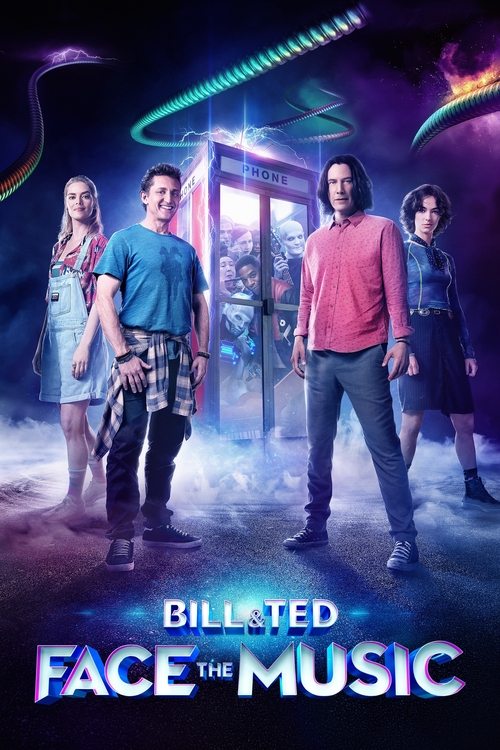
Bill & Ted Face the Music (2020)
Directed by Dean Parisot
No — Bill & Ted Face the Music is not especially woke, scoring 27 out of 100 on our wokeness meter.
Thirty years after the original, Bill and Ted return as middle-aged men whose marriages have curdled and whose prophesied song remains unwritten.
Consciousness Markers
The cast is notably diverse, with the daughters Billie and Thea played by Jack Haven and Samara Weaving, a female Great Leader (Holland Taylor), and a multi-ethnic supergroup of historical musicians including Jimi Hendrix, Louis Armstrong, and Ling Lun. The diversity is present but largely woven in without heavy commentary.
The daughters Billie and Thea drive the plot's resolution, assembling the historical supergroup and ultimately producing the universe-saving song, while the Great Leader and Kelly hold key authority roles. Female characters are central, though the film's tone is comedic rather than polemical.
The film deliberately reimagines historical figures, most notably casting Ling Lun—traditionally identified as male—as a woman, with the producers openly citing the series' disregard for historical accuracy. The gathering of anachronistic musicians is a playful rewriting of history.
The inclusion of Hendrix, Armstrong, and Ling Lun gives the ensemble a multiracial makeup, but the film engages no racial themes or commentary. Diversity is present without consciousness-raising.
Jack Haven is gender non-binary in real life and the daughters deliberately cultivated a genderless wardrobe, and the producers consciously dropped the anti-gay slurs from earlier films. However, the film itself contains no explicit LGBTQ+ narrative content.
The film is a lighthearted comedy that preaches unity and togetherness only in the vaguest, most celebratory sense, with no didactic messaging or moralizing.
There is no environmental or climate theme in the film; the threat is collapsing space-time, not ecological crisis.
No critique of capitalism or wealth appears; the film is a good-natured comedy about friendship and destiny.
No body-positivity themes or messaging are present.
No neurodivergence themes or characters are present.
Why it received this score
Thirty years after the original, Bill and Ted return as middle-aged men whose marriages have curdled and whose prophesied song remains unwritten. The film's cultural furniture has been quietly updated. Bill's daughter Thea and Ted's daughter Billie carry the plot's resolution, assembling a supergroup of historical musicians and producing the song that repairs the universe. A woman, Holland Taylor's Great Leader, holds future authority. Kristen Schaal's Kelly does the legwork. The casting is diverse without making a spectacle of its own diversity, which is the more graceful way to do it. The producers also dropped the anti-gay slurs that peppered the earlier installments, a decision that costs the film nothing and spares the audience some squirming.
The historical pageant is where the film's revisionist streak shows. Jimi Hendrix, Louis Armstrong and Mozart are recruited into a band, and Ling Lun, traditionally described as male, is played by a woman, with the filmmakers cheerfully noting that this series has never let accuracy interfere with a good gag. History becomes a jam session. That is a rewrite of the record, but a gentle one, motivated by casting arithmetic and a taste for the absurd. We look in vain for climate anxiety, for a critique of capital, for any meditation on bodies or brains. The threat here is collapsing space-time, not the planet, and the villain is a robot with poor aim.
The result is warm, silly and almost entirely free of sermonizing. It gestures at unity and togetherness, but only in the way a closing number gestures at a curtain. Nobody is scolded. Nobody is taught. The film asks only that we be excellent to each other, a sentiment old enough to be pre-modern and vague enough to offend no one. A pleasant artifact of a gentler comic tradition, and a box office casualty of a year that had other plans.
Analysis generated by our Consciousness Algorithm


Synopsis
Yet to fulfill their rock and roll destiny, the stakes are higher than ever for the now middle-aged Bill and Ted who set out on a new adventure when a visitor from the future warns them that only their song can save life as we know it.
Questions about Bill & Ted Face the Music
Is Bill & Ted Face the Music woke?
No — Bill & Ted Face the Music is not especially woke, scoring 27 out of 100 on our wokeness meter. That earns it a verdict of Based.
Does Bill & Ted Face the Music have any woke elements?
3 of the 10 markers register at 30 or above, led by Feminist Agenda (45), Representation Casting (45) and Revisionist History (35). On Feminist Agenda: The daughters Billie and Thea drive the plot's resolution, assembling the historical supergroup and ultimately producing the universe-saving song, while the Great Leader and Kelly hold key authority roles.
How does Bill & Ted Face the Music compare to other 2020 movies?
It ranks #59 of the 227 films from 2020 we've scored; their average is 21. The wokest is One Night in Miami... (83).
Is Bill & Ted Face the Music the most woke Bill & Ted movie?
Yes. It scores highest of the 3 Bill & Ted films we've scored.