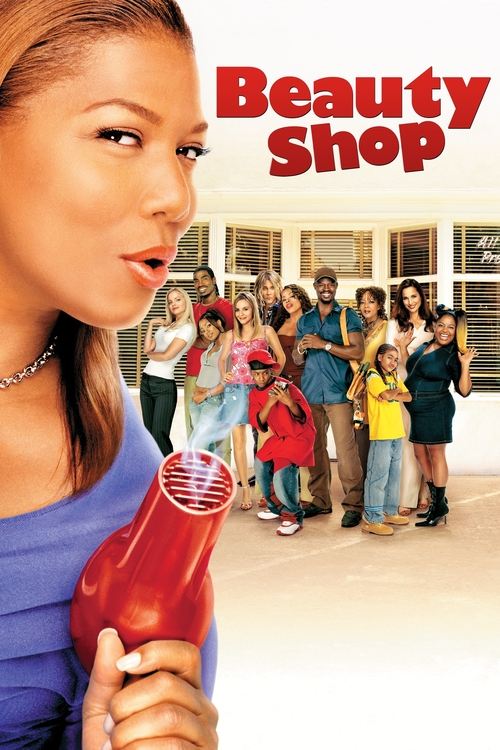
Beauty Shop (2005)
Directed by Bille Woodruff
No — Beauty Shop is not especially woke, scoring 30 out of 100 on our wokeness meter.
Beauty Shop arrives in 2005 as a spin-off of the Barbershop pictures, transplanting Queen Latifah's Gina Norris to Atlanta, where she quits a domineering Austrian boss and buys a run-down salon with a loan and a prayer.
Consciousness Markers
The film features a predominantly Black, female-led ensemble with supporting white and African immigrant characters, making it notably diverse for a 2005 studio comedy.
The story is set in a Black-owned Atlanta salon and touches on a white stylist fitting into a Black workplace, interracial romance, and a racism keyword, but it treats these lightly rather than as a central racial-justice thesis.
Gina is a widowed single mother who quits a domineering male boss to open her own salon, and the film emphasizes female entrepreneurship and solidarity among the mostly women staff.
The film delivers mild moral lessons about perseverance and community, but it remains a broad comedy rather than a preachy or issue-driven lecture.
There are no LGBTQ+ characters, themes, or subplots in the film.
There is no environmental or climate-related content in the film.
The film includes a small business and a corporate cosmetics meeting, but it does not critique capitalism or wealth inequality in any meaningful way.
Despite the beauty-salon setting, the film does not engage with body positivity, size acceptance, or related themes.
There is no depiction or discussion of neurodivergence in the film.
The film is a contemporary fictional comedy and does not revise or reinterpret historical events.
Why it received this score
Beauty Shop arrives in 2005 as a spin-off of the Barbershop pictures, transplanting Queen Latifah's Gina Norris to Atlanta, where she quits a domineering Austrian boss and buys a run-down salon with a loan and a prayer. The ensemble is almost entirely Black and almost entirely female, a configuration a studio comedy of that era could reach without ceremony. Alicia Silverstone's Lynn, the lone white stylist, spends the running time learning to fit in, and Djimon Hounsou's Joe, an electrician from Africa, bonds with Gina's daughter over piano. The picture wears its diversity lightly, as a matter of casting and setting, not as a thesis requiring defense.
The progressive content here is modest and mostly economic. Gina is a widowed single mother who walks away from a male employer and builds her own shop, and the film treats female entrepreneurship and workplace solidarity as plain goods. Race surfaces in a white woman navigating a Black workplace, in an interracial romance between James and Lynn, and in a keyword or two, but the film keeps its touch light. It is a comedy first. The sermonizing, such as it is, amounts to a few gentle nudges about perseverance, second chances, and the staff hauling in their own supplies to scrub a vandalized salon before a recital.
What the film declines to do is instructive. There is no queer presence, no environmental conscience, no meditation on body image despite all the mirrors and hair, no neurodivergent character, no rewriting of history. The shop sells a homemade conditioner to a cosmetics conglomerate, and nobody suggests the arrangement is a crime against the working class. Jorge receives a humiliating haircut, the villain is vanquished, and the credits roll. The result is a film of mild, ambient social awareness, the sort that costs nothing and offends no one. We classify it accordingly, with the weary respect owed to a vintage that never pretended to be difficult.
Analysis generated by our Consciousness Algorithm


Synopsis
Far from Chicago, hairdresser Gina Norris has relocated to Atlanta with her daughter and has quickly established herself as a rare talent in her profession. But after repeatedly butting heads with her shady, over-the-top boss, Jorge, Norris sets out to create her own salon -- even snagging a few of Jorge's employees and clients. Now, Jorge will do anything to shut her down.
Questions about Beauty Shop
Is Beauty Shop woke?
No — Beauty Shop is not especially woke, scoring 30 out of 100 on our wokeness meter. That earns it a verdict of Based.
Does Beauty Shop have any woke elements?
3 of the 10 markers register at 30 or above, led by Representation Casting (60), Racial Consciousness (45) and Feminist Agenda (40). On Representation Casting: The film features a predominantly Black, female-led ensemble with supporting white and African immigrant characters, making it notably diverse for a 2005 studio comedy.
How does Beauty Shop compare to other 2005 movies?
It ranks #16 of the 181 films from 2005 we've scored; their average is 13. The wokest is The Constant Gardener (72).
How is the Woke Score calculated?
An AI-assisted process researches the film and its reception, scores it 0–100 on ten markers, then combines those into one 0–100 Woke Score. It measures a specific set of 2020s cultural themes, not film quality.