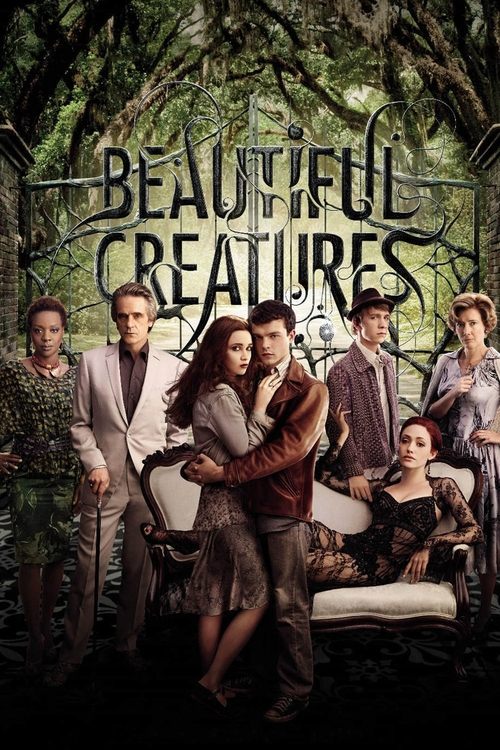
Beautiful Creatures (2013)
Directed by Richard LaGravenese
No — Beautiful Creatures is not especially woke, scoring 20 out of 100 on our wokeness meter.
Beautiful Creatures is a 2013 young adult romance adapted from the first Caster Chronicles novel, and it carries its influences openly.
Consciousness Markers
Viola Davis is given the prominent supporting role of Amma, the seer and family friend, and the Southern ensemble is somewhat integrated, but the leads remain two white teens and no casting choice is made in service of representation.
The supernatural power belongs to the girl rather than the boy — an inversion of the Twilight template — and Lena ultimately 'claims herself' and rejects the dark on her own terms, but the film is still organized around a boy's pursuit of a mysterious romantic object.
The screenplay gestures at a moral about intolerance — classmates praying to be shielded from Lena, the town's suspicion of the Ravenwoods — and Ethan's voiceover offers light social commentary on small-town conformity, but the messaging is soft and never preachy.
Prejudice against the Ravenwood caster family is drawn as small-town intolerance rather than a racial theme, and the Black characters occupy traditional Southern keeper/servant roles without the film interrogating the racial history of its setting.
No LGBTQ+ characters, themes, or subtext appear anywhere in the film.
There is no environmental content; the villain's desire to purge mortals from the Earth is a power fantasy, not a climate allegory.
The film contains no economic critique or anti-wealth messaging whatsoever.
Bodies, size, and appearance are not addressed as themes; the cast is uniformly conventionally attractive but no statement on body image is made.
No neurodivergent characters or themes are present, either explicitly or as metaphor.
The Civil War flashbacks present a Confederate soldier as a sympathetic doomed romantic, but this is standard Southern-gothic romance staging rather than a deliberate reframing of history for a modern ideological purpose.
Why it received this score
Beautiful Creatures is a 2013 young adult romance adapted from the first Caster Chronicles novel, and it carries its influences openly. A bookish boy in a South Carolina town dreams of a mysterious girl, then meets her, then spends most of the running time waiting for her sixteenth birthday to decide whether she will be light or dark. The film was sold as a gender-flipped supernatural romance, and the marketing was honest enough. The result is lush, mildly embarrassed by its own exposition, and financially doomed. It has the nervous energy of a franchise starter that already suspects it will not be starting a franchise.
The casting gives Viola Davis the substantial role of Amma, a seer and keeper with roots in the town's old Southern hierarchies, and the supporting ensemble is more integrated than the genre usually bothers to be. The leads, however, remain two white teenagers, and the Black characters occupy keeper and servant positions that the film never examines against the racial history of its setting. Prejudice against the Ravenwood family is framed as small-town suspicion of witches, not as a racial parable. On the gender front, the supernatural inheritance belongs to the girl, and Lena's final act of claiming herself has a certain defiant charge. Yet the story still orbits a boy's pursuit of a beautiful enigma, so the inversion is structural but not deeply feminist.
The film gestures toward a lesson about intolerance. Classmates pray to be shielded from Lena, the town whispers about her family, and Ethan's voiceover sighs over small-town conformity. The sermon never hardens into a sermon. There is no LGBTQ content, no climate allegory, no economic critique, no body-image statement, no neurodivergent thread. The Civil War flashbacks give us a doomed Confederate soldier as a romantic ghost, which is standard Southern gothic furniture, not a deliberate historical rewrite. What remains is a soft-spoken supernatural romance with a few progressive accents and no appetite for argument. It is the cinematic equivalent of a polite note left on a kitchen counter.
Analysis generated by our Consciousness Algorithm


Synopsis
Ethan Wate just wants to get to know Lena Duchannes better, but unbeknownst to him, Lena has strange powers. As Lena's 16th birthday approaches she might decide her fate, to be good or evil. A choice which will impact her relationship forever.
Questions about Beautiful Creatures
Is Beautiful Creatures woke?
No — Beautiful Creatures is not especially woke, scoring 20 out of 100 on our wokeness meter. That earns it a verdict of Based.
Does Beautiful Creatures have any woke elements?
1 of the 10 markers register at 30 or above, led by Representation Casting (32). On Representation Casting: Viola Davis is given the prominent supporting role of Amma, the seer and family friend, and the Southern ensemble is somewhat integrated, but the leads remain two white teens and no casting choice is made in service of representation.
How does Beautiful Creatures compare to other 2013 movies?
It ranks #59 of the 274 films from 2013 we've scored; their average is 14. The wokest is Belle (76).
How is the Woke Score calculated?
An AI-assisted process researches the film and its reception, scores it 0–100 on ten markers, then combines those into one 0–100 Woke Score. It measures a specific set of 2020s cultural themes, not film quality.