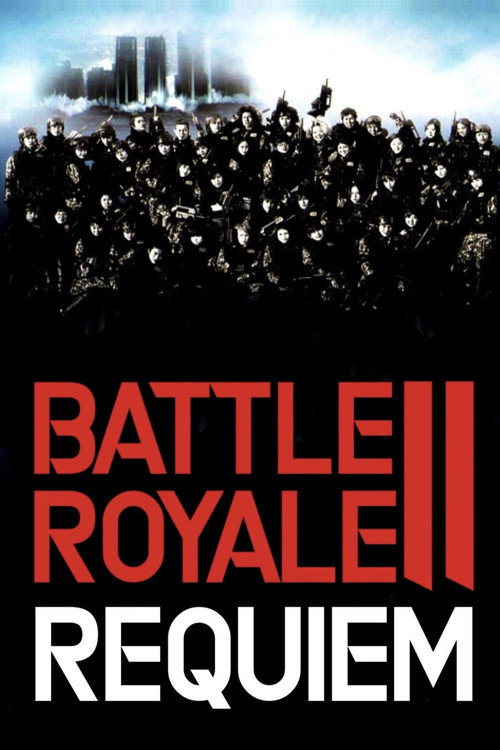
Battle Royale II: Requiem (2003)
Directed by Kenta Fukasaku
No — Battle Royale II: Requiem is not woke, scoring 10 out of 100 on our wokeness meter.
Battle Royale II: Requiem arrives three years after its predecessor with a heavier budget, a dead director, and a chip on its shoulder the size of Hashima Island.
Consciousness Markers
The film is deliberately provocative with overt political sermonizing — Shuya's televised call for the world's youth to rise against their rulers, and the director's stated desire to make audiences ponder big issues.
The conflict pits indoctrinated youth against a fascistic adult government, which is anti-authoritarian rather than a critique of capitalism or wealth.
Shiori Kitano and Noriko have significant roles with agency, but the film advances no feminist thesis or gender-justice messaging; their arcs are personal and familial.
The film carries strident anti-American and generational-warfare politics, but this is geopolitical rather than a racial-consciousness statement in the contemporary sense.
The cast is entirely Japanese in a Japanese production, which is natural rather than a deliberate diversity-casting statement. No conscious representation agenda is evident.
No LGBTQ+ characters, relationships, or themes appear anywhere in the film.
There is no environmental or climate theme in the film.
No body-positive messaging; the diabetic character's condition is a plot device, not a body-acceptance theme.
No neurodivergent characters or themes are present.
The film is an original dystopian fiction, not a reworking of historical events; no revisionist-history agenda.
Why it received this score
Battle Royale II: Requiem arrives three years after its predecessor with a heavier budget, a dead director, and a chip on its shoulder the size of Hashima Island. Kinji Fukasaku shot a single scene before prostate cancer took him; his son Kenta completed the picture and dedicated it to the old man. The result is a film that wants very badly to be dangerous. It is a sequel, an original story rather than an adaptation, and it carries itself like a manifesto that happens to contain teenagers with explosive collars.
Where the first film found its cruelty in a classroom, this one reaches for geopolitics. Shuya Nanahara has become an international terrorist, the Wild Seven have leveled a government building, and the students are conscripted to kill him. The film wears its anti-American posture openly, casting the United States as the missile-launching hand behind a fascistic adult order. Shuya takes to the airwaves on Christmas Day to urge the world's young to rise against their rulers. This is sermonizing, plainly, and the director said he wanted audiences to ponder big issues and to see the world through a terrorist's eyes. Provocation is the point.
Elsewhere the ledger is thin. The cast is uniformly Japanese because the production is Japanese, not because anyone set out to make a statement. Women carry real weight in the plot, Shiori and Noriko among them, though their arcs turn on fathers and family, not on a thesis about gender. There is no environmental lament, no body-acceptance thread (a diabetic character's condition is a mechanism for tension, nothing more), no neurodivergent figure, and no reworking of history, since the whole thing is invented. All that survives is a loud, muddled, oddly sincere film about the young inheriting a world their elders ruined. The anger is real. The analysis is not.
Analysis generated by our Consciousness Algorithm


Synopsis
It's three years after the events of the original Battle Royale, and Shuya Nanahara is now an internationally-known terrorist determined to bring down the government. His terrorist group, Wild Seven, stages an attack that levels several buildings in Tokyo on Christmas Day, killing 8000 people. In order for the government to study the benefits of "teamwork", the new students work in pairs, with their collars electronically linked so that if one of them is killed, the other dies as well. They must kill Nanahara in three days - or die.
Questions about Battle Royale II: Requiem
Is Battle Royale II: Requiem woke?
No — Battle Royale II: Requiem is not woke, scoring 10 out of 100 on our wokeness meter. That earns it a verdict of Ultra Based.
Does Battle Royale II: Requiem have any woke elements?
1 of the 10 markers register at 30 or above, led by Lecture Energy (45). On Lecture Energy: The film is deliberately provocative with overt political sermonizing — Shuya's televised call for the world's youth to rise against their rulers, and the director's stated desire to make audiences ponder big issues.
How does Battle Royale II: Requiem compare to other 2003 movies?
It ranks #59 of the 150 films from 2003 we've scored; their average is 12. The wokest is Mona Lisa Smile (60).
How is the Woke Score calculated?
An AI-assisted process researches the film and its reception, scores it 0–100 on ten markers, then combines those into one 0–100 Woke Score. It measures a specific set of 2020s cultural themes, not film quality.