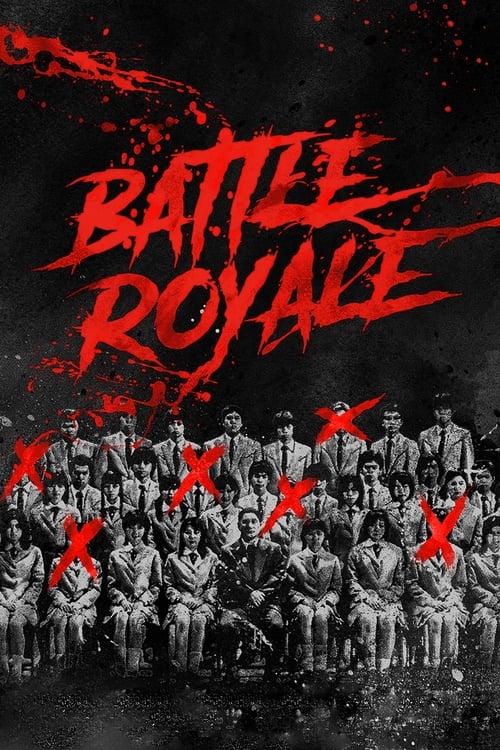
Battle Royale (2000)
Directed by Kinji Fukasaku
No — Battle Royale is not woke, scoring 8 out of 100 on our wokeness meter.
Battle Royale arrives from the year 2000 with a collar around its neck and a body count that renders most subsequent cultural hand-wringing redundant.
Consciousness Markers
Fukasaku described the film as a 'fable' carrying 'words to the next generation' about juvenile crime, but the social commentary is embedded in relentless violence rather than delivered as direct moralizing.
A Japanese production with an entirely Japanese cast and a notably large ensemble of young female characters; the diversity is native to the source culture rather than a deliberate representational statement.
Strong female characters exist (Mitsuko, Noriko, the lighthouse girls), but the film offers no feminist thesis; women are participants in the same brutally nihilistic game as the men.
The film critiques authoritarian government and the betrayal of youth by adults, but frames this as generational and institutional, not a critique of capitalism or class.
No LGBTQ+ characters, themes, or subtext of any kind.
No engagement with racial identity or racial politics whatsoever; the film is a monocultural Japanese dystopia.
No environmental or climate themes appear in the film.
No body-positivity themes or messaging present.
Mitsuko is depicted as traumatized and sociopathic, but the film treats this as tragedy and horror, not as neurodivergent identity to be affirmed.
No historical revisionism; the film is a fictional dystopia grounded in contemporary Japanese social anxieties.
Why it received this score
Battle Royale arrives from the year 2000 with a collar around its neck and a body count that renders most subsequent cultural hand-wringing redundant. Its dystopia is a totalitarian Japanese government that ships a ninth-grade class to an island and instructs the students to kill one another. The target of the film's scorn is generational and institutional: adults who lie to children, a teacher rejected by his own daughter, a state that treats its young as disposable. That is an old complaint, and it is not a complaint about markets. The film has no interest in class, capital, or the distribution of wealth. It has interest in a man in a tracksuit eating cookies while children die.
The cast is entirely Japanese, with an unusually large roster of young women given weapons, grudges, and screen time. This is a function of the source material and the national cinema it belongs to, not a casting brief written in a conference room. Nothing in the film engages race as a subject, and nothing engages queerness, climate, or body image. Mitsuko Souma's abuse and the sociopathy that follows are staged as tragedy and horror, which is where the film leaves them, unaffirmed and unclaimed.
Fukasaku called his film a fable and described it as words to the next generation, which sounds like a lecture and plays like a slaughterhouse. The moralizing sits inside the violence and is never extracted for our convenience. We are left with a film of faint social consciousness and no sermon at all, a rare vintage that has aged into mere provocation. We have classified it accordingly, and we will now lie down.
Analysis generated by our Consciousness Algorithm


Synopsis
In the future, the Japanese government captures a class of ninth-grade students and forces them to kill each other under the revolutionary "Battle Royale" act.
Questions about Battle Royale
Is Battle Royale woke?
No — Battle Royale is not woke, scoring 8 out of 100 on our wokeness meter. That earns it a verdict of Ultra Based.
Does Battle Royale have any woke elements?
Very few. None of the 10 markers reaches 30, the level where a marker counts as present; the highest is Lecture Energy at 15.
How does Battle Royale compare to other 2000 movies?
It ranks #65 of the 125 films from 2000 we've scored; their average is 13. The wokest is But I'm a Cheerleader (72).
How is the Woke Score calculated?
An AI-assisted process researches the film and its reception, scores it 0–100 on ten markers, then combines those into one 0–100 Woke Score. It measures a specific set of 2020s cultural themes, not film quality.