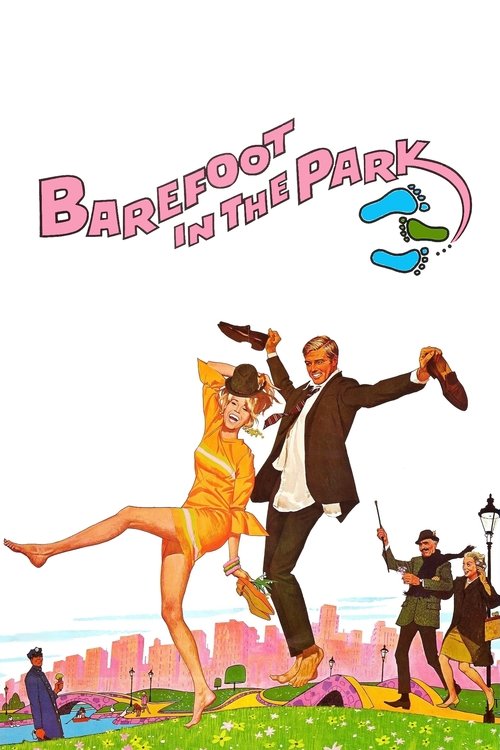
Barefoot in the Park (1967)
Directed by Gene Saks
No — Barefoot in the Park is not woke, scoring 0 out of 100 on our wokeness meter.
Barefoot in the Park presents a meticulously charming, if culturally static, examination of early marriage in Greenwich Village.
Consciousness Markers
The cast is entirely white and the film makes no effort at diverse or inclusive representation.
There are no LGBTQ+ characters, themes, or subtext.
The film is a traditional 1960s romantic comedy about newlyweds and does not advance a feminist agenda.
Race is not addressed or thematized in any way.
There is no environmental or climate-related content.
The film contains no critique of capitalism or wealth inequality.
There is no body-positivity theme or messaging.
Neurodivergence is not depicted or discussed.
The film is a contemporary romantic comedy and does not revise historical narratives.
The film aims to entertain rather than deliver progressive social lectures.
Why it received this score
Barefoot in the Park presents a meticulously charming, if culturally static, examination of early marriage in Greenwich Village. We find Robert Redford and Jane Fonda navigating the typical friction of a newlywed couple, their domestic disagreements providing the primary engine for the plot. The film is a delightful exercise in high-gloss, low-stakes romantic comedy. Its concerns are strictly those of the personal: mismatched personalities, awkward neighbors, and the difficulty of sharing a cramped apartment without an elevator. The narrative remains firmly rooted in a 1960s romantic farcical sensibility, choosing escapism over any form of contemporary social commentary. This is a story about finding love amidst personal chaos, not about dissecting broader systemic issues.
The script, adapted from a Neil Simon play, prioritizes effervescent chemistry and snappy dialogue above all else. The film operates within a comfortable, predictable framework of light-hearted misunderstandings. There is no attempt to infuse the story with progressive sensibilities regarding race, gender dynamics, or modern identity politics. The characters exist as archetypes within the confines of a classic romantic comedy structure. The conflict between the free-spirited Corie and the uptight Paul is entirely contained to their relationship, never expanding into a critique of wealth, social structures, or the state of the modern world.
Ultimately, the film functions as a highly polished piece of nostalgic entertainment. Its focus is entirely on the successful execution of a traditional romantic premise. The absence of specific cultural markers like environmentalism or discussions of non-traditional life paths is not a failure of writing. It is simply a reflection of the genre and the period it inhabits. We observe a carefully constructed bubble of New York domestic life, free of modern introspection. It is a pleasant, if culturally unremarkable, time capsule of escapism.
Analysis generated by our Consciousness Algorithm
Part of


Synopsis
In this film based on a Neil Simon play, newlyweds Corie, a free spirit, and Paul Bratter, an uptight lawyer, share a sixth-floor apartment in Greenwich Village. Soon after their marriage, Corie tries to find a companion for mother, Ethel, who is now alone, and sets up Ethel with neighbor Victor. Inappropriate behavior on a double date causes conflict, and the young couple considers divorce.
Questions about Barefoot in the Park
Is Barefoot in the Park woke?
No — Barefoot in the Park is not woke, scoring 0 out of 100 on our wokeness meter. That earns it a verdict of Ultra Based.
Does Barefoot in the Park have any woke elements?
No. All 10 markers score zero.
How does Barefoot in the Park compare to other 1967 movies?
It ranks #15 of the 19 films from 1967 we've scored; their average is 10. The wokest is In the Heat of the Night (60).
How is the Woke Score calculated?
An AI-assisted process researches the film and its reception, scores it 0–100 on ten markers, then combines those into one 0–100 Woke Score. It measures a specific set of 2020s cultural themes, not film quality.