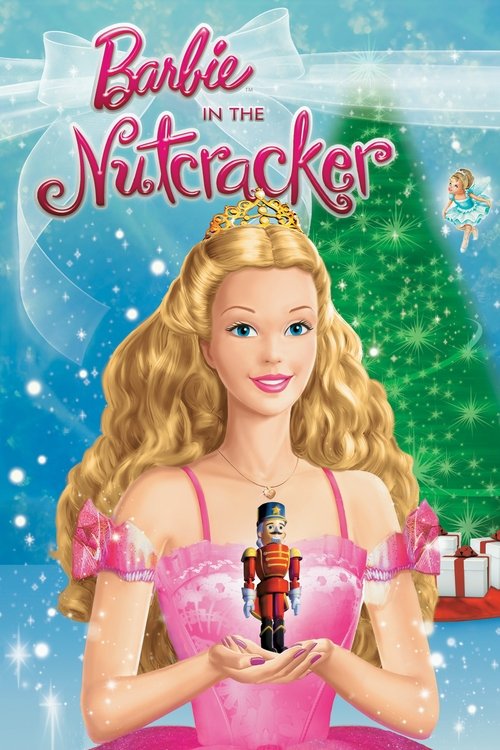
Barbie in the Nutcracker (2001)
Directed by Owen Hurley
No — Barbie in the Nutcracker is not especially woke, scoring 32 out of 100 on our wokeness meter.
Barbie in the Nutcracker arrives from 2001 as the opening entry in what became a sprawling animated franchise, a 76-minute home video production assembled by Mainframe Entertainment and Mattel, with the London Symphony Orchestra on the soundtrack and New York City Ballet dancers feeding motion capture data into the machinery.
Consciousness Markers
The film was explicitly designed to empower girls, featuring a female protagonist, a female mentor in Aunt Elizabeth, and a 'kind, clever, brave' heroine, though its feminism is mild and constrained by Mattel's doll-brand expectations.
The film ends with a gentle moral about perseverance and self-confidence, but it lacks the preachy social-justice lecture energy of modern woke cinema.
The film features an all-white voice cast and characters, with no meaningful racial or ethnic diversity in the narrative.
There are no LGBTQ+ characters, relationships, or themes in the film.
The film does not engage with racial identity, racism, or racial justice themes.
There is no environmental or climate-related messaging in the film.
The film is a Mattel toy commercial and contains no anti-capitalist or eat-the-rich critique.
The film reinforces conventional Barbie doll beauty standards and does not promote body positivity.
No neurodivergent characters or themes are present.
The film is a fantasy adaptation of a fairy tale and ballet, not a revisionist historical narrative.
Why it received this score
Barbie in the Nutcracker arrives from 2001 as the opening entry in what became a sprawling animated franchise, a 76-minute home video production assembled by Mainframe Entertainment and Mattel, with the London Symphony Orchestra on the soundtrack and New York City Ballet dancers feeding motion capture data into the machinery. One animator was assigned to Barbie's hair alone. That is the level of care available when a toy company decides to make a movie, and it shows in the softness of the lighting and the stiffness of nearly everything else. The Tchaikovsky borrowings are generous. The storytelling is not.
The film's social program is modest and openly commercial. Screenwriter Rob Hudnut has said the aim was to empower girls, and the production replaced Clara's godfather with Aunt Elizabeth, a world traveller, purely to supply a female mentor. The heroine's mantra was kind, clever, brave. Mattel representatives then trimmed the edges: a scene in which Clara stumbles while carrying a tray was cut because Barbie would never stumble, and a voice performance was asked to sound less angry. The result is girl power as brand management, cheerful and bounded, with a heroine who does more romancing than rescuing. The gesture is real. The ceiling is low.
The surrounding markers are silent. The voice cast is uniformly white, the narrative has no interest in race, and there is no LGBTQ presence, no environmental theme, no critique of the toy empire bankrolling the enterprise, no body diversity, and no neurodivergent characterization. The 1890s German setting is fairy tale furniture, not history under revision. A closing moral about perseverance and self-confidence lands gently, without a sermon attached. Then the credits roll and the merchandise begins: eight dolls, a Hallmark ornament, ballet bags, sleepwear. The film exists to sell those things, and it does so with a Nutcracker suite and a snow globe. We can admire the craft and still record that this vintage offers very little to the sommelier of social consciousness. It is sweet, it is harmless, and it is a catalogue.
It is sweet, it is harmless, and it is a catalogue with a hair rig. The classification stands at the low end, and the cellar is tidy.
{"thematic_tags": ["book_adaptation"]}
Analysis generated by our Consciousness Algorithm


Synopsis
The Mouse King casts an evil spell over Clara that causes her to shrink. Clara and the Nutcracker set out on an adventurous journey to find Sugarplum Princess, who has the power to undo the spell.
Questions about Barbie in the Nutcracker
Is Barbie in the Nutcracker woke?
No — Barbie in the Nutcracker is not especially woke, scoring 32 out of 100 on our wokeness meter. That earns it a verdict of Based.
Does Barbie in the Nutcracker have any woke elements?
1 of the 10 markers register at 30 or above, led by Feminist Agenda (45). On Feminist Agenda: The film was explicitly designed to empower girls, featuring a female protagonist, a female mentor in Aunt Elizabeth, and a 'kind, clever, brave' heroine, though its feminism is mild and constrained by Mattel's doll-brand expectations.
How does Barbie in the Nutcracker compare to other 2001 movies?
It ranks #13 of the 148 films from 2001 we've scored; their average is 12. The wokest is Monster's Ball (60).
How is the Woke Score calculated?
An AI-assisted process researches the film and its reception, scores it 0–100 on ten markers, then combines those into one 0–100 Woke Score. It measures a specific set of 2020s cultural themes, not film quality.