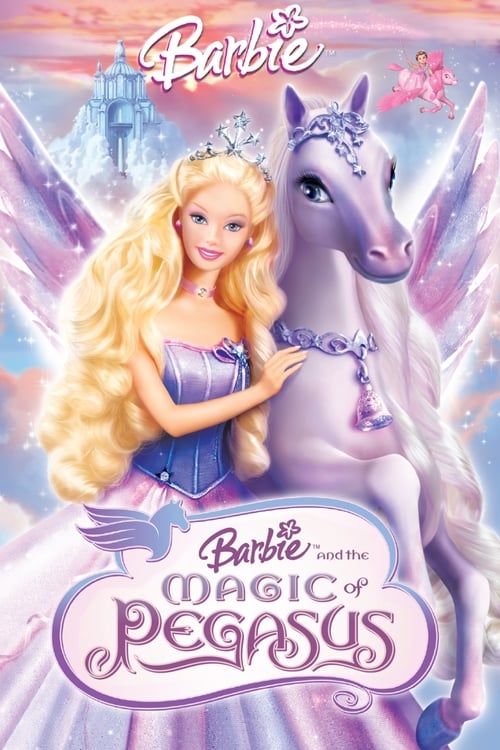
Barbie and the Magic of Pegasus (2005)
Directed by Greg Richardson
No — Barbie and the Magic of Pegasus is not woke, scoring 12 out of 100 on our wokeness meter.
Princess Annika skates on forbidden ice, adopts a polar bear cub, and refuses a sorcerer's hand in marriage, which promptly petrifies her entire village.
Consciousness Markers
Princess Annika is a headstrong female protagonist who refuses an unwanted marriage and saves her family, but the film remains a traditional fairy-tale narrative rather than a modern feminist statement.
The film features an entirely white/default-coded cast of characters with no meaningful racial or ethnic diversity.
There are no LGBTQ+ characters, relationships, or themes present in the story.
The film does not engage with race, racism, or racial identity in any form.
A polar bear cub appears as a cute sidekick, but there is no environmental or climate-change messaging.
The greedy trader Ferris is a minor comic antagonist, but the film contains no critique of capitalism or wealth inequality.
There is no body-positivity theme or challenge to conventional beauty standards.
No characters are depicted with neurodivergent traits or conditions, and the topic is not addressed.
The film is an original fairy tale with no historical setting or revisionist historical narrative.
The story is told as light fantasy entertainment and does not pause for moralizing or didactic speeches.
Why it received this score
Princess Annika skates on forbidden ice, adopts a polar bear cub, and refuses a sorcerer's hand in marriage, which promptly petrifies her entire village. This is the sixth entry in the Barbie film series and the first built from wholly original material, a distinction the studio presumably regarded as a gamble. The result plays as a brisk, brightly colored fairy tale about a winged horse who is secretly a sister, a wand assembled from courage, love, and ice, and a wizard who has already turned three previous wives into trolls. It is a confection, and it knows it.
On the matter of social consciousness, the film is a near-total blank. Annika is headstrong, she declines an unwanted suitor, and she rescues her family, which registers as a faint pulse of feminine agency. Yet the machinery around her is the oldest kind: a princess, a quest, a marriage plot resolved by a blacksmith with good cheekbones. The cast is uniformly pale and unremarked upon. No character contends with race, with sexuality, with wealth as a system, or with the body as a site of judgment. The polar bear cub exists to be adorable, not to mourn a melting ice cap. A greedy trader appears, cheats, and is transformed into a doormat, which is a punishment for dishonesty, not a critique of commerce.
The film also declines to lecture. It tells its story, resolves its spells, and lifts a wand into the sky to become a star. There is no sermon, no lesson appended to the closing frame, no sense that the audience is being graded on its virtue. In 2005 this was unremarkable. Viewed from the present, it reads as a relic of a gentler commercial instinct, a toy advertisement with a Haydn score and a Brie Larson power ballad. We classify it without complaint. It asks nothing of us, and we ask little of it.
Analysis generated by our Consciousness Algorithm


Synopsis
Princess Annika escapes the clutches of the evil wizard, explores the wonders of Cloud Kingdom, and teams up with a magnificent winged horse - who turns out to be her sister, Princess Brietta - to defeat the wizard and break the spells that imprisoned her family.
Questions about Barbie and the Magic of Pegasus
Is Barbie and the Magic of Pegasus woke?
No — Barbie and the Magic of Pegasus is not woke, scoring 12 out of 100 on our wokeness meter. That earns it a verdict of Ultra Based.
Does Barbie and the Magic of Pegasus have any woke elements?
Very few. None of the 10 markers reaches 30, the level where a marker counts as present; the highest is Feminist Agenda at 20.
How does Barbie and the Magic of Pegasus compare to other 2005 movies?
It ranks #68 of the 181 films from 2005 we've scored; their average is 13. The wokest is The Constant Gardener (72).
How is the Woke Score calculated?
An AI-assisted process researches the film and its reception, scores it 0–100 on ten markers, then combines those into one 0–100 Woke Score. It measures a specific set of 2020s cultural themes, not film quality.