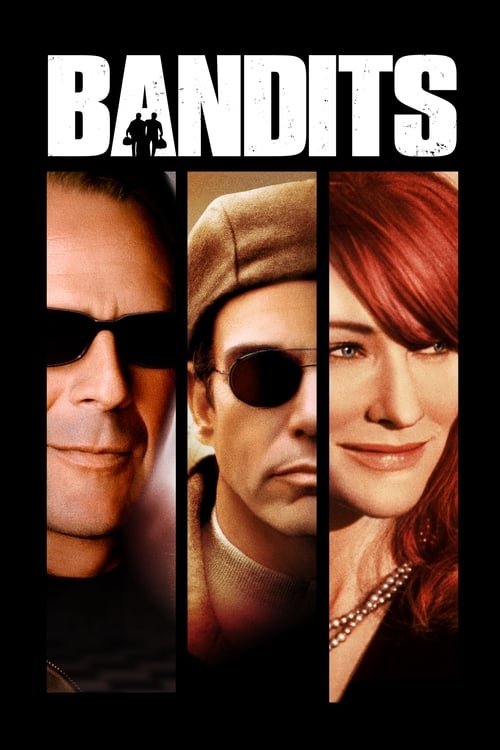
Bandits (2001)
Directed by Barry Levinson
No — Bandits is not woke, scoring 8 out of 100 on our wokeness meter.
Barry Levinson's Bandits arrives from 2001, a year when a studio caper could still concern itself chiefly with the logistics of robbing banks and the romantic entanglements of its stars.
Consciousness Markers
Cate Blanchett's Kate is a restless housewife who flees a failing marriage and asserts some agency, but she is largely defined by the love triangle and the men's rivalry over her.
The cast is led by three white stars (Willis, Thornton, Blanchett) with a predominantly white supporting ensemble; Troy Garity's mixed-race presence is incidental rather than a deliberate representation statement.
The framing device of a tabloid reality-TV show offers mild media satire, but the film never lectures the audience on social or political issues.
The protagonists rob banks, but purely for personal enrichment and a Mexican retirement fantasy, not as any ideological critique of wealth or capitalism.
Billy Bob Thornton's Terry is a hypochondriac with assorted phobias and quirks, but these are played strictly for comedy rather than as a neurodivergence theme.
No LGBTQ+ characters, relationships, or themes appear anywhere in the film.
The film engages no racial themes or commentary whatsoever; it is a white-led caper with no racial dimension.
There is no environmental or climate-related content in the film.
No body-positivity themes or messaging are present.
The film is a fictional contemporary caper with no historical subject matter to revise.
Why it received this score
Barry Levinson's Bandits arrives from 2001, a year when a studio caper could still concern itself chiefly with the logistics of robbing banks and the romantic entanglements of its stars. Bruce Willis and Billy Bob Thornton play Joe and Terry, escaped convicts who kidnap bank managers the night before a heist and spend the evening with their families. The gimmick earns them tabloid fame and a spot on the FBI's Ten Most Wanted list. Cate Blanchett's Kate collides with them, literally, and the film settles into a love triangle that consumes its second half. The cast is white and the concerns are personal. Troy Garity appears as the dim getaway driver, a mixed-race presence the film treats as scenery.
Kate is the closest thing to a progressive figure here. She abandons a failing marriage and asserts a measure of control over her circumstances. The screenplay, however, keeps her defined by the men who want her, and her eventual agency arrives as a plot twist instead of a thesis. Thornton's Terry suffers from a catalogue of phobias and imagined ailments, played for laughs at every turn. The robberies generate no argument about wealth or its distribution. Joe and Terry steal so they can retire in Mexico. That is the entire economic philosophy, and the film is content to leave it there.
The framing device, a lurid reality show called Criminals at Large, gestures at media satire without ever pressing a point. Levinson has assembled three performers of genuine charm and pointed them down a highway with no destination in mind. The result is agreeable, overlong, and untroubled by the questions a later decade would insist upon. It wants only to amuse, and mostly it does.
Analysis generated by our Consciousness Algorithm


Synopsis
After escaping from prison, Joe and Terry go on a crime spree, robbing banks through Oregon and California in order to finance their scheme for a new life south of the border. Unfortunately, things get more complicated when they meet Kate, who runs into them with her car. She joins the bandits on their cross-country spree, and eventually she steals something, too: their hearts.
Questions about Bandits
Is Bandits woke?
No — Bandits is not woke, scoring 8 out of 100 on our wokeness meter. That earns it a verdict of Ultra Based.
Does Bandits have any woke elements?
Very few. None of the 10 markers reaches 30, the level where a marker counts as present; the highest is Feminist Agenda at 18.
How does Bandits compare to other 2001 movies?
It ranks #64 of the 148 films from 2001 we've scored; their average is 12. The wokest is Monster's Ball (60).
How is the Woke Score calculated?
An AI-assisted process researches the film and its reception, scores it 0–100 on ten markers, then combines those into one 0–100 Woke Score. It measures a specific set of 2020s cultural themes, not film quality.