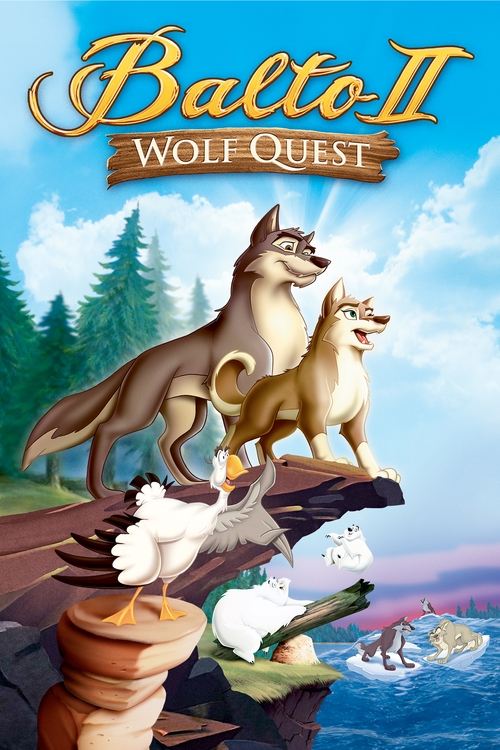
Balto: Wolf Quest (2002)
Directed by Phil Weinstein
No — Balto: Wolf Quest is not woke, scoring 7 out of 100 on our wokeness meter.
Balto II: Wolf Quest arrives as a direct-to-video continuation of a film that had already wrung a decent melodrama out of a real sled dog and a diphtheria outbreak.
Consciousness Markers
Muru's speech about lineage telling you what you are but not who you are, plus the recurring self-discovery moral, gives the film a mild didactic streak typical of children's animation.
Aleu, a female wolfdog, is the protagonist and ultimately becomes the pack leader foretold by prophecy, giving the film a mild female-empowerment arc, though it plays as a natural coming-of-age story rather than an agenda.
The film touches on Aleu's mixed wolfdog heritage and the shame of being a 'half-breed,' which can be read as a metaphor for mixed identity, but it is framed as species and self-discovery rather than racial commentary.
Aleu is passed over for adoption because her wolf-like appearance, and the film gently affirms accepting one's own nature, but this is identity-themed rather than a body-positivity message.
The voice cast is entirely white actors with no diverse or inclusive casting effort; the characters are animated animals with no human representation to speak of.
There is no LGBTQ+ content, subtext, or character in this direct-to-video animated sequel.
The caribou herd's migration is a plot device for the pack's survival, not a climate-change allegory; no environmental messaging is present.
Niju's desire to raid other animal clans is simple villainous selfishness, not a critique of capitalism or wealth.
Balto's prophetic dreams and spirit guides are mystical plot mechanics, not depictions of neurodivergence.
The film is a wholly fictional animal adventure with no historical revisionism.
Why it received this score
Balto II: Wolf Quest arrives as a direct-to-video continuation of a film that had already wrung a decent melodrama out of a real sled dog and a diphtheria outbreak. This installment, released in 2002 by Universal Cartoon Studios, sends the half-wolf Balto and his daughter Aleu into the Alaskan wild for a lesson in self-acceptance. The animation was outsourced to Taiwan and completed in roughly thirty-six weeks, and the screen shows it: flat backgrounds, stiff animal mouths, a general air of economy. Kevin Bacon, Bob Hoskins, Bridget Fonda and Phil Collins declined or were unavailable, so Maurice LaMarche, Charles Fleischer, Jodi Benson and Kevin Schon stepped in. Mark Hamill voices the villainous wolf Niju.
The story belongs to Aleu, a female wolfdog passed over at adoption because she looks too wild, then nearly shot by a hunter, then told the truth about her father's blood. She flees, and the film follows her toward a prophecy that a pack will be led by the one who is a wolf but does not know. That arc gives the picture a modest female-empowerment shape, though it functions as ordinary coming-of-age material. The mouse Muru appears to explain that lineage tells Aleu what she is but not who she is, which is the film's thesis delivered plainly and more than once. Aleu's mixed heritage carries a faint resonance for anyone reading it as a story about a half-breed finding worth in both halves, but the script keeps its sights on species and self, not social commentary.
This is a modest children's adventure with a heroine, a prophecy, and a moral about accepting your nature. The environmental angle is absent; the caribou migrate because the plot requires it, not because anyone is lecturing about the climate. Niju's scheme to raid neighboring animal clans is the greed of a stock villain, not an indictment of markets. The vocal cast is uniformly white, the animals are animated, and nothing here resembles a modern identity program. The film earned a Humanitas Prize for its script, an accurate label for something well-intentioned, gentle, and largely inert. It sits in the low teens on any honest scale of cultural messaging, a relic of an era when a children's sequel could aim no higher than teaching a wolfdog to like herself.
Analysis generated by our Consciousness Algorithm
Part of


Synopsis
Balto and his daughter Aleu embark on a journey of adventure and self discovery.
Questions about Balto: Wolf Quest
Is Balto: Wolf Quest woke?
No — Balto: Wolf Quest is not woke, scoring 7 out of 100 on our wokeness meter. That earns it a verdict of Ultra Based.
Does Balto: Wolf Quest have any woke elements?
Very few. None of the 10 markers reaches 30, the level where a marker counts as present; the highest is Lecture Energy at 20.
How does Balto: Wolf Quest compare to other 2002 movies?
It ranks #92 of the 150 films from 2002 we've scored; their average is 12. The wokest is Far from Heaven (78).
How is the Woke Score calculated?
An AI-assisted process researches the film and its reception, scores it 0–100 on ten markers, then combines those into one 0–100 Woke Score. It measures a specific set of 2020s cultural themes, not film quality.