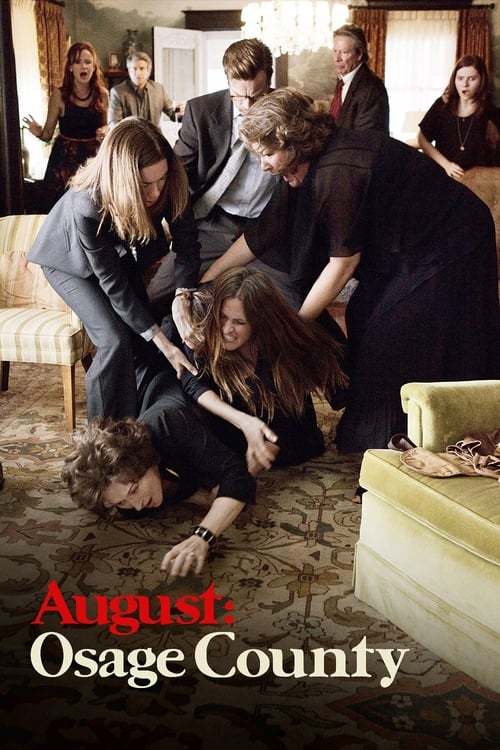
August: Osage County (2013)
Directed by John Wells
No — August: Osage County is not woke, scoring 10 out of 100 on our wokeness meter.
August: Osage County arrives with the weight of a Pulitzer-winning play and an ensemble cast that seems assembled by a celestial casting director.
Consciousness Markers
Includes a Native American character (Johnna) played by Misty Upham, but the role is organic to the source material and not framed as a diversity statement.
Centers on strong-willed daughters and a matriarch, but explores family dysfunction rather than a feminist agenda.
No LGBTQ+ characters or themes are present.
No exploration of racial issues or consciousness; the Native character is present but not used to comment on race.
No climate or environmental themes.
No anti-capitalist or eat-the-rich messaging.
No body positivity themes.
No neurodivergence themes; addiction and mental illness are depicted but not framed as neurodivergence.
No revisionist history elements.
A dark family drama that does not lecture on social issues.
Why it received this score
August: Osage County arrives with the weight of a Pulitzer-winning play and an ensemble cast that seems assembled by a celestial casting director. The film concerns the Weston family of rural Oklahoma, who gather after the patriarch's disappearance and subsequent drowning. What follows is a long, hot afternoon of pill-hoarding, truth-telling, and emotional shrapnel. The source material is a tragicomedy, though the comedy often struggles to breathe under the weight of so much thespian exertion. Meryl Streep's Violet is a matriarch who weaponizes honesty, and Julia Roberts's Barbara is the daughter who inherited the arsenal. The film is about family dysfunction, not social instruction. It does not lecture, it performs an autopsy.
On the representation front, the film includes Johnna, a Cheyenne caregiver played by Misty Upham. The role is organic to the play and functions as a quiet witness to the family's unraveling. The film does not frame her presence as a diversity statement, and no racial consciousness is explored. The women of the Weston family are strong-willed and sharp-tongued, but their conflicts are personal, not ideological. There is no feminist agenda on display, only a matriarch and her daughters locked in a cycle of inherited cruelty. The film has no interest in climate, capitalism, body positivity, neurodivergence, or revisionist history. It has no LGBTQ+ characters. It does not lecture on social issues. It is, instead, a dark family drama that earns its emotional force through performance and spite.
The result is a film that feels out of step with contemporary progressive sensibilities, not because it is reactionary, but because it is uninterested in them. It is a period piece in its own way, a chamber drama of addiction and resentment. The cast is excellent. The screenplay is faithful. The experience is exhausting in the way a family reunion can be exhausting. There is no sermon here, just a slow-motion collapse. For those keeping score, the cultural markers are sparse. The film exists in a pre-2015 register, which is to say it trusts its audience to endure discomfort without a moral appended. That is not nothing. It is also not very much.
Analysis generated by our Consciousness Algorithm


Synopsis
An intense look at the lives of the strong-willed daughters of the Weston family, whose paths have diverged until a family crisis brings them back to the Midwest house they grew up in, and to the dysfunctional mother who raised them.
Questions about August: Osage County
Is August: Osage County woke?
No — August: Osage County is not woke, scoring 10 out of 100 on our wokeness meter. That earns it a verdict of Ultra Based.
Does August: Osage County have any woke elements?
Very few. None of the 10 markers reaches 30, the level where a marker counts as present; the highest is Feminist Agenda at 20.
How does August: Osage County compare to other 2013 movies?
It ranks #120 of the 274 films from 2013 we've scored; their average is 14. The wokest is Belle (76).
How is the Woke Score calculated?
An AI-assisted process researches the film and its reception, scores it 0–100 on ten markers, then combines those into one 0–100 Woke Score. It measures a specific set of 2020s cultural themes, not film quality.