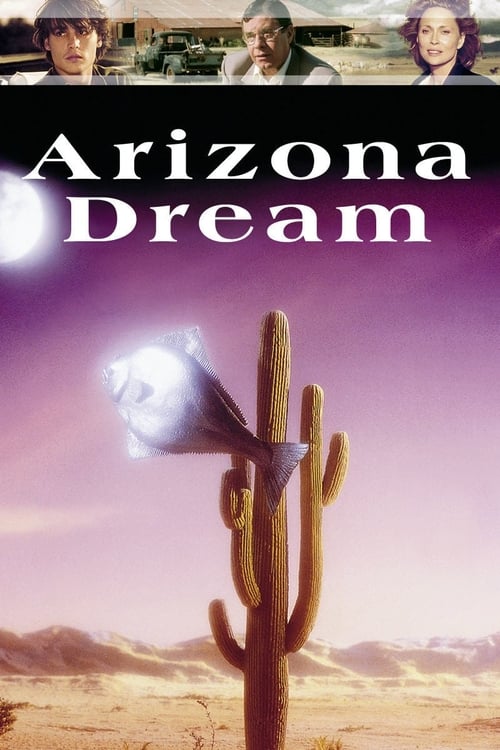
Arizona Dream (1993)
Directed by Emir Kusturica
No — Arizona Dream is not woke, scoring 6 out of 100 on our wokeness meter.
Emir Kusturica's Arizona Dream arrives from 1993, a year when a European director could still drop Johnny Depp into the Arizona desert and let him dream about an Inuit fisherman hauling a halibut out of the ice.
Consciousness Markers
The Cadillac dealership and the 'American Dream' keyword gesture at consumerist hollowness, but the film is too dreamlike and apolitical to mount a real eat-the-rich argument.
Elaine and Grace are vivid, eccentric women with their own obsessions (flight, reincarnation), but the film treats them as surrealist characters rather than vehicles for a feminist thesis.
The recurring Inuit/Eskimo dream framing and Inuktitut dialogue are deployed as magical-realist atmosphere, not as racial consciousness or commentary on Indigenous experience.
Kusturica's sensibility is lyrical and absurdist rather than didactic; the film never pauses to lecture the audience on social or political lessons.
The cast is overwhelmingly white European and American, with no meaningful ethnic diversity and no commentary on representation. Paulina Porizkova's presence is the only non-US principal, and it carries no representational intent.
There are no LGBTQ+ characters, relationships, or subtext anywhere in the film's romantic entanglements, which are strictly heterosexual.
Environmental themes are entirely absent; the flying machine and turtles are personal symbols, not ecological statements.
No body-positivity themes or messaging of any kind appear in the film.
The characters are quirky and unstable, but their eccentricity is presented as surrealist whimsy rather than neurodivergence to be affirmed or explored.
The film is a personal, dream-logic fable with no interest in revising or reframing historical narratives.
Why it received this score
Emir Kusturica's Arizona Dream arrives from 1993, a year when a European director could still drop Johnny Depp into the Arizona desert and let him dream about an Inuit fisherman hauling a halibut out of the ice. The plot, such as it is, involves a family Cadillac dealership, a trophy wedding, a woman building a flying machine, and a stepdaughter who wishes to be reincarnated as a turtle. The film drifts. It is meant to drift. Roger Ebert found it goofier than hell and could not look away, which remains the most accurate review on record.
The picture carries almost none of the social signifiers we are here to tally. Its romantic entanglements are entirely heterosexual. Its cast is uniformly white, European and American, with no representational ambition anywhere in the frame. Elaine and Grace are vivid, obsessive women, but the film cares about their obsessions, flight and reincarnation, not about any argument concerning women's place in the world. The Inuit dream sequences, conducted in Inuktitut, serve as magical-realist wallpaper. They evoke a culture without examining one. The Cadillac showroom and its American Dream keyword offer a faint whiff of consumerist critique, though the film is too enchanted with its own reverie to press the charge. There is no ecology here, no body politics, no neurodivergent affirmation, no historical revision, and no sermon. Kusturica never stops the movie to instruct us, which is its own small mercy.
What remains is a personal fable, lyrical and absurd, containing a shotgun, a piñata, a suicide, and a flying fish at the close. It is strange and sincere and entirely uninterested in the cultural ledger we keep. The eccentricity of these characters reads as surrealist whimsy, not as a condition to be affirmed or a thesis to be advanced. We are left with a dream about a fish, a Cadillac, and a man asleep on the roof of a dealership. The classification is straightforward. This is a pre-2015 humanist oddity, and it scores accordingly.
Analysis generated by our Consciousness Algorithm


Synopsis
Rebellious young Axel Blackmar gets caught up into the family car business when his cousin, Paul, coaxes him to come to Arizona to attend the wedding of their Uncle Leo. As Axel makes the decision to try selling Cadillacs with his family, he meets an eccentric woman named Elaine and her equally quirky stepdaughter, Grace. Their lives become inextricably intertwined through romance, dreams – and death.
Questions about Arizona Dream
Is Arizona Dream woke?
No — Arizona Dream is not woke, scoring 6 out of 100 on our wokeness meter. That earns it a verdict of Ultra Based.
Does Arizona Dream have any woke elements?
Very few. None of the 10 markers reaches 30, the level where a marker counts as present; the highest is Eat the Rich at 15.
How does Arizona Dream compare to other 1993 movies?
It ranks #48 of the 97 films from 1993 we've scored; their average is 11. The wokest is Bound by Honor (60).
How is the Woke Score calculated?
An AI-assisted process researches the film and its reception, scores it 0–100 on ten markers, then combines those into one 0–100 Woke Score. It measures a specific set of 2020s cultural themes, not film quality.