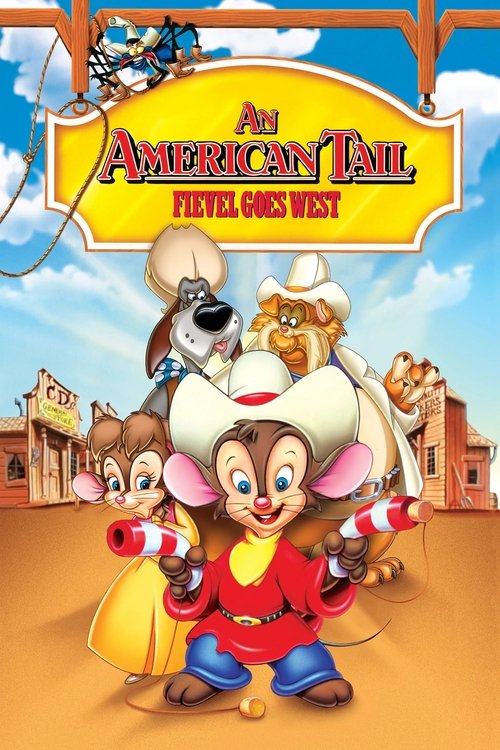
An American Tail: Fievel Goes West (1991)
Directed by Simon Wells
No — An American Tail: Fievel Goes West is not woke, scoring 6 out of 100 on our wokeness meter.
An American Tail: Fievel Goes West arrives as the 1991 sequel nobody demanded and the inaugural production of Amblimation, a studio assembled to keep the Roger Rabbit animators employed.
Consciousness Markers
The Mousekewitzes are Russian-Jewish immigrant mice and a Native American mouse tribe appears, but these are period-genre fixtures rather than modern inclusive casting; the voice cast is uniformly white.
Cat R. Waul is an aristocratic con artist who tricks the mice into building his saloon before eating them, a mild exploitation-of-labor villain scheme rather than an economic polemic.
Tanya pursues a singing career and Miss Kitty gets an arc, but both are framed through romance and showbiz convention rather than any feminist critique.
Immigrant and frontier-settlement themes exist, and a Native mouse tribe is depicted, but entirely as Western-genre set dressing with no racial commentary.
A lighthearted animated musical comedy that preaches nothing; any moral is the generic 'believe in yourself' variety.
No LGBTQ+ characters, themes, or subtext of any kind.
The dried-up river is a villain's sabotage plot device, not an environmental message.
No body-image or body-acceptance themes present.
No neurodivergent characters or themes.
The film parodies the Western genre but makes no revisionist historical claims.
Why it received this score
An American Tail: Fievel Goes West arrives as the 1991 sequel nobody demanded and the inaugural production of Amblimation, a studio assembled to keep the Roger Rabbit animators employed. It is hand-drawn, brisk, and cheerfully derivative, pitting a family of Russian-Jewish immigrant mice against an aristocratic con artist cat and his hench-spider. James Stewart recorded his final role here, as a dozing bloodhound sheriff, and the film opened against Beauty and the Beast on the same weekend, a contest history has settled without appeal.
The cultural inventory is modest. The Mousekewitzes carry their immigrant identity without much comment, and a tribe of Native mice appears in the desert, though the film uses them as Western set dressing and nothing further. The voice cast is uniformly white, so any inclusive gesture halts at the design stage. Tanya wants to sing and Miss Kitty receives a saloon-girl arc, but both are routed through romance and showbiz convention, with no critique of either institution offered. Cat R. Waul does trick the mice into building his saloon before planning to eat them, which amounts to a villain's scheme about exploited labor and little else.
The remaining ledger is blank. The dried river is sabotage, not an environmental alarm. Nobody wrestles with body image, nobody is neurodivergent, and the frontier is parodied instead of revised. The film preaches only the generic instruction to believe in yourself, and it does so without raising its voice. We are left with a brisk, well-animated diversion, culturally benign and almost aggressively unbothered by the century that followed it.
Analysis generated by our Consciousness Algorithm
Part of


Synopsis
Some time after the Mousekewitz's have settled in America, they find that they are still having problems with the threat of cats. That makes them eager to try another home out in the west, where they are promised that mice and cats live in peace. Unfortunately, the one making this claim is an oily con artist named Cat R. Waul who is intent on his own sinister plan.
Questions about An American Tail: Fievel Goes West
Is An American Tail: Fievel Goes West woke?
No — An American Tail: Fievel Goes West is not woke, scoring 6 out of 100 on our wokeness meter. That earns it a verdict of Ultra Based.
Does An American Tail: Fievel Goes West have any woke elements?
Very few. None of the 10 markers reaches 30, the level where a marker counts as present; the highest is Eat the Rich at 12.
How does An American Tail: Fievel Goes West compare to other 1991 movies?
It ranks #40 of the 68 films from 1991 we've scored; their average is 14. The wokest is Paris Is Burning (77).
How is the Woke Score calculated?
An AI-assisted process researches the film and its reception, scores it 0–100 on ten markers, then combines those into one 0–100 Woke Score. It measures a specific set of 2020s cultural themes, not film quality.