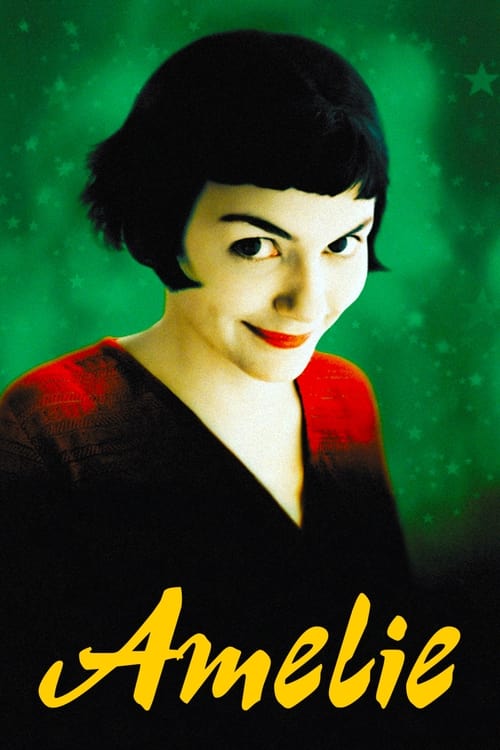
Amélie (2001)
Directed by Jean-Pierre Jeunet
No — Amélie is not woke, scoring 5 out of 100 on our wokeness meter.
Jean-Pierre Jeunet's Amélie arrives with a palette of greens and golds, a score of accordion waltzes, and a heroine who rearranges the lives of her Montmartre neighbors with the quiet determination of a filing clerk.
Consciousness Markers
Amélie is a female protagonist who engineers her own happiness and that of others, but the film frames this as whimsical romance rather than any feminist critique of gender roles or patriarchy.
The cast is overwhelmingly white French, and the film was explicitly criticized by Serge Kaganski for presenting a picturesque, minority-free vision of Paris; the presence of Jamel Debbouze (Moroccan descent) as Lucien is incidental rather than a deliberate diversity statement.
The greengrocer Collignon is a petty tyrant who abuses his meek assistant Lucien, and Amélie's pranks humble him, but this is a small comic subplot about personal cruelty rather than any systemic critique of wealth or capitalism.
Amélie is depicted as painfully shy, isolated, and possessed of an overactive imagination, and the ensemble is a gallery of eccentrics, but the film never frames any of this through a neurodivergence lens.
There are no LGBTQ+ characters, relationships, or themes anywhere in the film.
The film engages no racial themes whatsoever; its most notable racial discourse is external criticism that it erased minorities from its Parisian fantasy.
No environmental or climate themes appear in the film.
The film contains no body-positivity themes or messaging.
The film is a contemporary fictional romance with no historical revisionism.
Amélie is a whimsical, lighthearted fable that charms rather than preaches; it contains no didactic messaging.
Why it received this score
Jean-Pierre Jeunet's Amélie arrives with a palette of greens and golds, a score of accordion waltzes, and a heroine who rearranges the lives of her Montmartre neighbors with the quiet determination of a filing clerk. It is a lovely thing to watch. Audrey Tautou's Amélie is shy, isolated, and possessed of an imagination that runs well ahead of her courage, and the film follows her small campaigns of kindness with real tenderness. The ensemble is a cabinet of eccentrics: a hypochondriac, a reclusive painter, a young man who photographs strangers in passport booths. Charm, in this case, is not a crime.
The trouble, such as it is, lies in what the film declines to notice. Serge Kaganski observed at the time that this Paris is a postcard with the demographics airbrushed out, and the defense that Jamel Debbouze appears as Lucien does not quite answer the charge. He is present, and the film does nothing with him. Amélie's gender is likewise a fact instead of an argument. She is a woman who engineers her own happiness, and the film treats this as romance, not as a case to be made. The greengrocer Collignon receives a comeuppance for his cruelty to his meek assistant, which is a small comic pleasure and not an indictment of commerce.
There is no queer presence here, no environmental conscience, no reckoning with history, and no sermon. The eccentrics of the Café des 2 Moulins are never diagnosed, and Amélie's shyness is a temperament, not a condition. This is a fable that wants only to be liked, and it succeeds. For those of us who spend our evenings cataloguing the ideological freight of popular cinema, the film offers a strange kind of relief: a text with almost nothing to say and a great deal of pleasure in saying it. We score it accordingly. Some vintages are light, and light is not the same as empty.
Analysis generated by our Consciousness Algorithm


Synopsis
At a tiny Parisian café, the adorable yet painfully shy Amélie accidentally discovers a gift for helping others. Soon Amelie is spending her days as a matchmaker, guardian angel, and all-around do-gooder. But when she bumps into a handsome stranger, will she find the courage to become the star of her very own love story?
Questions about Amélie
Is Amélie woke?
No — Amélie is not woke, scoring 5 out of 100 on our wokeness meter. That earns it a verdict of Ultra Based.
Does Amélie have any woke elements?
Very few. None of the 10 markers reaches 30, the level where a marker counts as present; the highest is Feminist Agenda at 12.
How does Amélie compare to other 2001 movies?
It ranks #101 of the 148 films from 2001 we've scored; their average is 12. The wokest is Monster's Ball (60).
How is the Woke Score calculated?
An AI-assisted process researches the film and its reception, scores it 0–100 on ten markers, then combines those into one 0–100 Woke Score. It measures a specific set of 2020s cultural themes, not film quality.