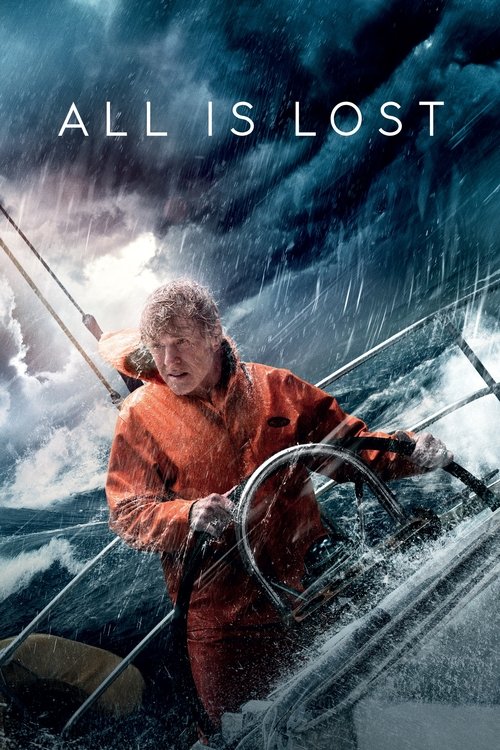
All Is Lost (2013)
Directed by J.C. Chandor
No — All Is Lost is not woke, scoring 0 out of 100 on our wokeness meter.
All Is Lost runs eighty-five minutes, employs one actor, and speaks fifty-one words.
Consciousness Markers
The sole cast member is Robert Redford, an older white man; there is no ensemble and no diversity casting of any kind.
No LGBTQ+ characters, themes, or subtext appear in this solitary survival narrative.
The film has no female characters and no engagement with feminist themes whatsoever.
There is no racial commentary or consciousness; the film is a wordless man-versus-nature struggle.
The storm and shipping container are plot devices for survival, not vehicles for climate messaging or environmental advocacy.
The stray shipping container could be read as a stray metaphor for global commerce, but the film makes no such argument and offers no anti-capitalist critique.
No body-positivity themes; the film is concerned with physical survival, not body image or acceptance.
No neurodivergent characters or themes are present.
The film is a fictional survival story with no historical revisionism.
With only 51 spoken words and no dialogue, the film has no capacity for lecturing or moralizing of any kind.
Why it received this score
All Is Lost runs eighty-five minutes, employs one actor, and speaks fifty-one words. Robert Redford plays a nameless mariner whose sloop is opened by a drifting shipping container somewhere in the Indian Ocean. He patches the hull, pumps the bilge, climbs the mast, gets thrown overboard, loses the mast anyway, and trades the foundering boat for a life raft and a shrinking supply of fresh water. The screenplay offers no name, no family, no past. There is weather, competence, and the slow arithmetic of survival.
The usual apparatus of contemporary social concern is absent here, and the absence is total. There is no ensemble to diversify and no woman to consult. No community, no argument about who deserves what. The ocean holds no positions. When a container tumbles off a cargo ship, a viewer could read the moment as a comment on global commerce, but the film declines to make that comment. It requires a hole in a hull, and a container is a tidy way to make one. Anyone arriving in search of a sermon will leave hungry, and the film will not apologize for the empty plate.
This is not a deficiency. It is a classification. The politics of the film are the politics of rope and bucket, and its moral instruction extends no further than the observation that a man who fails to reef his sails in time will regret it. A film with fifty-one spoken words has no capacity for lecturing, which may be its quietest virtue. What remains is craft: Alex Ebert's score, the sound design, and the spectacle of a man in his late seventies performing his own water stunts. The vintage is austere. We taste salt, canvas, and mortality. We do not taste the decade that made it.
Analysis generated by our Consciousness Algorithm
Part of


Synopsis
During a solo voyage in the Indian Ocean, a veteran mariner awakes to find his vessel taking on water after a collision with a stray shipping container. With his radio and navigation equipment disabled, he sails unknowingly into a violent storm and barely escapes with his life. With any luck, the ocean currents may carry him into a shipping lane -- but, with supplies dwindling and the sharks circling, the sailor is forced to face his own mortality.
Questions about All Is Lost
Is All Is Lost woke?
No — All Is Lost is not woke, scoring 0 out of 100 on our wokeness meter. That earns it a verdict of Ultra Based.
Does All Is Lost have any woke elements?
No. All 10 markers score zero.
How does All Is Lost compare to other 2013 movies?
It ranks #249 of the 274 films from 2013 we've scored; their average is 14. The wokest is Belle (76).
How is the Woke Score calculated?
An AI-assisted process researches the film and its reception, scores it 0–100 on ten markers, then combines those into one 0–100 Woke Score. It measures a specific set of 2020s cultural themes, not film quality.