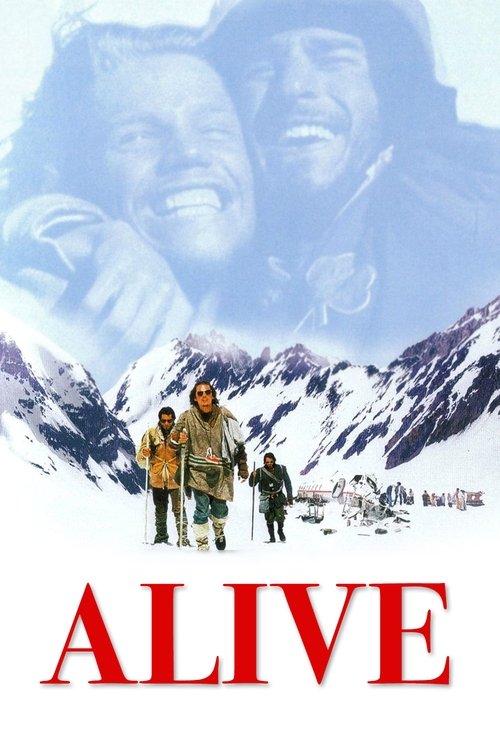
Alive (1993)
Directed by Frank Marshall
No — Alive is not woke, scoring 0 out of 100 on our wokeness meter.
Alive arrives from 1993, a Hollywood studio retelling of the 1972 Andes crash, shot in English with a cast of American and Canadian actors playing Uruguayan rugby players.
Consciousness Markers
The Uruguayan rugby team is portrayed by a uniformly white, English-speaking cast of American and Canadian actors; the film makes no gesture toward diverse or inclusive casting.
No LGBTQ+ characters, themes, or subtext appear anywhere in the film.
Women appear only as mothers, sisters, and wives who perish early; the narrative is entirely a story of male survival and camaraderie with no feminist framing.
The film engages no racial themes whatsoever; the story is a culturally homogeneous account of Uruguayan survivors.
The Andes setting is a survival obstacle, not an environmentalist statement; no climate messaging is present.
No economic critique or class commentary; the film is a straightforward survival drama.
The opposite of body positivity is at play — Roger Ebert criticized the actors for looking too healthy after two months of near-starvation, and the film treats emaciation as horror, not affirmation.
No neurodivergent characters or themes are depicted.
The film is a faithful, technically advised retelling of the 1972 crash (survivor Nando Parrado served as consultant); it revises nothing for ideological purposes.
The film offers no moralizing sermon; critics noted it downplays the sociological and ethical debates in favor of action and a vague religiosity rather than preaching.
Why it received this score
Alive arrives from 1993, a Hollywood studio retelling of the 1972 Andes crash, shot in English with a cast of American and Canadian actors playing Uruguayan rugby players. Frank Marshall's film shows no interest in interrogating that substitution. The faces are white, the accents are Californian, and the movie proceeds as though the Andes were merely a cold place where North Americans happened to fall out of the sky. Nando Parrado served as technical advisor, which lends the production an air of fidelity it deploys sparingly.
The film's treatment of women is instructive. They are mothers, sisters, and wives, and they die in the first act to make room for male endurance. Illeana Douglas's Liliana suffocates under an avalanche, and the camera mourns her for a moment before returning to the men and their deliberations. The cannibalism, the central ethical crisis, gets a brief debate and a fade to the decision. A Newsweek critic complained that the sociological texture of the book had been traded for action and a vague religiosity. That is a fair read. The film is not preachy. It is not political. It is a survival picture with a cross on a pile of stones at the end.
Roger Ebert noted that the actors looked too healthy for men who had starved for two months, a body image problem running opposite to anything the culture would later litigate. Emaciation here is horror, not affirmation. There is no racial argument, no economic critique, no environmental sermon, no queer subtext, no neurodivergent interiority. It is a 1993 studio product about white men eating the dead in order to live, and it tells that story with competence and a straight face. We classify it accordingly. Zero across the board, and no notes for the projectionist.
{"thematic_tags": ["true_story", "book_adaptation"]}
Analysis generated by our Consciousness Algorithm
Part of


Synopsis
The amazing true story of a Uruguayan rugby team's plane that crashed in the middle of the Andes mountains, and their immense will to survive and pull through alive, forced to do anything and everything they could to stay alive on meager rations and through the freezing cold.
Questions about Alive
Is Alive woke?
No — Alive is not woke, scoring 0 out of 100 on our wokeness meter. That earns it a verdict of Ultra Based.
Does Alive have any woke elements?
No. All 10 markers score zero.
How does Alive compare to other 1993 movies?
It ranks #76 of the 97 films from 1993 we've scored; their average is 11. The wokest is Bound by Honor (60).
How is the Woke Score calculated?
An AI-assisted process researches the film and its reception, scores it 0–100 on ten markers, then combines those into one 0–100 Woke Score. It measures a specific set of 2020s cultural themes, not film quality.