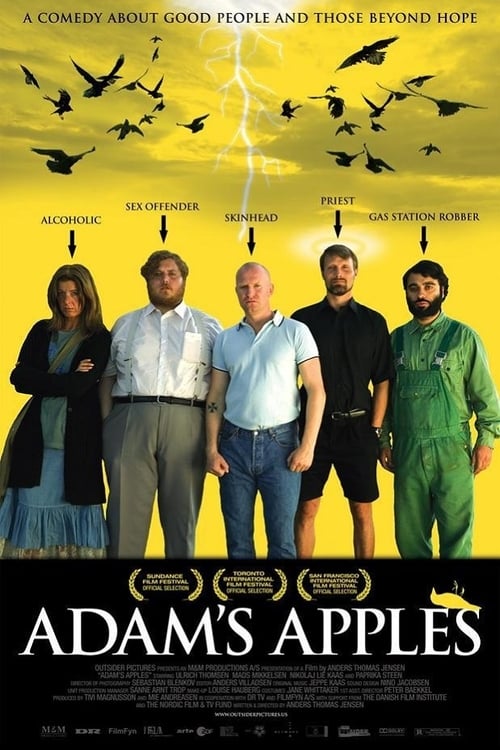
Adam's Apples (2005)
Directed by Anders Thomas Jensen
No — Adam's Apples is not woke, scoring 9 out of 100 on our wokeness meter.
Adam's Apples arrives from 2005 Denmark, which is to say from a time before the current cultural accounting.
Consciousness Markers
The film centers on a neo-Nazi protagonist and includes a Middle Eastern character, so racial friction is present as a plot element, but it is treated as a moral/redemptive allegory rather than modern racial-justice consciousness.
The cast is predominantly Danish and white, with Ali Kazim as Khalid, a Saudi robber — a role that is more ethnic stereotype than self-conscious inclusive casting. No deliberate representation agenda is evident.
The film engages faith and theodicy as a dark comic allegory rather than delivering a social-justice sermon; its moralizing is theological, not activist.
No LGBTQ+ characters or themes appear anywhere in the film.
Paprika Steen's Sarah is a functional supporting character; the film advances no feminist argument or gendered critique.
No environmental or climate themes are present.
No economic critique or anti-capitalist messaging appears; the film's concerns are theological and moral.
No body-positivity themes or messaging are present.
Ivan's severely disabled child is a plot device for his suffering, not a neurodivergence-affirming element.
The film is a contemporary allegory of the Book of Job, not a revisionist retelling of historical events.
Why it received this score
Adam's Apples arrives from 2005 Denmark, which is to say from a time before the current cultural accounting. Anders Thomas Jensen has built a black comedy on the Book of Job: a neo-Nazi named Adam (Ulrich Thomsen) is paroled into a parish rehabilitation program run by Ivan (Mads Mikkelsen), a priest whose optimism borders on the pathological. Adam is assigned to bake an apple pie. The tree is beset by crows, then worms. God, or something, keeps interfering.
The film's engine is theological. Ivan has terminal brain cancer, a dead wife, a severely disabled child, and a childhood of abuse. The village doctor suggests he reframes catastrophe as demonic testing because the plain facts would be unbearable. Adam weaponizes Job against him and the priest's faith collapses. This is moral argument of an old kind, conducted in scripture and suffering. It is not a social program. There is no gender critique here, no environmental conscience, no economic grievance. The church is not a symbol of anything except the church. Sarah is a supporting player with a drinking problem and no thesis attached to her.
Racial friction exists, certainly. The protagonist is a neo-Nazi, and his fellow parolee Khalid (Ali Kazim) is a Saudi gas station robber drawn in broad, unflattering strokes. That tension serves the redemption plot, not any contemporary racial-justice framework. The cast is Danish and white, and no inclusive-casting logic governs it. What moralizing the film offers concerns faith and the problem of evil, delivered through crows, worms, and a single surviving apple. It asks whether a man can believe in goodness after the evidence has been stacked against him. That question is ancient, and the film treats it as ancient. The epilogue, in which Adam stays on as Ivan's assistant and two more ex-convicts arrive at the door, closes the circle on mercy, not on politics.
Analysis generated by our Consciousness Algorithm


Synopsis
A neo-nazi sentenced to community service at a church clashes with the blindly devotional priest.
Questions about Adam's Apples
Is Adam's Apples woke?
No — Adam's Apples is not woke, scoring 9 out of 100 on our wokeness meter. That earns it a verdict of Ultra Based.
Does Adam's Apples have any woke elements?
Very few. None of the 10 markers reaches 30, the level where a marker counts as present; the highest is Racial Consciousness at 20.
How does Adam's Apples compare to other 2005 movies?
It ranks #83 of the 181 films from 2005 we've scored; their average is 13. The wokest is The Constant Gardener (72).
How is the Woke Score calculated?
An AI-assisted process researches the film and its reception, scores it 0–100 on ten markers, then combines those into one 0–100 Woke Score. It measures a specific set of 2020s cultural themes, not film quality.