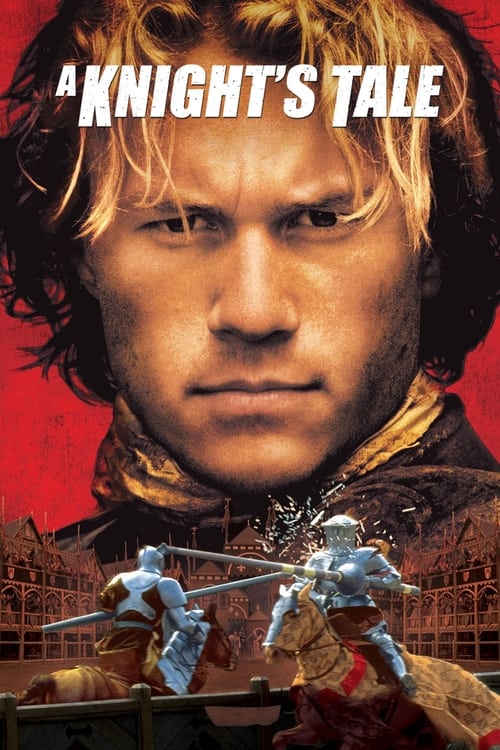
A Knight's Tale (2001)
Directed by Brian Helgeland
No — A Knight's Tale is not woke, scoring 8 out of 100 on our wokeness meter.
A Knight's Tale arrives from 2001 with its classic rock needle drops and its peasant squire who would be a knight, and it means no harm to anyone.
Consciousness Markers
Kate the female blacksmith is a mild gender-nonconformity note, and Jocelyn has a moment of agency in demanding William lose on her behalf, but the film is fundamentally a male hero's romance-driven quest.
The plot hinges on class barriers—a peasant barred from tournaments who 'changes his stars'—but it celebrates individual meritocratic ascent rather than critiquing wealth or capitalism.
The film is deliberately anachronistic with modern rock music and attitudes, but this is stylistic playfulness rather than an ideological rewriting of history.
The cast is almost entirely white European, with no meaningful racial diversity; the medieval setting is populated by conventional period-appropriate faces.
The film is a crowd-pleasing underdog story that wears its 'honor' and 'change your stars' themes lightly, with no preachy sermonizing.
There are no LGBTQ+ characters, themes, or subtext anywhere in the film.
Race is never addressed or thematized; the film has no racial consciousness whatsoever.
No environmental or climate themes appear in the film.
No body-positivity themes or messaging are present.
No neurodivergent characters or themes are depicted.
Why it received this score
A Knight's Tale arrives from 2001 with its classic rock needle drops and its peasant squire who would be a knight, and it means no harm to anyone. Heath Ledger plays William Thatcher, a thatcher's son who dons a dead man's armor and talks his way onto the jousting circuit on the strength of a forged patent and Paul Bettany's motormouthed Chaucer. The whole enterprise is a Rocky picture on horseback, as the critics of the day observed, and it is content to be exactly that.
The social consciousness on display is modest and mostly decorative. The cast is uniformly white and European, a medieval pageant with no interest in disturbing its own tableau. Kate the blacksmith offers a flicker of gender nonconformity before the plot remembers it needs her to repair armor and teach the hero to dance. Jocelyn, the noblewoman, is granted one genuine assertion of will when she demands William lose a match on her behalf, though the romance remains a prize draped over a man's quest. The class friction is real enough on its surface: a peasant barred from the lists, forbidden from changing his stars. Yet the film resolves this tension through individual ascent and royal dispensation, not any reckoning with the order that kept him out. Prince Edward simply rewrites the man's bloodline and the matter is settled.
Where the film does reach for something modern, it is in its deliberate anachronism, the funk and the classic rock and the knowing winks, which is playfulness and not argument. It never lectures. The themes of honor and destiny are worn as lightly as the armor, which the production built from resin so nobody would get hurt. The picture wants only to entertain, and on that modest contract it delivers.
Analysis generated by our Consciousness Algorithm


Synopsis
William Thatcher, a knight's peasant apprentice, gets a chance at glory when the knight dies suddenly mid-tournament. Posing as a knight himself, William won't stop until he's crowned tournament champion—assuming matters of the heart don't get in the way.
Questions about A Knight's Tale
Is A Knight's Tale woke?
No — A Knight's Tale is not woke, scoring 8 out of 100 on our wokeness meter. That earns it a verdict of Ultra Based.
Does A Knight's Tale have any woke elements?
Very few. None of the 10 markers reaches 30, the level where a marker counts as present; the highest is Eat the Rich at 15.
How does A Knight's Tale compare to other 2001 movies?
It ranks #64 of the 148 films from 2001 we've scored; their average is 12. The wokest is Monster's Ball (60).
How is the Woke Score calculated?
An AI-assisted process researches the film and its reception, scores it 0–100 on ten markers, then combines those into one 0–100 Woke Score. It measures a specific set of 2020s cultural themes, not film quality.