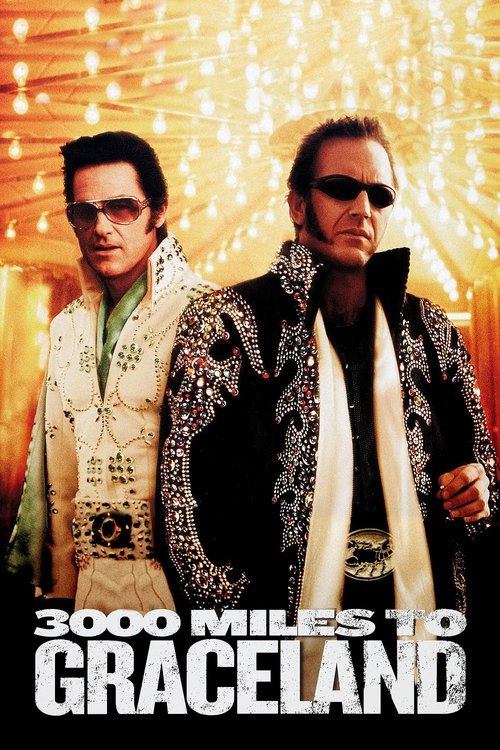
3000 Miles to Graceland (2001)
Directed by Demian Lichtenstein
No — 3000 Miles to Graceland is not woke, scoring 5 out of 100 on our wokeness meter.
3000 Miles to Graceland arrives from 2001 as a heist picture dressed in sequined Elvis jumpsuits, a premise that promises far more wit than the finished product can deliver.
Consciousness Markers
Standard early-2000s ensemble casting; the cast is predominantly white men with a single Black supporting actor (Bokeem Woodbine) and one prominent female lead, cast without any diversity-conscious framing.
Courteney Cox's Cybil is a scheming, self-interested single mother and thief, but the film has no feminist thesis — she is a genre archetype, not a statement.
Theft of casino money is pure genre greed, not a critique of capitalism or class; the film celebrates the score rather than condemning the system.
No engagement with race or racial politics; the story is a straightforward heist/betrayal narrative.
A pulpy, violent heist movie with no didactic tendencies — it has nothing to lecture the audience about politically.
No LGBTQ+ characters, themes, or subtext whatsoever.
No environmental or climate content of any kind.
No body-positivity themes or messaging present.
No depiction or discussion of neurodivergence.
No historical revisionism; the film is a contemporary (for 2001) fictional crime story.
Why it received this score
3000 Miles to Graceland arrives from 2001 as a heist picture dressed in sequined Elvis jumpsuits, a premise that promises far more wit than the finished product can deliver. Kurt Russell and Kevin Costner lead a crew of impersonators who rob a Las Vegas casino, then turn on each other with the enthusiasm of men who have seen too many crime films and learned the wrong lessons. The result was a box-office bomb and a critical punching bag, nominated for a fistful of Razzies. Its cultural politics are not complicated. They are absent.
The cast is a standard early-2000s assemblage: white men in varying states of menace, one Black supporting player in Bokeem Woodbine, and Courteney Cox as Cybil, a single mother and thief whose scheming is purely generic. There is no LGBTQ content, no climate concern, no body-positivity message, no engagement with neurodivergence, and no revisionist history. Race is not a subject. Cybil's behavior might be read as feminist by a very generous viewer, but the film offers no thesis beyond survival and larceny. The theft of casino money is greed as genre mechanics, not a critique of capital. The movie enjoys the score too much to condemn the system that produced it.
Lecture energy is minimal. This is a mean, violent, occasionally silly crime film with nothing to teach us about society. It does not sermonize. It does not scold. It simply shoots, betrays, and drives off into the desert. That absence of moral instruction is not a virtue. It is a reminder that some films exist entirely outside the contemporary conversation, content to be nasty for their own sake. As a document of social consciousness, it is a void. As a heist movie, it is a tedious one. The Elvis impersonators remain the most politically engaged characters, and they are only engaged in robbery.
Analysis generated by our Consciousness Algorithm


Synopsis
It was an ingenious enough plan: rob the Riviera Casino's count room during an Elvis impersonator convention. But Thomas Murphy decided to keep all the money for himself and shot all his partners, including recently-freed ex-con Michael Zane. With $3.2 million at stake, the Marshals Service closing in, Michael must track down Murphy.
Questions about 3000 Miles to Graceland
Is 3000 Miles to Graceland woke?
No — 3000 Miles to Graceland is not woke, scoring 5 out of 100 on our wokeness meter. That earns it a verdict of Ultra Based.
Does 3000 Miles to Graceland have any woke elements?
Very few. None of the 10 markers reaches 30, the level where a marker counts as present; the highest is Representation Casting at 15.
How does 3000 Miles to Graceland compare to other 2001 movies?
It ranks #101 of the 148 films from 2001 we've scored; their average is 12. The wokest is Monster's Ball (60).
How is the Woke Score calculated?
An AI-assisted process researches the film and its reception, scores it 0–100 on ten markers, then combines those into one 0–100 Woke Score. It measures a specific set of 2020s cultural themes, not film quality.