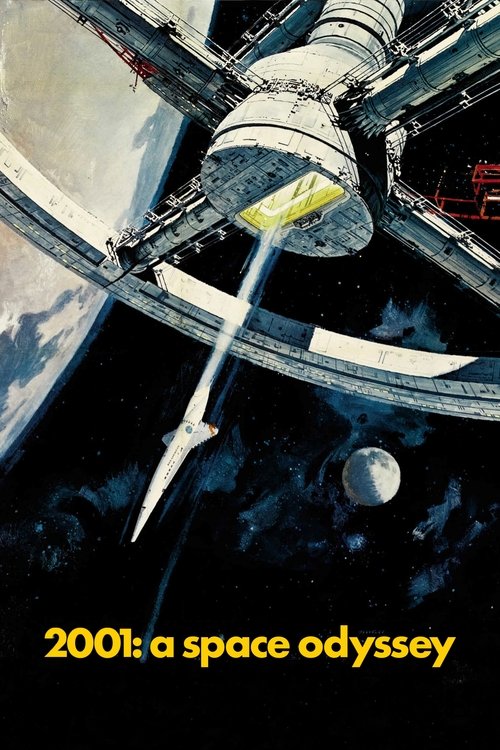
2001: A Space Odyssey (1968)
Directed by Stanley Kubrick
No · Ultra Based
How we score movies →Consciousness Markers
While the film is genuinely artistic and not preachy, its extended sequences of technical exposition and philosophical monologue carry a professorial tone. The Star Child sequence ventures into almost mystical lecture territory, though this is offset by Kubrick's commitment to visual storytelling.
The cast is overwhelmingly white and male. Female characters appear as stewardesses and support staff with minimal agency or dialogue. No meaningful representation of racial or gender diversity in the space program.
Women serve functional roles in support positions but have no agency in the narrative. The few female characters exist to facilitate the male astronauts' mission and are not developed as autonomous beings with their own goals.
The film makes no acknowledgment of race or racial issues. The cast is entirely white, and there is no commentary on or awareness of racial dynamics, despite the film being made during the Civil Rights era.
No LGBTQ+ themes, characters, or subtext present. The film is entirely heteronormative and contains no indication of any non-heterosexual relationships or identities.
No climate-related themes or environmental consciousness appears in the film. The narrative focuses on space exploration and existential philosophy without any concern for environmental impact or sustainability.
The film presents no critique of capitalism or wealth inequality. The space program is treated as a neutral technical endeavor rather than a product of capitalist competition or military-industrial interests.
The film contains no body positivity messaging or representation of diverse body types. All astronauts are conventionally fit, and there is no commentary on or acceptance of bodily difference.
No representation of neurodivergent characters or themes. The film's characters are all neurotypical, and there is no exploration of neurodiversity or disability.
The film does not reframe or reinterpret historical events. Its vision of the future is presented as a straightforward extrapolation of technological progress.


Synopsis
Humanity finds a mysterious object buried beneath the lunar surface and sets off to find its origins with the help of HAL 9000, the world's most advanced super computer.
Why it received this score
Stanley Kubrick's 1968 masterwork remains a towering achievement in science fiction cinema, though its social consciousness registers as virtually dormant by contemporary standards. The film presents a vision of the future populated almost exclusively by white male astronauts and scientists, with women relegated to ancillary roles as stewardesses and mission controllers who exist primarily to serve the narrative needs of the male protagonists. Even HAL 9000, the film's most compelling character, is voiced by a man and coded as masculine throughout, leaving no space for female technological agency in this imagined future.
The film's philosophical ambitions are entirely metaphysical rather than sociopolitical. Kubrick concerns himself with the nature of consciousness, evolution, and humanity's place in the cosmos, not with the inequities of the systems that produced the space program. There is no interrogation of the military-industrial complex that funded the space race, no critique of capitalist competition between superpowers, no acknowledgment of the civil rights upheaval occurring in 1968 America. The film's universe is one of pure technical rationality and cosmic transcendence, hermetically sealed against the messier realities of its historical moment.
What we encounter is a film of staggering artistic vision that simply exists outside the framework of modern progressive sensibilities. It was made before the cultural markers we now associate with social consciousness became part of mainstream discourse, and it makes no pretense of engaging with them. To score it as anything other than minimal on these metrics would be to misapply contemporary standards to a work that was never designed to address them.
Analysis generated by our Consciousness Algorithm
Critic Reviews
“This is the way this ground-breaking monument was meant to be seen: in mind-boggling 70mm.”
“Its special effects are used so seamlessly as part of an overall artistic strategy that, as critic Annette Michelson has pointed out, they don't even register as such, and thus are almost impossible to trivialize, a feat unmatched in movies.”
“Only a few films are transcendent, and work upon our minds and imaginations like music or prayer or a vast belittling landscape...Alone among science-fiction movies, 2001 is not concerned with thrilling us, but with inspiring our awe.”
“A crackpot Looney Tune, pretentious, abysmally slow, amateurishly acted and, above all, wrong.”