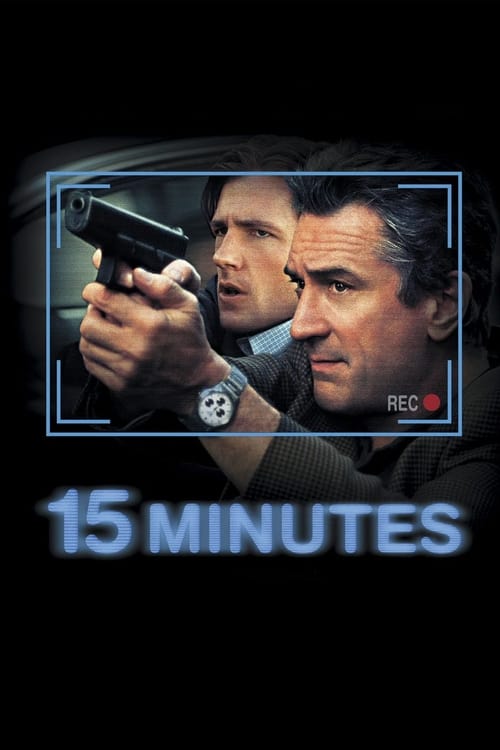
15 Minutes (2001)
Directed by John Herzfeld
No — 15 Minutes is not woke, scoring 14 out of 100 on our wokeness meter.
John Herzfeld's 15 Minutes arrives from 2001, a period when the culture still believed a motion picture could scold television and be thanked for it.
Consciousness Markers
Critics widely noted the satire of media sensationalism is 'too heavy-handed,' with the film repeatedly hammering its thesis about fame, violence, and tabloid culture directly at the audience.
The film satirizes the commercialization of violence — tabloid TV paying $1 million for a snuff tape and killers monetizing their crimes — which reads as a critique of media capitalism, though it targets sensationalism rather than class or wealth itself.
The cast includes Black actors (Avery Brooks as a police captain) and Eastern European performers (Karel Roden, Oleg Taktarov) in prominent roles, but their presence serves the plot rather than any representational agenda.
Nicolette is a working tabloid reporter with some professional agency, but she functions largely as a girlfriend and eventual hostage; there is no feminist argument or critique of patriarchy.
No LGBTQ+ characters, themes, or subtext appear anywhere in the film.
Immigrant status (Czech and Eastern European characters) drives the plot but is never framed through a lens of racial or systemic consciousness.
No environmental or climate themes of any kind.
No body-positivity themes or messaging present.
Emil's insanity plea is a cynical legal stratagem, not a depiction of genuine neurodivergence or mental-health advocacy.
The film is a contemporary fictional crime thriller with no historical re-framing.
Why it received this score
John Herzfeld's 15 Minutes arrives from 2001, a period when the culture still believed a motion picture could scold television and be thanked for it. Robert De Niro plays a celebrity homicide detective trailed by a tabloid crew, Edward Burns plays the fire marshal assigned to the same arson, and two Czech ex-convicts roam New York filming their own murders in the hope of selling the footage. The Warhol joke is stretched to feature length and then explained to us at length, in case the stretch was too subtle.
The film's real quarry is the marketplace for carnage. A tabloid program pays one million dollars for a videotape of a man being suffocated, and the killers treat their body count as a retirement plan. This is a critique of media capitalism aimed at sensation and ratings instead of class or wealth, which keeps the sermon narrow. It also keeps the sermon loud. Critics at the time found the satire heavy-handed, and they were correct. The movie repeats its point about fame and violence until the audience has no room to disagree and no reason to care.
On the representational front, Avery Brooks appears as a police captain and the killers are played by Eastern European actors, all of them functional pieces of the plot. Immigrant status drives the machinery without ever becoming a subject of racial or systemic reflection. Melina Kanakaredes gives the reporter Nicolette a job, a notebook, and eventually a gun to her head; the film has no argument about gender to make. The insanity plea is a legal stratagem, not a study of mental illness. There is no environmental concern, no body politics, no historical revision, and no queer presence of any kind. That leaves a brisk, ugly thriller which mistakes volume for insight, a vintage we can catalog and set back on the shelf.
Analysis generated by our Consciousness Algorithm


Synopsis
When Eastern European criminals Oleg and Emil come to New York City to pick up their share of a heist score, Oleg steals a video camera and starts filming their activities, both legal and illegal. When they learn how the American media circus can make a remorseless killer look like the victim and make them rich, they target media-savvy NYPD Homicide Detective Eddie Flemming and media-naive FDNY Fire Marshal Jordy Warsaw, the cops investigating their murder and torching of their former criminal partner, filming everything to sell to the local tabloid TV show "Top Story."
Questions about 15 Minutes
Is 15 Minutes woke?
No — 15 Minutes is not woke, scoring 14 out of 100 on our wokeness meter. That earns it a verdict of Ultra Based.
Does 15 Minutes have any woke elements?
1 of the 10 markers register at 30 or above, led by Lecture Energy (35). On Lecture Energy: Critics widely noted the satire of media sensationalism is 'too heavy-handed,' with the film repeatedly hammering its thesis about fame, violence, and tabloid culture directly at the audience.
How does 15 Minutes compare to other 2001 movies?
It ranks #44 of the 148 films from 2001 we've scored; their average is 12. The wokest is Monster's Ball (60).
How is the Woke Score calculated?
An AI-assisted process researches the film and its reception, scores it 0–100 on ten markers, then combines those into one 0–100 Woke Score. It measures a specific set of 2020s cultural themes, not film quality.