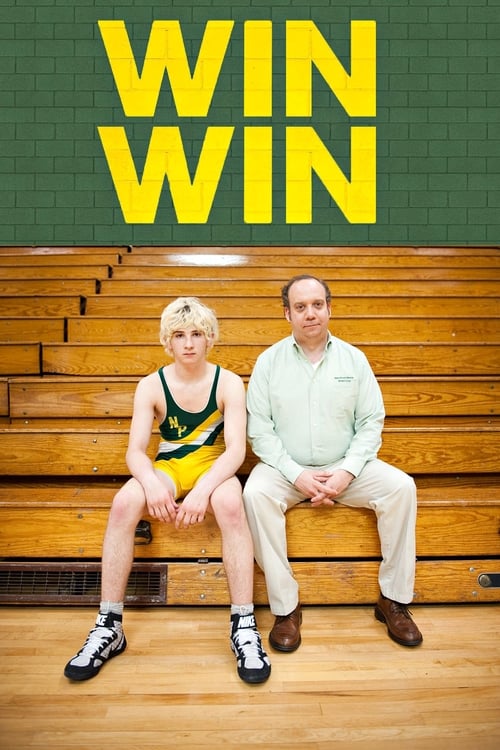
Win Win (2011)
Directed by Tom McCarthy
No — Win Win is not woke, scoring 2 out of 100 on our wokeness meter.
Tom McCarthy's Win Win arrives from 2011, a year in which a struggling New Jersey attorney could commit a modest act of guardianship fraud and the culture would treat it as a character flaw instead of a policy failure.
Consciousness Markers
The cast is almost entirely white with no effort toward diverse or inclusive representation. There is no commentary on casting or representation.
No LGBTQ+ characters, themes, or subtext appear in the film.
While Amy Ryan's character is a strong moral presence, the film does not advance a feminist agenda or explicitly critique patriarchy.
The story is set in a white New Jersey suburb and does not engage with racial identity, inequality, or consciousness.
There is no environmental theme, climate anxiety, or ecological message.
The film depicts financial desperation and a lawyer's exploitation of guardianship, but frames it as an individual moral failing rather than a systemic anti-capitalist critique.
No body-positive messaging, fat acceptance, or critique of beauty standards is present.
Leo's early dementia is a plot device, not a portrayal of neurodivergence or advocacy for neurodiverse communities.
The film is a contemporary humanist dramedy with no historical revisionism or reframing of past events.
The tone is warm and character-driven, avoiding preachy speeches or overt ideological instruction.
Why it received this score
Tom McCarthy's Win Win arrives from 2011, a year in which a struggling New Jersey attorney could commit a modest act of guardianship fraud and the culture would treat it as a character flaw instead of a policy failure. Paul Giamatti plays Mike Flaherty, a man who pockets a monthly stipend for an elderly client he has parked in a care facility, then absorbs the client's grandson into his household once the boy proves useful on the wrestling mat. The film regards this arrangement with warmth. It asks whether Mike is a good man doing a bad thing, and it answers, gently, that he is a tired man doing an ordinary thing.
The picture is a humanist dramedy of the old school, and it declines nearly every invitation the current moment would extend. The cast is white, suburban, and untroubled by the question. No character pauses to explain the moral architecture of the story. Nobody delivers a speech. The screenplay trusts its audience to notice that Mike's fraud is sad instead of systemic, and it never converts his financial anxiety into an argument about the machinery that produced it. Even Leo's dementia serves the plot, not a cause. The film has no thesis to press upon us.
What remains is craft: Giamatti's hangdog decency, Amy Ryan's steadying presence, a wrestling team that learns to win, and a resolution in which the guilty party tends bar and everyone is fine. This is a film about trying to be good, as the notices of the day had it, and it means that sincerely. It offers no instruction, no accounting, no scoreboard beyond the one in the gymnasium. In the ledger I maintain, it registers as a clean zero, and I record that fact without complaint. A quiet, well-made thing, guilty only of being decent.
Analysis generated by our Consciousness Algorithm
Part of


Synopsis
When down-on-his-luck part-time high school wrestling coach Mike agrees to become legal guardian to an elderly man, his ward's troubled grandson turns out to be a star grappler, sparking dreams of a big win -- until the boy's mother retrieves him.
Questions about Win Win
Is Win Win woke?
No — Win Win is not woke, scoring 2 out of 100 on our wokeness meter. That earns it a verdict of Ultra Based.
Does Win Win have any woke elements?
No. All 10 markers score zero.
How does Win Win compare to other 2011 movies?
It ranks #205 of the 245 films from 2011 we've scored; their average is 11. The wokest is Paul (68).
How is the Woke Score calculated?
An AI-assisted process researches the film and its reception, scores it 0–100 on ten markers, then combines those into one 0–100 Woke Score. It measures a specific set of 2020s cultural themes, not film quality.