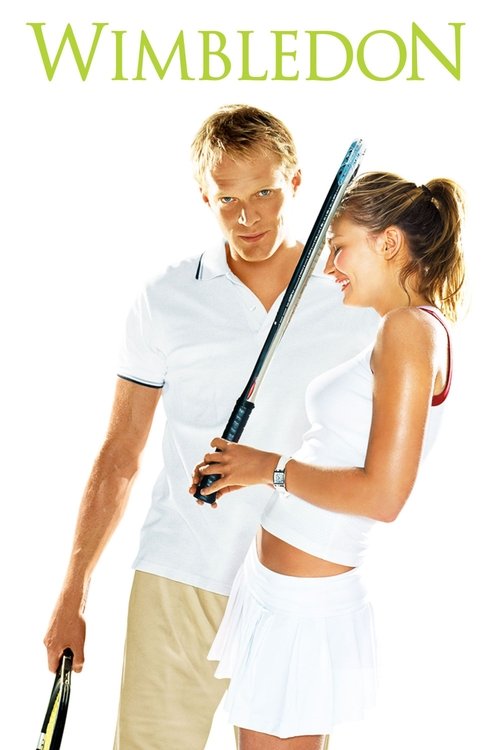
Wimbledon (2004)
Directed by Richard Loncraine
No — Wimbledon is not woke, scoring 5 out of 100 on our wokeness meter.
Peter Colt is a British tennis professional whose ranking has slid from eleventh to one hundred nineteenth, a decline he meets with the mild resignation of a man whose wealthy family never required him to fight for anything.
Consciousness Markers
Kirsten Dunst's Lizzie is a driven rising tennis star with her own ambitions, but the narrative subordinates her career to the male lead's redemption, even having her lose a match because of their tryst.
The cast is overwhelmingly white and Anglophone, with no meaningful effort at diverse representation; the film simply casts conventionally attractive leads of the era.
There are no LGBTQ+ characters, themes, or subtext anywhere in this heterosexual sports romance.
The film engages no racial themes whatsoever; the world of professional tennis here is depicted as uniformly white without comment.
No environmental or climate content of any kind.
Peter comes from a comfortable wealthy family and the film celebrates the commercial world of professional sport and endorsements without critique.
No body-positivity themes; the film features conventionally fit athletes and standard romantic-comedy aesthetics.
No neurodivergent characters or themes are present.
The film is a fictional contemporary story with no historical revisionism.
This is a light, well-behaved romantic comedy that preaches nothing; Ebert himself noted it is about nice people having good things happen.
Why it received this score
Peter Colt is a British tennis professional whose ranking has slid from eleventh to one hundred nineteenth, a decline he meets with the mild resignation of a man whose wealthy family never required him to fight for anything. He arrives at Wimbledon on a wild card, intending one final tournament before a comfortable job at a club. Then a hotel key mix-up deposits him in the shower of Lizzie Bradbury, an American rising star, and the machinery of the romantic comedy engages. Richard Loncraine directs with the smooth efficiency of a man assembling flat-pack furniture. Nothing here aspires to more than pleasant.
Lizzie is the film's most interesting problem. Kirsten Dunst plays her as driven, ambitious, and entirely aware of her own trajectory, which makes it all the more dispiriting when the screenplay converts her into a motivational instrument for the male lead's redemption arc. She loses her semifinal because of a tryst the script arranges, breaks up with him over it, then returns from the airport to hand him the tactical secret of his opponent's serve. Her own Wimbledon titles arrive in a closing caption, off-screen, as an afterthought. The gesture is faint but it registers.
The remaining ledger is bare. The cast is uniformly white and Anglophone, the sport depicted as a rarefied enclave of fit, comfortable people with no racial dimension, no queer presence, no environmental concern, no body-positivity, no neurodivergence, and no historical argument to make. Peter comes from money and the film regards the commercial apparatus of professional tennis with uncomplicated affection. Roger Ebert observed that this is a well-behaved movie about nice people who have good things happen to them. He meant it kindly. It is also the most accurate description of the film's emptiness.
Analysis generated by our Consciousness Algorithm


Synopsis
Britain’s Peter Colt has never quite lived up to his dreams of tennis stardom. Once ranked as high as number 11 in the world, the journeyman veteran has watched his number slip to 119 as his confidence on the court slowly ebbs away. Now, on the eve of his leaving the world of professional tennis, he’s granted a wild card, allowing him to play his final Wimbledon tournament…make that his final tournament ever.
Questions about Wimbledon
Is Wimbledon woke?
No — Wimbledon is not woke, scoring 5 out of 100 on our wokeness meter. That earns it a verdict of Ultra Based.
Does Wimbledon have any woke elements?
Very few. None of the 10 markers reaches 30, the level where a marker counts as present; the highest is Feminist Agenda at 12.
How does Wimbledon compare to other 2004 movies?
It ranks #116 of the 178 films from 2004 we've scored; their average is 12. The wokest is Tropical Malady (62).
How is the Woke Score calculated?
An AI-assisted process researches the film and its reception, scores it 0–100 on ten markers, then combines those into one 0–100 Woke Score. It measures a specific set of 2020s cultural themes, not film quality.