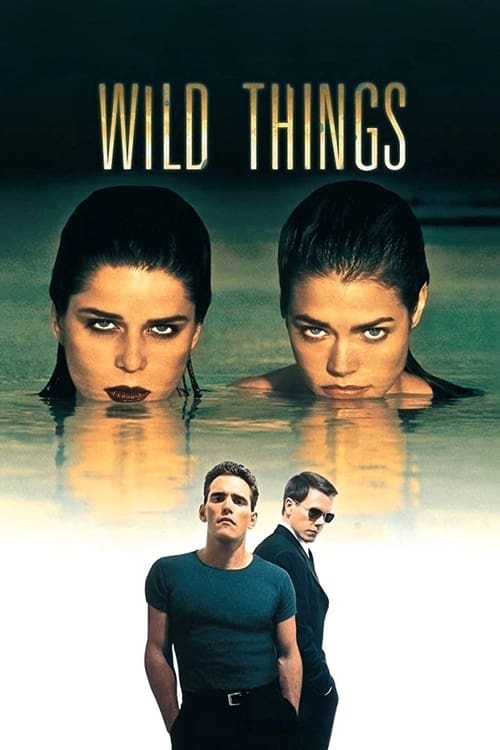
Wild Things (1998)
Directed by John McNaughton
No — Wild Things is not woke, scoring 10 out of 100 on our wokeness meter.
Wild Things arrives from 1998, which is to say from a moment when a director could follow Henry: Portrait of a Serial Killer with a swamp-soaked erotic thriller and call it a career move toward the mainstream.
Consciousness Markers
Class resentment drives the plot, with a poor Everglades girl conning wealthy Blue Bay elites, and the director has described it as his most political film about social class.
The cast is overwhelmingly white, with Daphne Rubin-Vega as a Latina detective in a supporting role; diversity is incidental rather than a casting statement.
A lesbian encounter between Kelly and Suzie exists, and a gay subplot was reportedly cut, but the content is exploitative titillation rather than LGBTQ+ thematic advocacy.
Female characters have manipulative agency, but the film frames them through lurid femme-fatale tropes rather than any feminist agenda.
No racial themes, commentary, or consciousness are present in the film.
The Everglades setting is atmospheric only; there is no environmental or climate message.
The film trades on conventional eroticized beauty and nudity, with no body-positivity themes.
No neurodivergence themes or representation are present.
The film is a contemporary crime thriller with no historical revisionism.
It is a trashy erotic thriller that aims to titillate and twist, not to lecture the audience on social issues.
Why it received this score
Wild Things arrives from 1998, which is to say from a moment when a director could follow Henry: Portrait of a Serial Killer with a swamp-soaked erotic thriller and call it a career move toward the mainstream. John McNaughton assembles Matt Dillon, Kevin Bacon, Neve Campbell, Denise Richards, and Bill Murray, then sets them loose on a plot involving a false rape accusation, an eight and a half million dollar settlement, and a scheme with more turns than a Florida highway. The Everglades supply atmosphere and humidity. They supply nothing else.
The film's nearest claim to a social program is its class resentment. A poor girl from the trailer park outmaneuvers the wealthy Blue Bay elite, and McNaughton has described the picture as his most political work on exactly those grounds. The observation holds. Suzie Toller ends the film alone on a ninety foot sailboat with a briefcase of cash while nearly everyone with a trust fund is dead or disgraced. That is a real strain of resentment toward money, though it arrives wrapped in nudity, betrayal, and a speargun.
Elsewhere the cultural inventory comes up thin. Daphne Rubin-Vega appears as a detective, a Latina presence in a cast otherwise composed of the pale and the prosperous, and the film treats her as furniture with a badge. A lesbian encounter between Campbell and Richards is staged for the camera's benefit, and a gay subplot involving the two male leads was removed before release, which places the film's queer content in the realm of spectacle. There is no environmental argument, no body-positive message, no neurodivergent representation, and no attempt to rewrite the historical record. The film does not lecture. It seduces, then it removes its own teeth with pliers. As social instruction it is worthless. As a demonstration of how to end a movie, it remains difficult to fault.
Analysis generated by our Consciousness Algorithm


Synopsis
When teen-socialite Kelly Van Ryan and troubled bad girl Suzie Toller accuse guidance counselor Sam Lombardo of rape, he's suspended by the school, rejected by the town, and fighting to get his life back. One cop suspects conspiracy, but nothing is what it seems...
Questions about Wild Things
Is Wild Things woke?
No — Wild Things is not woke, scoring 10 out of 100 on our wokeness meter. That earns it a verdict of Ultra Based.
Does Wild Things have any woke elements?
1 of the 10 markers register at 30 or above, led by Eat the Rich (30). On Eat the Rich: Class resentment drives the plot, with a poor Everglades girl conning wealthy Blue Bay elites, and the director has described it as his most political film about social class.
How does Wild Things compare to other 1998 movies?
It ranks #46 of the 118 films from 1998 we've scored; their average is 12. The wokest is Show Me Love (60).
How is the Woke Score calculated?
An AI-assisted process researches the film and its reception, scores it 0–100 on ten markers, then combines those into one 0–100 Woke Score. It measures a specific set of 2020s cultural themes, not film quality.