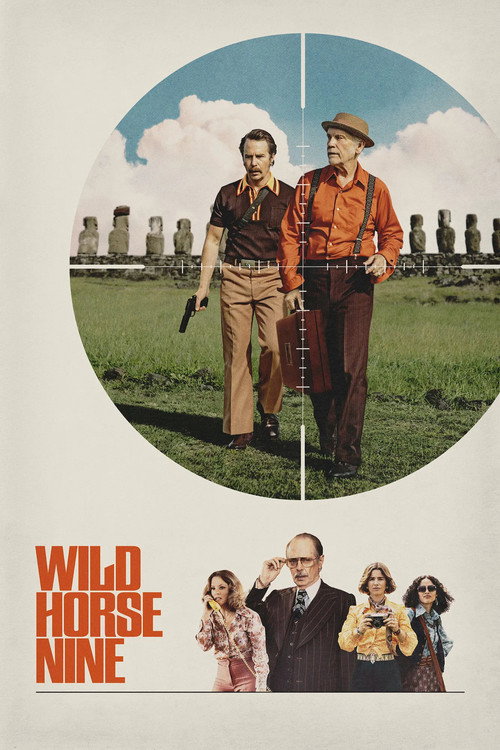
Wild Horse Nine (2026)
Directed by Martin McDonagh
No — Wild Horse Nine is not especially woke, scoring 38 out of 100 on our wokeness meter.
Martin McDonagh dispatches two aging CIA operatives to Easter Island in 1973 and dares you to feel bad about it.
Consciousness Markers
The 1973 Chilean coup serves as the film's backdrop, and CIA complicity in the Pinochet takeover is not a subtext but a premise. Named historical operations are deployed as punchlines and indictments simultaneously, positioning U.S. intelligence as the organizing villain of twentieth-century history.
Dialogue explicitly flags the Indigenous name Rapa Nui over the colonial designation Easter Island, and the film's critical reception included sustained discussion of its imperialist lens and the erasure of Chilean and Indigenous trauma beneath the Americans' moral crisis. These are concrete, specific elements, not background texture.
Chilean actresses Mariana di Girolamo and Ailín Salas occupy significant supporting roles as pro-Allende students, and the casting is story-integral rather than cosmetic. The film does not, however, operate as a modern diversity showcase, and the leads remain two white American men of a certain vintage.
The film explicitly satirizes U.S. interventionism, with dialogue cataloguing covert CIA operations in Guatemala, the Congo, the Bay of Pigs, and beyond. The target is American imperial power rather than capitalism as an economic system, but the two are not cleanly separable in McDonagh's framing.
Parker Posey plays the CIA bureau chief MJ, a female authority figure over two male operatives, and the Chilean women function as moral catalysts rather than passive bystanders. The film nonetheless centers its existential weight entirely on its male leads, which critics noted without apparent irony.
McDonagh's signature mode is cynical banter and moral ambiguity, and critics specifically noted the absence of overt partisan messaging. Malkovich's character expresses casual, humorous disdain for social justice movements. The historical indictment is present but worn lightly, which is almost the most damning thing about it.
No LGBTQ+ themes, characters, or subtext appear in any available research or critical commentary. The film's romantic and interpersonal dynamics are entirely heterosexual in framing.
No climate themes, environmental messaging, or ecological consciousness of any kind appear in the film or its surrounding discourse.
No body positivity themes, fat acceptance discourse, or related messaging appear anywhere in the film's content or critical reception.
No neurodivergent characters, themes, or framing are present in the film or noted in any critical source.
Why it received this score
Martin McDonagh dispatches two aging CIA operatives to Easter Island in 1973 and dares you to feel bad about it. John Malkovich and Sam Rockwell, operating as Chris and Lee, are the kind of men who have participated in the quiet dismantling of several democracies and remain, on balance, pretty good company. The film plants them among the moai statues of Rapa Nui, a location chosen with the precision of someone who understands that ancient monoliths staring blankly into the middle distance are the correct backdrop for men who have done what these men have done. McDonagh, who described his intentions as moving toward "a much more political place," has arrived there by the scenic route, stopping frequently to let his characters be funny.
The progressive architecture of the film is real, if not aggressive. The Chilean students Monica and Alicia, played by Mariana di Girolamo and Ailín Salas, exist at the intersection of Indigenous identity and anti-imperialist politics, and the script takes the trouble to have someone correct the colonial place name to its face. The CIA's historical ledger, Guatemala through the Bay of Pigs, is recited with the breezy fluency of men who have memorized it the way others memorize sports statistics. Several critics found this insufficient, arguing that the film subordinates the actual victims of U.S. foreign policy to the interior weather of the men who enabled it. This is a fair point. It is also, structurally, the entire tradition of the buddy film, and McDonagh does not appear to have lost sleep over the tension.
What saves the film from earnest self-congratulation is Malkovich's character, who expresses something close to contempt for the very progressive sensibilities the film is simultaneously trafficking in. The racial consciousness is present but worn with a certain exhaustion. The historical revisionism is pointed but never preachy, which in the current climate counts as a form of restraint. Parker Posey runs the bureau. Tom Waits is in it. The statues watch everything and say nothing, which is the correct response.
Analysis generated by our Consciousness Algorithm
Part of
Synopsis
Shortly before the 1973 Chilean coup, CIA agents Chris and Lee are dispatched from Santiago to Easter Island by their bureau chief, MJ. Amongst the Island's iconic statues, and as the longtime partners wrestle with their dark pasts and present conspiracies, Chris's newfound bond with a pair of rebellious students threatens to send everyone's trip to this remote paradise sideways.
Questions about Wild Horse Nine
Is Wild Horse Nine woke?
No — Wild Horse Nine is not especially woke, scoring 38 out of 100 on our wokeness meter. That earns it a verdict of Based.
Does Wild Horse Nine have any woke elements?
4 of the 10 markers register at 30 or above, led by Revisionist History (48), Racial Consciousness (42) and Representation Casting (38). On Revisionist History: The 1973 Chilean coup serves as the film's backdrop, and CIA complicity in the Pinochet takeover is not a subtext but a premise.
How does Wild Horse Nine compare to other 2026 movies?
It ranks #187 of the 800 films from 2026 we've scored; their average is 23. The wokest is Between Us (89).
How is the Woke Score calculated?
An AI-assisted process researches the film and its reception, scores it 0–100 on ten markers, then combines those into one 0–100 Woke Score. It measures a specific set of 2020s cultural themes, not film quality.