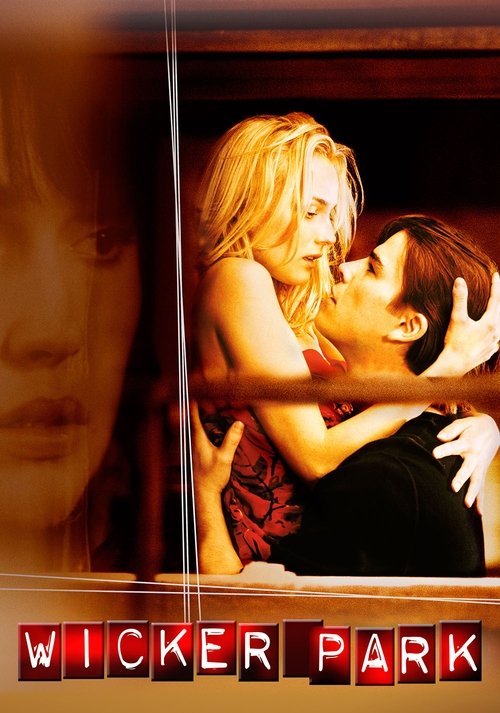
Wicker Park (2004)
Directed by Paul McGuigan
No — Wicker Park is not woke, scoring 0 out of 100 on our wokeness meter.
Wicker Park arrives in 2004 carrying the weary baggage of a French original, L'Appartement, and a development history that chewed through directors and leading men before settling on Paul McGuigan and Josh Hartnett.
Consciousness Markers
The cast is uniformly white, with no meaningful racial or ethnic diversity in any role.
No LGBTQ+ characters, themes, or subtext appear anywhere in the film.
Women function as objects of romantic obsession and plot machinery; the film offers no feminist critique or agency-driven framing.
Race is entirely absent as a subject; the story is a white, upper-middle-class romantic thriller.
No environmental or climate themes whatsoever.
The protagonist is an advertising executive; the film has no critique of wealth or capitalism.
No body-positivity themes; the film trades on conventional glamour and beauty standards.
No neurodivergent characters or themes are present.
A contemporary romantic thriller with no historical subject matter to revise.
The film is a convoluted romance-mystery with no didactic or preachy messaging.
Why it received this score
Wicker Park arrives in 2004 carrying the weary baggage of a French original, L'Appartement, and a development history that chewed through directors and leading men before settling on Paul McGuigan and Josh Hartnett. The premise is a man who abandons a business trip to China in order to stalk the memory of a woman who vanished two years earlier. He is an advertising executive. Chicago looks expensive. Everyone has good cheekbones and a cell phone they decline to use. This is a romantic thriller assembled from coincidence, and the critics of the day were unimpressed, handing it a 27 percent approval rating and a box office return well short of its budget.
For the purposes of cultural classification, the film presents a clean slate. Its cast is uniformly white, its women exist as objects of pursuit and plot machinery, and race never surfaces as a subject. There is no queer subtext, no environmental concern, no critique of the wealth on display, and no interest in bodies beyond conventional glamour. The heroine is a dancer, which is offered as a personality. No character is coded as neurodivergent. The narrative is contemporary and therefore has no history to revise, and the film never pauses to instruct its audience on anything, which may be its single most admirable quality. It simply wants to be a puzzle, and a muddled one at that.
A sommelier of such things would note the absence of any modern social consciousness, and would note it without disappointment. Wicker Park is a product of its moment, a glossy exercise in mistaken identity and withheld notes, guilty chiefly of implausibility. It lectures no one. It represents no one in particular. It asks only that we believe a woman would keep a secret for two years for no reason the screenplay can defend. The vintage is 2004, the body is thin, and the finish is a shrug.
Analysis generated by our Consciousness Algorithm


Synopsis
Matthew, a young advertising executive in Chicago, puts his life and a business trip to China on hold when he thinks he sees Lisa, the love of his life who left him without a word two years earlier, walking out of a restaurant one day.
Questions about Wicker Park
Is Wicker Park woke?
No — Wicker Park is not woke, scoring 0 out of 100 on our wokeness meter. That earns it a verdict of Ultra Based.
Does Wicker Park have any woke elements?
No. All 10 markers score zero.
How does Wicker Park compare to other 2004 movies?
It ranks #151 of the 178 films from 2004 we've scored; their average is 12. The wokest is Tropical Malady (62).
How is the Woke Score calculated?
An AI-assisted process researches the film and its reception, scores it 0–100 on ten markers, then combines those into one 0–100 Woke Score. It measures a specific set of 2020s cultural themes, not film quality.