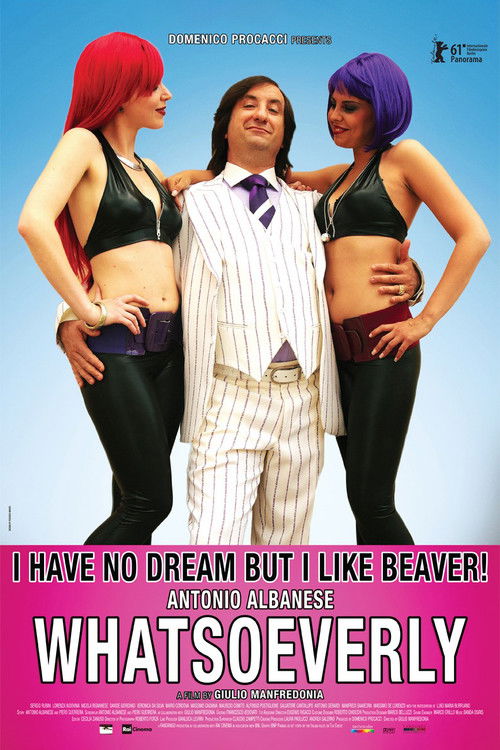
Whatsoeverly (2011)
Directed by Giulio Manfredonia
No — Whatsoeverly is not woke, scoring 14 out of 100 on our wokeness meter.
Cetto La Qualunque, the Calabrian entrepreneur and aspiring mayor at the center of Qualunquemente, is a man who names his South American mistress "Thing" and cannot recall his own daughter's name.
Consciousness Markers
The film critiques a corrupt entrepreneur who enters politics for personal gain, reflecting crony capitalism, but it is not a systemic anti-capitalist manifesto.
The film is a satirical comedy that shows rather than lectures, with only mild political messaging.
The cast is entirely Italian with no intentional diverse casting; the South American character is a caricature, not progressive representation.
No LGBTQ+ themes or characters; the protagonist's homophobia is depicted as a negative trait but not explored as a theme.
The film satirizes a sexist protagonist but does not advance a feminist agenda; women are largely objects of his abuse.
Racism is shown as a character flaw, but the film lacks a progressive racial consciousness or critique of systemic racism.
No environmental or climate themes are present.
The protagonist body-shames his son's girlfriend, and the film does not promote body positivity.
No neurodivergent characters or themes.
No historical revisionism; it is a contemporary satire.
Why it received this score
Cetto La Qualunque, the Calabrian entrepreneur and aspiring mayor at the center of Qualunquemente, is a man who names his South American mistress "Thing" and cannot recall his own daughter's name. Antonio Albanese built the character for Italian television and brought him to the cinema in 2011, where the film was duly screened at Berlin. The plot follows Cetto as he returns from exile abroad to his hometown, learns that a decent man intends to run for mayor, and decides to run himself, mostly to stay out of prison.
The satire is broad and unapologetic. Cetto shoots at mannequins painted to resemble Black men, forces his timid son to abandon a girlfriend who fails his physical standards, and promises the electorate a supply of prostitutes alongside the abolition of taxes. He is racist, homophobic, and contemptuous of the disabled, and the film presents all of it as comedy of exposure. The camera does not lecture. It watches. The audience is trusted to find him repellent, which most will, and the production declines to append the corrective sermon a more anxious studio might have demanded.
A faint economic complaint sits buried in the material, since Cetto is a crony entrepreneur who treats politics as an extension of his own ledger, and the bought reporter and the hired campaign manager complete the portrait of a system greased by self-interest. That is where the social criticism begins and ends. Women exist as objects of his appetite, the migrant girlfriend is a caricature and not a character, and the film's politics remain those of a well-aimed sneer. It is a funny and frequently ugly piece of work, belonging to a tradition of Italian satire that trusts misanthropy to do the work of morality. The classification is straightforward: a low reading across the cultural-awareness instruments, with the needle twitching only for the venal entrepreneur and the occasional nudge of conscience.
Analysis generated by our Consciousness Algorithm
Synopsis
Corrupt and sleazy entrepreneur Cetto La Qualunque comes back to Italy and "jumps into politics" lest his law-abiding opponent, Giovanni De Santis, is elected as mayor.
Questions about Whatsoeverly
Is Whatsoeverly woke?
No — Whatsoeverly is not woke, scoring 14 out of 100 on our wokeness meter. That earns it a verdict of Ultra Based.
Does Whatsoeverly have any woke elements?
Very few. None of the 10 markers reaches 30, the level where a marker counts as present; the highest is Eat the Rich at 20.
How does Whatsoeverly compare to other 2011 movies?
It ranks #65 of the 245 films from 2011 we've scored; their average is 11. The wokest is Paul (68).
How is the Woke Score calculated?
An AI-assisted process researches the film and its reception, scores it 0–100 on ten markers, then combines those into one 0–100 Woke Score. It measures a specific set of 2020s cultural themes, not film quality.