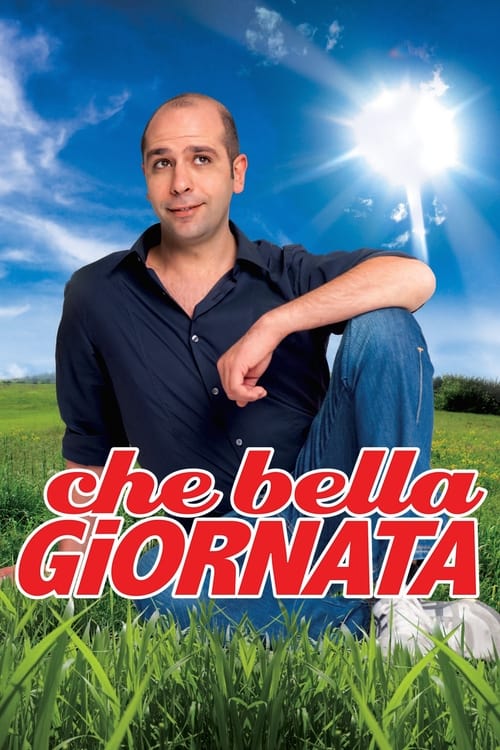
What a Beautiful Day (2011)
Directed by Gennaro Nunziante
No — What a Beautiful Day is not woke, scoring 5 out of 100 on our wokeness meter.
Che bella giornata arrives from 2011, a year when Italian cinema was still comfortable letting a bumbling Milanese nightclub bouncer fail his carabiniere exam three times and call it a plot.
Consciousness Markers
Arab characters (Farah, her brother Sufien) are central to the plot, but they function as comedic stereotype vehicles rather than as a deliberate push for diverse casting; this is a mainstream Italian comedy of its era, not a representation project.
The film touches on Arab/Muslim characters and terrorism, but treats them through broad comedic caricature rather than any modern racial-consciousness framework; the humanization of Farah is sentimental rather than activist.
The female lead exists to be seduced and humanized by the male protagonist's charm; there is no feminist framing or commentary.
This is a broad, politically incorrect comedy that plays everything for laughs; it delivers no moral lesson or preaching to the audience.
No LGBTQ+ characters, subtext, or themes appear anywhere in the film.
No climate or environmental themes are present.
The film's nods to cronyism and bureaucratic perks are running gags about Italian institutions, not an anti-capitalist or eat-the-rich critique.
No body positivity themes or messaging.
Checco is written as an uneducated buffoon, not as a character with a diagnosed neurodivergence; his incompetence is slapstick, not representation.
No historical revisionism; the film is a contemporary fictional farce.
Why it received this score
Che bella giornata arrives from 2011, a year when Italian cinema was still comfortable letting a bumbling Milanese nightclub bouncer fail his carabiniere exam three times and call it a plot. Checco Zalone plays the title fool, a man whose stated reason for wanting police work is the perks and the cronyism, a confession delivered at the oral examination with the confidence of a man who has never once been told no. Through an archbishop's recommendation he lands as a security guard at the Milan Cathedral, where he stumbles into a terrorist conspiracy and, by degrees, into the affections of the woman sent to manipulate him. It is a farce, and it knows it.
The film's Arab characters, Sufien and his sister Farah, sit at the center of the machinery, though they arrive as caricature first and people second. Farah's arc bends toward sentimental redemption: she is softened by Checco's family, his trullo, his guileless kindness, and she abandons the bombing. This is humanization by way of the male lead's charm, and the woman exists to be won over by it. There is no framework of cultural critique here, no accounting for the unspecified bombing that killed her family. The comedy treats terrorism as a prop and ethnicity as a punchline, which is a different thing from representation.
Elsewhere the film is a running gag about Italian institutions, cronyism, bureaucratic perks, the relatives all named Capobianco. None of this amounts to a critique of capital, and no climate anxiety, no body politics, no neurological diversity, no historical revision intrudes. The film preaches nothing. It wants only to be funny, and in Italy it very much was, outgrossing Avatar in its opening weekend and briefly claiming the domestic record. We are left to classify a comedy that has no message at all, which in this line of work is its own kind of relief.
Analysis generated by our Consciousness Algorithm
Synopsis
Checco, an uneducated but self-satisfied fellow from Milan, who has always dreamed of becoming a police officer, fails his entrance exam for the third time. It must be said that at the oral examination Checco said that the reason why he wanted to join the police was benefits in kind and cronyism! But the young man has connections and he soon finds himself a security agent at the Milan Cathedral. Of course the bumbling idiot proves a living catastrophe! Spotted by Sufien, an Arab terrorist who is preparing an attack against the cathedral, Checco appears as the perfect sucker. To manipulate him, he sends his charming sister Farah to him, with the mission to seduce him...
Questions about What a Beautiful Day
Is What a Beautiful Day woke?
No — What a Beautiful Day is not woke, scoring 5 out of 100 on our wokeness meter. That earns it a verdict of Ultra Based.
Does What a Beautiful Day have any woke elements?
Very few. None of the 10 markers reaches 30, the level where a marker counts as present; the highest is Representation Casting at 15.
How does What a Beautiful Day compare to other 2011 movies?
It ranks #165 of the 245 films from 2011 we've scored; their average is 11. The wokest is Paul (68).
How is the Woke Score calculated?
An AI-assisted process researches the film and its reception, scores it 0–100 on ten markers, then combines those into one 0–100 Woke Score. It measures a specific set of 2020s cultural themes, not film quality.