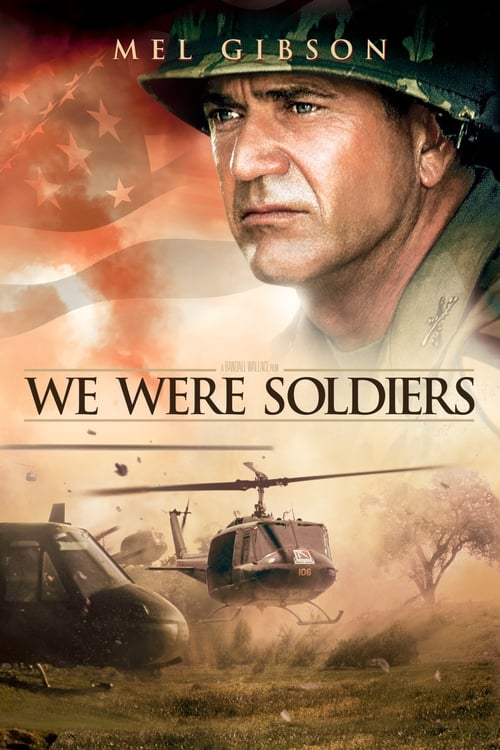
We Were Soldiers (2002)
Directed by Randall Wallace
No — We Were Soldiers is not woke, scoring 12 out of 100 on our wokeness meter.
The 2002 vintage of We Were Soldiers arrives with a great deal of mud, napalm, and square-jawed resolve, and it carries itself with the confidence of a picture that believes it has finally told the truth about the Ia Drang Valley.
Consciousness Markers
Vietnamese characters, including commander Nguyen Huu An and his soldiers, are cast with Vietnamese actors and given dignified screen time rather than serving as faceless antagonists. However, this is story-appropriate humanism rather than a modern identity-casting mandate.
Julia Moore takes charge of the base wives and the grim duty of delivering casualty telegrams, giving the home-front women a measure of agency. It remains a largely traditional military-wife role in a male-dominated war narrative.
The film treats the North Vietnamese as honorable, competent soldiers with families of their own, a notable departure from faceless-enemy conventions. This is pre-2015 humanist respect rather than modern racial-consciousness framing.
The film carries a soft moral about honoring soldiers on both sides, but it is largely an apolitical, rousing combat saga rather than a preachy message vehicle.
No LGBTQ+ characters, themes, or subtext appear anywhere in the film.
No environmental or climate themes are present.
No critique of capitalism, wealth, or economic systems appears in the film.
No body-positivity themes are present.
No neurodivergence themes or characters are present.
The film does alter history, inventing a climactic heroic charge that never occurred, but this is old-fashioned patriotic embellishment rather than progressive reinterpretation of the past.
Why it received this score
The 2002 vintage of We Were Soldiers arrives with a great deal of mud, napalm, and square-jawed resolve, and it carries itself with the confidence of a picture that believes it has finally told the truth about the Ia Drang Valley. Randall Wallace stages the ambushes and the artillery with real craft, and he extends an unusual courtesy to his adversaries. The North Vietnamese commander Nguyen Huu An is played by a Vietnamese actor, given a name, a strategy, and a moment of quiet grief over his own dead. His soldiers carry photographs of sweethearts. This is the old humanism of the war picture, not a modern casting mandate, and it earns a modest nod for decency without pretending to be a statement.
The film's omissions are equally instructive. Nobody in the battalion is gay, or worried about the climate, or inclined to question the defense contractors whose helicopters keep them alive. The men are standard-issue in body and mind alike, and no soldier's neurology is offered up as a lesson. The wives on the base get a thread of their own, mostly casualty telegrams and casseroles, a traditional role dressed in a little authority. The picture is far too busy being rousing to interrogate anything.
History, meanwhile, receives a shove. The climactic charge that ends the battle never happened, a piece of patriotic embroidery the director cheerfully acknowledged. This is not the refashioning of the past in service of a contemporary moral. It is the older, simpler sin of making a victory look tidier than it was. The film's message amounts to a gentle suggestion that soldiers on both sides suffered, delivered without a podium. A respectable vintage. Dry, sturdy, and mercifully free of sermonizing.
Analysis generated by our Consciousness Algorithm
Part of


Synopsis
The year is 1965 and America is at war with North Vietnam. Commanding the air cavalry is Lt. Col. Hal Moore (Gibson), a born leader committed to his troops. His target: the Ia Drang Valley, called "The Valley of Death." As Moore prepares for one of the most violent battles in U.S. history, he delivers a stirring promise to his soldiers and their families: "I will leave no man behind...dead or alive. We will all come home together."
Questions about We Were Soldiers
Is We Were Soldiers woke?
No — We Were Soldiers is not woke, scoring 12 out of 100 on our wokeness meter. That earns it a verdict of Ultra Based.
Does We Were Soldiers have any woke elements?
Very few. None of the 10 markers reaches 30, the level where a marker counts as present; the highest is Representation Casting at 22.
How does We Were Soldiers compare to other 2002 movies?
It ranks #45 of the 150 films from 2002 we've scored; their average is 12. The wokest is Far from Heaven (78).
How is the Woke Score calculated?
An AI-assisted process researches the film and its reception, scores it 0–100 on ten markers, then combines those into one 0–100 Woke Score. It measures a specific set of 2020s cultural themes, not film quality.