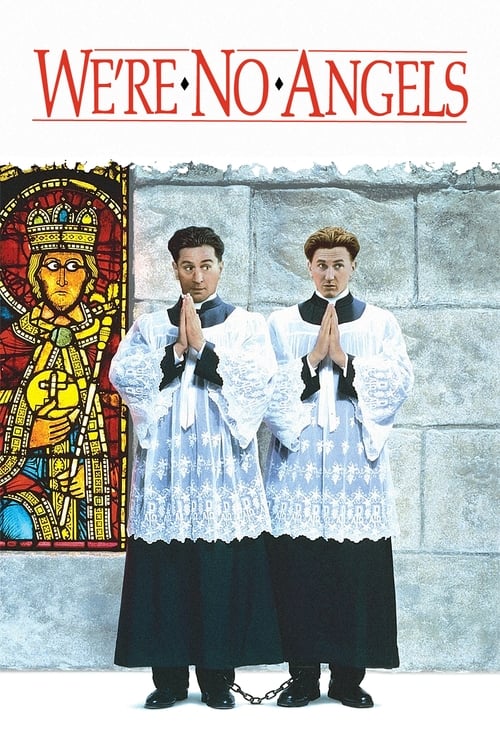
We're No Angels (1989)
Directed by Neil Jordan
No — We're No Angels is not woke, scoring 3 out of 100 on our wokeness meter.
We're No Angels arrives in 1989 as a remake of a 1955 comedy, reworked by David Mamet and directed by Neil Jordan, with Robert De Niro and Sean Penn as escaped convicts who impersonate priests in a Depression-era border town.
Consciousness Markers
The cast is almost entirely white with no deliberate push for diverse or inclusive representation; a period 1930s New York setting provides no such imperative.
Demi Moore's Molly is a laundress and prostitute whose arc revolves around her mute daughter being saved by the male leads; she is a plot device rather than a feminist statement.
No LGBTQ+ characters, themes, or subtext appear anywhere in this monastery caper.
No engagement with race or racial politics; the story concerns escaped white convicts in a Depression-era upstate town.
No environmental or climate themes whatsoever.
While set during the Great Depression with an abusive warden, the film has no economic-justice thesis or eat-the-rich messaging.
No body-diversity or body-positivity themes are present.
The deaf-and-mute daughter is a healing-miracle plot device, not a depiction of neurodivergence or disability advocacy.
A loose remake with a new Mamet scenario, but it makes no revisionist claims about history.
A lightweight buddy comedy that never lectures the audience on social or moral issues.
Why it received this score
We're No Angels arrives in 1989 as a remake of a 1955 comedy, reworked by David Mamet and directed by Neil Jordan, with Robert De Niro and Sean Penn as escaped convicts who impersonate priests in a Depression-era border town. The premise is sturdy, the faces are good, and the whole enterprise settles into a gentle caper about mistaken identity and small-town grace. There is nothing here that wishes to instruct us. The film wants to amuse, and mostly it does, in a manner that feels borrowed from an earlier, less anxious decade of studio comedy.
The cast is white and largely male, a fact the film neither notices nor apologizes for, and the setting offers no reason to expect otherwise. Demi Moore appears as Molly, a laundress and prostitute, and her function is to be rescued: her mute daughter is healed after a near-drowning, a miracle that serves the plot and the male leads who administer it. The girl's silence is a narrative device, a problem to be solved, not a portrait of disability or of a mind that works differently. Nothing in the screenplay reaches for a thesis about money, power, or the environment, despite the Depression backdrop and an abusive warden who exists to be a villain.
A few gestures toward inclusion can be detected if we squint: the presence of a woman with an arc, however thin, and a cast that is not exclusively one nationality. These are modest credits. The film's cultural vocabulary belongs to 1989, and it has aged into a pleasant, harmless artifact. It lectures no one, represents almost no one, and challenges nothing. On the modern index of social consciousness, it registers as a whisper in an empty room.
Analysis generated by our Consciousness Algorithm
Part of


Synopsis
Two escaped cons' only prayer to escape is to pass themselves off as priests and pass by the police blockade at the border into the safety of Canada.
Questions about We're No Angels
Is We're No Angels woke?
No — We're No Angels is not woke, scoring 3 out of 100 on our wokeness meter. That earns it a verdict of Ultra Based.
Does We're No Angels have any woke elements?
Very few. None of the 10 markers reaches 30, the level where a marker counts as present; the highest is Representation Casting at 8.
How does We're No Angels compare to other 1989 movies?
It ranks #56 of the 68 films from 1989 we've scored; their average is 10. The wokest is Do the Right Thing (72).
How is the Woke Score calculated?
An AI-assisted process researches the film and its reception, scores it 0–100 on ten markers, then combines those into one 0–100 Woke Score. It measures a specific set of 2020s cultural themes, not film quality.