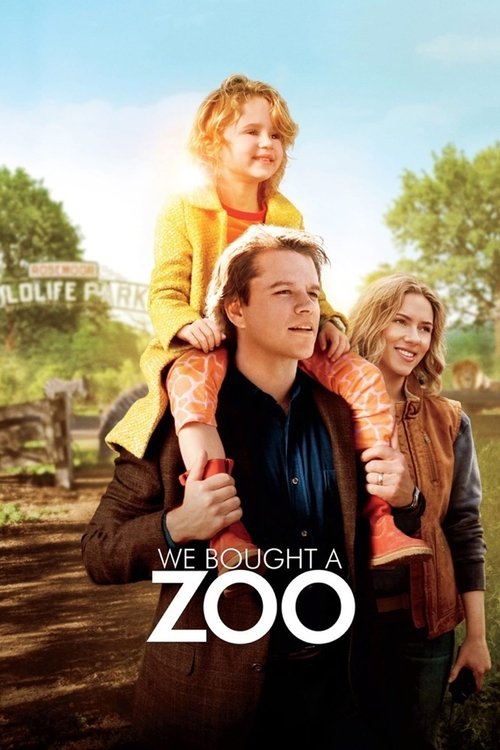
We Bought a Zoo (2011)
Directed by Cameron Crowe
No — We Bought a Zoo is not woke, scoring 6 out of 100 on our wokeness meter.
We Bought a Zoo arrives from 2011, which is to say from the last stretch of an era when a studio could spend fifty million dollars on a widower, a tiger, and a rainstorm, and call the result a family picture.
Consciousness Markers
The cast is overwhelmingly white, with J.B. Smoove and Kym Whitley relegated to brief supporting turns as a realtor and a hardware clerk; there is no deliberate diversity-forward casting agenda.
Scarlett Johansson's Kelly is a capable head zookeeper, but she functions primarily as a love interest and surrogate mother figure rather than a vehicle for any feminist thesis.
The zoo's financial precarity and the accountant brother's caution touch on money worries, but the film is a warm-hearted entrepreneurial redemption story, not an eat-the-rich polemic.
The film is sentimental and earnest about grief and family, but it never pauses to lecture the audience on social or political matters.
No LGBTQ+ characters, themes, or subtext appear anywhere in the film.
The film engages no racial themes, commentary, or consciousness whatsoever.
There is no environmental or climate-crisis messaging; the animals are a family-drama backdrop, not an ecological sermon.
No body-positivity themes or messaging are present.
No neurodivergent characters or themes are depicted.
The film is loosely adapted from a memoir and Americanizes the British setting, but this is standard dramatization, not ideologically revisionist history.
Why it received this score
We Bought a Zoo arrives from 2011, which is to say from the last stretch of an era when a studio could spend fifty million dollars on a widower, a tiger, and a rainstorm, and call the result a family picture. Cameron Crowe directs with his customary soft-focus sincerity. Matt Damon plays Benjamin Mee, a man who loses his wife and responds by purchasing a dilapidated animal park in the California hills. The film is loosely drawn from a British memoir, then relocated to American soil and smoothed of its rougher edges. Nobody on screen appears troubled by this. It is warm, it is well-meaning, and it is engineered to make an audience cry at the correct intervals.
On the matter of social consciousness, the picture is mostly inert. Scarlett Johansson's head zookeeper is competent and steady with a bucket, but the screenplay keeps her tethered to the role of eventual love interest and de facto mother to two children who need one. J.B. Smoove and Kym Whitley appear as a realtor and a hardware clerk, brief turns that register as casting convenience. The film has money on its mind in the mildest way. The accountant brother frets, the USDA inspector presents a bill, and the whole apparatus resolves into a story about a plucky entrepreneur who succeeds through gumption. Any critique of capital is left at the gate with the ticket takers.
The absences are more instructive than the presences. There is no LGBTQ material, no engagement with race as a subject, no ecological sermon disguised as animal husbandry, no body-positivity messaging, no neurodivergent arc. The film is earnest about grief and parenting, and that earnestness never curdles into instruction. It wants to be loved, not to correct us. A viewer seeking a thesis will find only peacocks and a fallen tree. The rest of us get Matt Damon being sad in a raincoat, which, to be fair, he does rather well.
Analysis generated by our Consciousness Algorithm


Synopsis
Benjamin has lost his wife and, in a bid to start his life over, purchases a large house that has a zoo – welcome news for his daughter, but his son is not happy about it. The zoo is in need of renovation and Benjamin sets about the work with the head keeper and the rest of the staff, but, the zoo soon runs into financial trouble.
Questions about We Bought a Zoo
Is We Bought a Zoo woke?
No — We Bought a Zoo is not woke, scoring 6 out of 100 on our wokeness meter. That earns it a verdict of Ultra Based.
Does We Bought a Zoo have any woke elements?
Very few. None of the 10 markers reaches 30, the level where a marker counts as present; the highest is Representation Casting at 12.
How does We Bought a Zoo compare to other 2011 movies?
It ranks #148 of the 245 films from 2011 we've scored; their average is 11. The wokest is Paul (68).
How is the Woke Score calculated?
An AI-assisted process researches the film and its reception, scores it 0–100 on ten markers, then combines those into one 0–100 Woke Score. It measures a specific set of 2020s cultural themes, not film quality.