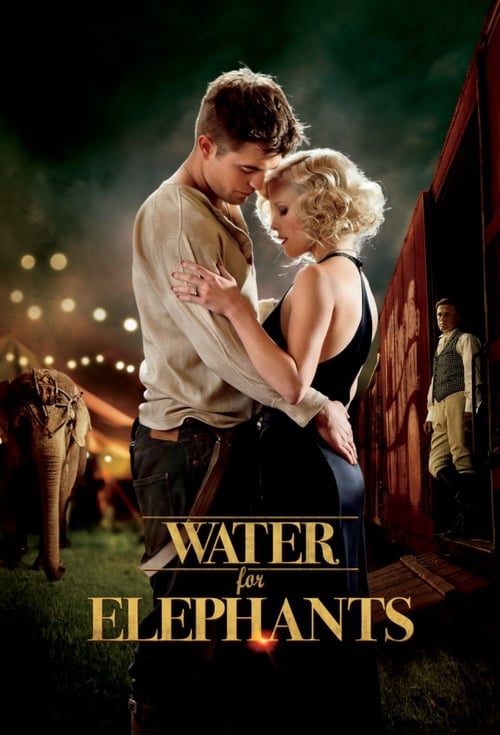
Water for Elephants (2011)
Directed by Francis Lawrence
No — Water for Elephants is not woke, scoring 5 out of 100 on our wokeness meter.
There is a comfort in watching a film that has no interest in the present moment.
Consciousness Markers
The cast is overwhelmingly white, with the notable exception of Mark Povinelli, a little-person actor, cast as the circus clown Walter. This is a natural period-appropriate role rather than a conscious diversity initiative.
The Great Depression backdrop and the bank foreclosing on Jacob's family home provide mild economic-hardship texture, but the film is a melodrama, not a critique of capitalism.
Marlena is largely a damsel defined by her abusive husband and rescued by the male protagonist; the film critiques domestic violence but offers no feminist framework or female agency.
The film is an old-fashioned romantic melodrama that aims to entertain rather than preach; any moralizing about animal cruelty is incidental to the plot.
No LGBTQ+ characters, themes, or subtext appear anywhere in the film.
The film engages no racial themes whatsoever; its Depression-era circus world is presented without any racial commentary.
No environmental or climate themes are present.
No body-positivity themes are present.
No neurodivergent characters or themes are depicted.
The film is a straightforward period melodrama set in 1931; it makes no revisionist historical claims.
Why it received this score
There is a comfort in watching a film that has no interest in the present moment. Water for Elephants arrives from 2011 dressed as 1931, a Depression-era circus melodrama in which a veterinary student named Jacob jumps a train, tends to a Polish-speaking elephant, and falls for a married performer named Marlena. Francis Lawrence directs with the polished restraint of a studio craftsman, and the result is handsome, unhurried, and entirely content to be a period romance. The camera gazes at Reese Witherspoon and Robert Pattinson with golden affection. The script asks nothing more of them than to smolder.
On the matter of social consciousness, the film is a near-total abstention. Its cast is white to a man, save for Mark Povinelli as the clown Walter, a bit of period-appropriate casting that carries no declarative weight. Racial themes go untouched. LGBTQ themes go untouched. The environment is not a concern of anyone on screen, nor is body image, nor neurodivergence. The Great Depression appears as texture, a foreclosure and a breadline, never as an argument about capital. Marlena is a woman defined first by an abusive husband and second by the man who rescues her from him. The film disapproves of August's cruelty. It does not propose that she might have left on her own.
What remains is a well-tailored piece of nostalgia, the kind Hollywood once produced by the dozen. It lectures no one, which is its quiet virtue and its chief limitation. The animal cruelty subplot lands with some force, though the film treats it as tragedy instead of sermon. We are left with an artifact: sincere, watchable, and almost aggressively untroubled by the culture that would greet it. A safe picture. A forgotten one, too, which may be the fairest verdict of all.
{"thematic_tags": ["book_adaptation"]}
Analysis generated by our Consciousness Algorithm


Synopsis
In this captivating Depression-era melodrama, impetuous veterinary student Jacob Jankowski joins a celebrated circus as an animal caretaker but faces a wrenching dilemma when he's transfixed by angelic married performer Marlena.
Questions about Water for Elephants
Is Water for Elephants woke?
No — Water for Elephants is not woke, scoring 5 out of 100 on our wokeness meter. That earns it a verdict of Ultra Based.
Does Water for Elephants have any woke elements?
Very few. None of the 10 markers reaches 30, the level where a marker counts as present; the highest is Representation Casting at 12.
How does Water for Elephants compare to other 2011 movies?
It ranks #165 of the 245 films from 2011 we've scored; their average is 11. The wokest is Paul (68).
How is the Woke Score calculated?
An AI-assisted process researches the film and its reception, scores it 0–100 on ten markers, then combines those into one 0–100 Woke Score. It measures a specific set of 2020s cultural themes, not film quality.