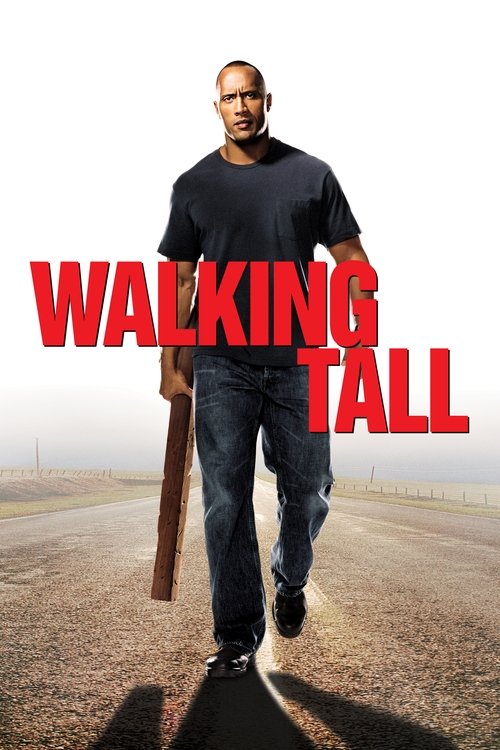
Walking Tall (2004)
Directed by Kevin Bray
No — Walking Tall is not woke, scoring 10 out of 100 on our wokeness meter.
Walking Tall arrives in 2004 as a remake of a 1973 picture, which itself drew on the tenure of a Tennessee sheriff named Buford Pusser.
Consciousness Markers
Dwayne Johnson, a Black/Samoan actor, takes on a role based on the white Sheriff Buford Pusser, a race-swap that adds diversity but without any explicit commentary.
No LGBTQ+ characters or themes are present.
Female characters are limited to traditional roles (stripper, sister, mother) and the film offers no feminist perspective.
Despite a Black lead, the film never engages with racial issues or consciousness.
No environmental or climate themes.
The villain is a corrupt casino owner, but the film's resolution is to reopen a cedar mill, not to critique capitalism.
No body positivity themes.
No neurodivergent characters or themes.
While based on a true story, the film is a loose action remake that does not reinterpret history through a modern progressive lens.
The civic speech is a standard action-movie rallying cry, not a social lecture.
Why it received this score
Walking Tall arrives in 2004 as a remake of a 1973 picture, which itself drew on the tenure of a Tennessee sheriff named Buford Pusser. Dwayne Johnson, then billed as The Rock, plays a Green Beret who comes home to find the cedar mill shuttered, a casino running the town, and his nephew in a hospital bed after a meth overdose. He takes a length of lumber to the security staff. The film is lean, loud, and entirely uninterested in subtext. It was not made to argue. It was made to hit things, and it hits them with a two-by-four, which critics at the time noted with some weariness.
The one thread worth pulling is the casting. Johnson inherits a role built from a white Southern lawman, and that substitution carries a certain weight on paper. On screen it carries none. The film never once acknowledges race, never lets the town's reaction to a Black sheriff complicate the plot, never gives the swap any meaning beyond the box office logic of putting a bankable star in a familiar shell. Female characters orbit the hero as stripper, sister, and mother, with the love interest quitting her job and handing him a weapon as her fullest expression of agency. There is no queer presence, no environmental conscience, no body politics, no neurodivergence. The picture is not hostile to any of it. It simply never occurs to the picture.
The villain owns a casino and runs drugs through it, which might look like a class critique until the hero's remedy turns out to be reopening a cedar mill. That is the political imagination on offer: a good small business replacing a bad big one. The courtroom speech is a civic rallying cry, not a sermon, and the film ends with the sheriff's star and a clean town. It is a blunt instrument, and it is honest about being one.
Analysis generated by our Consciousness Algorithm


Synopsis
A former U.S. soldier returns to his hometown to find it overrun by crime and corruption, which prompts him to clean house.
Questions about Walking Tall
Is Walking Tall woke?
No — Walking Tall is not woke, scoring 10 out of 100 on our wokeness meter. That earns it a verdict of Ultra Based.
Does Walking Tall have any woke elements?
Very few. None of the 10 markers reaches 30, the level where a marker counts as present; the highest is Representation Casting at 25.
How does Walking Tall compare to other 2004 movies?
It ranks #70 of the 178 films from 2004 we've scored; their average is 12. The wokest is Tropical Malady (62).
How is the Woke Score calculated?
An AI-assisted process researches the film and its reception, scores it 0–100 on ten markers, then combines those into one 0–100 Woke Score. It measures a specific set of 2020s cultural themes, not film quality.