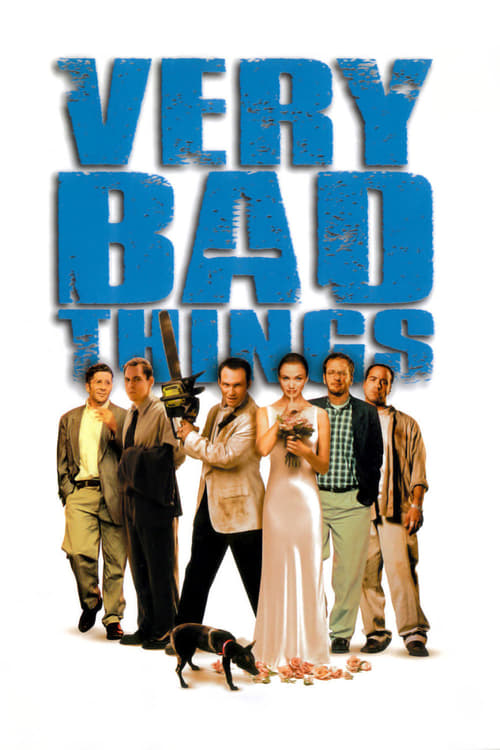
Very Bad Things (1998)
Directed by Peter Berg
No — Very Bad Things is not woke, scoring 5 out of 100 on our wokeness meter.
Peter Berg's feature debut opens with a bachelor party in Las Vegas and closes with two men in wheelchairs under the care of a woman collapsing in the street.
Consciousness Markers
The film satirizes suburban materialism, the wedding-industrial complex, and men driven to murder over a life-insurance payout, but its cynicism is misanthropic rather than a systemic eat-the-rich critique.
The film offers no moral instruction or social messaging; it is a nihilistic provocation that critics found mean-spirited and empty rather than preachy.
The ensemble is uniformly white, with the sole non-white performer (Kobe Tai) cast as a doomed stripper, which is the opposite of considered representation casting.
No LGBTQ+ characters, themes, or subtext appear anywhere in the film.
Women are either disposable victims (the stripper) or monstrous obstacles (Laura), and the film's gaze is thoroughly bro-centric; this is not a feminist text by any measure.
Ebert flagged the script's reliance on racial humor, but this is casual crudeness rather than any progressive racial consciousness.
No environmental or climate themes are present.
No body-positivity themes or messaging.
No neurodivergence themes or characters.
No historical revisionism; the film is a contemporary fictional black comedy.
Why it received this score
Peter Berg's feature debut opens with a bachelor party in Las Vegas and closes with two men in wheelchairs under the care of a woman collapsing in the street. In between, five suburban friends convert a hotel-room accident into a body count, a conspiracy, and finally a wedding. The film arrived in 1998 to a 40 percent approval rating and the consensus phrase "mean-spirited and empty," which remains an accurate inventory.
As a document of progressive social consciousness, the film is barren. The cast is uniformly white. The single non-white performer, Kobe Tai, plays the stripper who dies in the bathroom before the first act concludes, which is not representation so much as housekeeping. Women fare no better. Tina exists to be disposed of, and Laura, once she learns the truth, demands her dream wedding proceed on schedule and later bludgeons a man with a hat rack. There is no LGBTQ content, no climate concern, no body-positivity messaging, no neurodivergent character, and no revisionist history. The film occupies a present tense with no interest in correcting the record.
Traces of something survive. The script sneers at suburban materialism, the wedding-industrial complex, and men who will commit murder over a life insurance payout. This is cynicism aimed at people, not systems. Ebert's objection to the script's racial humor describes crudeness, not consciousness. And the film offers no instruction of any kind. It does not tell us how to live, whom to vote for, or which behaviors to correct. It presents a worst-case scenario and watches. That absence of sermonizing is the closest thing to a virtue on offer here, and it arrives attached to a great deal of tedium and blood.
Analysis generated by our Consciousness Algorithm


Synopsis
Kyle Fisher has one last night to celebrate life as a single man before marrying Laura, so he sets out to Vegas with four of his best buddies. But a drug and alcohol filled night on the town with a stripper who goes all the way, turns into a cold night in the desert with shovels when the stripper goes all the way into a body bag after dying in their bathroom. And that's just the first of the bodies to pile up before Kyle can walk down the aisle...
Questions about Very Bad Things
Is Very Bad Things woke?
No — Very Bad Things is not woke, scoring 5 out of 100 on our wokeness meter. That earns it a verdict of Ultra Based.
Does Very Bad Things have any woke elements?
Very few. None of the 10 markers reaches 30, the level where a marker counts as present; the highest is Eat the Rich at 12.
How does Very Bad Things compare to other 1998 movies?
It ranks #82 of the 118 films from 1998 we've scored; their average is 12. The wokest is Show Me Love (60).
How is the Woke Score calculated?
An AI-assisted process researches the film and its reception, scores it 0–100 on ten markers, then combines those into one 0–100 Woke Score. It measures a specific set of 2020s cultural themes, not film quality.