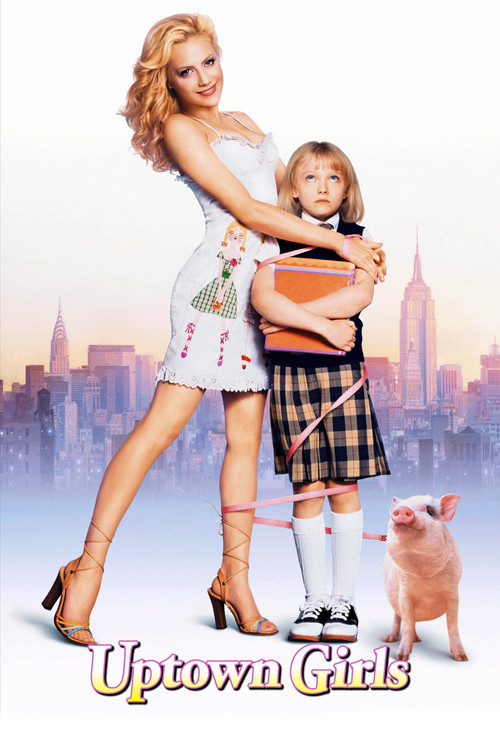
Uptown Girls (2003)
Directed by Boaz Yakin
No — Uptown Girls is not woke, scoring 6 out of 100 on our wokeness meter.
Uptown Girls arrives from 2003 with the soft confidence of a film that knows exactly how small it wants to be.
Consciousness Markers
Donald Faison appears as a prominent supporting character, but the film does not comment on race or diversity; casting is naturalistic rather than a statement.
Centers on two female leads and their emotional growth, but offers no explicit feminist critique or agenda.
No LGBTQ+ themes or characters are present.
No exploration of racial identity, systemic racism, or racial consciousness.
No environmental or climate-related themes.
Wealth and class are present as plot devices, but the film does not critique capitalism or advocate for wealth redistribution.
No body positivity themes or messaging.
Ray's hypochondria and obsessive behaviors are portrayed as quirks, not as neurodivergence or a subject of advocacy.
No historical revisionism or reimagining of past events.
The film delivers moral lessons through character interactions but does not lecture the audience on social issues.
Why it received this score
Uptown Girls arrives from 2003 with the soft confidence of a film that knows exactly how small it wants to be. Boaz Yakin directs Brittany Murphy as Molly Gunn, the orphaned daughter of a dead rock star, and Dakota Fanning as Ray, an eight-year-old hypochondriac who quotes Baryshnikov and keeps her grief filed under orderliness. Manhattan glows. The trust fund evaporates. A nanny job follows. The whole enterprise is a princess myth with a fall from grace, and it is content to remain one.
The cultural inventory here is thin, and honest about being thin. Two women carry the story and grow toward each other, though the film never converts that into an argument about anything. Donald Faison appears as Huey, a steady supporting presence, and the casting draws no attention to itself, which is its own kind of statement about 2003 studio comedy. There is no queer text. There is no racial inquiry. Class exists as mechanism: an accountant embezzles, a wealthy executive mother neglects her child, and the resolution arrives through an auction of guitars. Nobody proposes a tax.
Ray's obsessive rituals are treated as quirks, comedy furniture for a precocious child, not as a condition worth understanding. The film has no opinion on the climate, no interest in rewriting history, and no appetite for sermonizing. Its lessons come through hugs and tutus. Critics gave it fourteen percent and audiences gave it an A minus, which is the most accurate cultural document the film produced. Two decades on, it survives as a talismanic dress and a tender performance, not a thesis.
Analysis generated by our Consciousness Algorithm


Synopsis
Molly Gunn, the freewheeling daughter of a deceased rock legend, is forced to get a job when her manager steals her money. As nanny to Ray - the precocious, oft-ignored daughter of a music executive - she learns what it means to be an adult while teaching Ray how to be a child.
Questions about Uptown Girls
Is Uptown Girls woke?
No — Uptown Girls is not woke, scoring 6 out of 100 on our wokeness meter. That earns it a verdict of Ultra Based.
Does Uptown Girls have any woke elements?
Very few. None of the 10 markers reaches 30, the level where a marker counts as present; the highest is Representation Casting at 15.
How does Uptown Girls compare to other 2003 movies?
It ranks #93 of the 150 films from 2003 we've scored; their average is 12. The wokest is Mona Lisa Smile (60).
How is the Woke Score calculated?
An AI-assisted process researches the film and its reception, scores it 0–100 on ten markers, then combines those into one 0–100 Woke Score. It measures a specific set of 2020s cultural themes, not film quality.