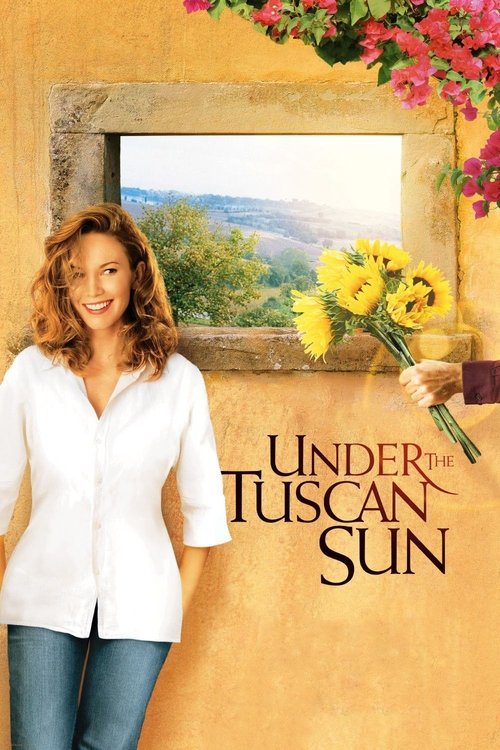
Under the Tuscan Sun (2003)
Directed by Audrey Wells
No — Under the Tuscan Sun is not especially woke, scoring 32 out of 100 on our wokeness meter.
Under the Tuscan Sun arrives from 2003, a romantic comedy of divorce and real estate, written and directed by Audrey Wells and carried on Diane Lane's face.
Consciousness Markers
A woman-directed film centered entirely on a divorced woman reclaiming her identity, buying property, and rebuilding her life on her own terms, with female friendship as its emotional spine.
An ensemble that includes Sandra Oh as the protagonist's best friend, a warmly depicted lesbian couple, and a significant subplot driven by Polish immigrant laborers in Italy.
Frances's best friend Patti is pregnant with her girlfriend Grace, a same-sex couple presented matter-of-factly as a loving, expectant family well before such depictions were common in mainstream 2003 rom-coms.
The Polish worker Pawel is denied permission to marry his Italian sweetheart because he is foreign and has no family, a mild nod to European xenophobia that Frances resolves by declaring herself his family.
Light 'stop looking for love and it will find you' messaging and a gentle pro-acceptance resolution to the wedding subplot, but the film is chiefly escapism and rarely sermonizes.
No environmental themes whatsoever; the Tuscan countryside functions purely as scenery.
The divorce settlement and Frances's loss of her home to a freeloading ex are personal grievances, not a critique of capital; the villa fantasy is, if anything, aspirational yuppie consumption.
No engagement with body image or size-diversity themes.
No neurodivergent characters or themes present.
No historical reframing; the film is a contemporary personal memoir adaptation.
Why it received this score
Under the Tuscan Sun arrives from 2003, a romantic comedy of divorce and real estate, written and directed by Audrey Wells and carried on Diane Lane's face. Frances Mayes loses her house to a cheating husband, takes a tour of Tuscany, and buys a dilapidated villa on a whim. The result is a travelogue with a mortgage. The film has no environmental conscience, no interest in body image, no neurodivergent characters, and no appetite for reframing history. Its relationship to money is aspirational: the villa is a purchase, not a polemic. Roger Ebert called the picture yuppie porn, and the ledger supports him. Nothing here critiques capital. A woman simply spends it.
The cultural awareness that does surface is modest and specific. Sandra Oh plays the best friend, a presence the film treats as ordinary. Patti, that friend, is pregnant with her girlfriend Grace, and the couple is presented as a loving, expectant family without a syllable of justification. In 2003, that was quietly ahead of the mainstream. The Polish laborers who renovate the villa supply the film's one brush with social friction: Pawel is refused permission to marry his Italian sweetheart because he is foreign and has no family. Frances answers by declaring herself his family. It is a small gesture, and the film knows it.
The feminist reading is where the film earns its keep. A woman directs it. A woman's interior life organizes it. Female friendship, not romance, supplies the emotional spine, and the romance that does arrive is treated as a bonus. The sermonizing is light. Frances learns that if she stops hunting for love, love will find her, and the wedding subplot resolves with a gentle nod toward acceptance. This is messaging delivered at a murmur, not a shout. The film prefers scenery to instruction, and we are left with a pleasant, well-photographed shrug.
Analysis generated by our Consciousness Algorithm


Synopsis
Frances Mayes, a 35-year-old professor and writer from San Francisco, decides to take a tour of Tuscany following a difficult divorce. After impulsively buying a run-down villa in the Italian countryside, she begins to piece her life back together in unexpected ways.
Questions about Under the Tuscan Sun
Is Under the Tuscan Sun woke?
No — Under the Tuscan Sun is not especially woke, scoring 32 out of 100 on our wokeness meter. That earns it a verdict of Based.
Does Under the Tuscan Sun have any woke elements?
4 of the 10 markers register at 30 or above, led by Feminist Agenda (55), LGBTQ+ Themes (40) and Representation Casting (40). On Feminist Agenda: A woman-directed film centered entirely on a divorced woman reclaiming her identity, buying property, and rebuilding her life on her own terms, with female friendship as its emotional spine.
How does Under the Tuscan Sun compare to other 2003 movies?
It ranks #8 of the 150 films from 2003 we've scored; their average is 12. The wokest is Mona Lisa Smile (60).
How is the Woke Score calculated?
An AI-assisted process researches the film and its reception, scores it 0–100 on ten markers, then combines those into one 0–100 Woke Score. It measures a specific set of 2020s cultural themes, not film quality.